

Drawings and documents
National Archives restored drawings: drawing
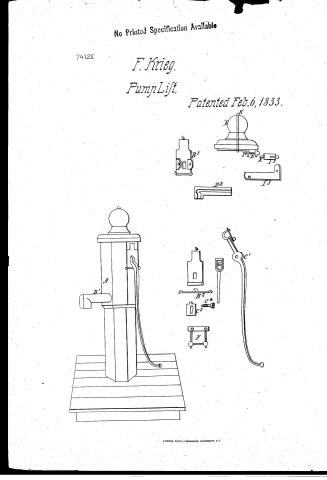
Friedrick Krieg's Patent Drawing for a Pump

National Archives, Restored Patent Drawings (Record Group 241) · Full-size scan at the National Archives · Catalog record
Show the text on the drawing Hide (99 words)
Words on the drawing as machine-read by the National Archives; not checked. Useful mainly for searching.
CL / 103. / Elements, / Operating Devices. / RIEDRICK KRIE G'S. / $150 / CLASSI ICATION / PUMP. / 7412 / DIVISION. / Patented 6th Feb 1833. / C1, / 11, / B,3, / AT / 1,2, / B.2. / C.2 / T,3, / D.2, / C.3. / D.1, / References. / A Represents the Pump. / the fulerum plate / the handle or lever. / "8 / the spout. / the ball cap or the top of the Pump. / two screrobolts, one round plates aflat plate opposite the round plate / a screw bolt to fasten the cap. / G " / a spear or piston. / the plate to Easten the cap. and Eulerum to the Pump
USPTO scan
The patent as scanned by the USPTO
-
 Page 1
-
 Page 2
-
 Page 3


U.S. Patent and Trademark Office · Google Patents
Show the transcription Hide (649 words)
Machine transcription (LightOnOCR) of the pages as scanned by the USPTO, most of them the handwritten copies made when the records were restored after the 1836 fire. Not checked; it can misread handwriting, so compare it with the scan.
Page 1.
No Printed Specification Available
7412X
F. Krieg.
Pump Lift,
Patented Feb. 6, 1833.
Page 2.
Feb 6, 1833
Frederick Hriey Baltimore City
Sellew Patent
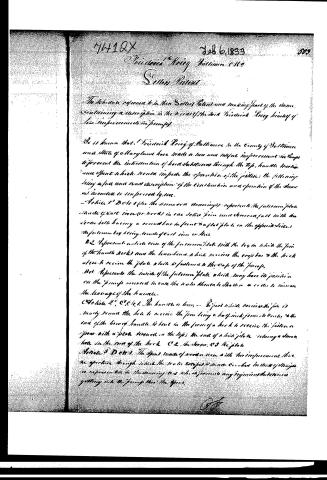
The subscriber refers to in this Sellew Patent and making part of the same containing a description in the words of the said Frederick Hriey himself of his improvements in pumps.
He it known that F. Frederick Hriey of Baltimore in the County of Baltimore and State of Maryland have made a new and useful improvement in pumps to prevent the introduction of hard substances through the top, handle, and valve stem of such pumps which would impede the operation of the pump. The following being a full and exact description of the construction and operation of the same as intended to be employed by me.
Article 1st. Plate 1 (for the annexed drawings) represents the patent plate made of cast iron (or wood) in one solid piece and screwed fast with two screws bolts having a round bar in front to a flat plate on the opposite sides the patent box being made of cast iron or steel.
B2 Represents a side view of the patent plate with the box in which the pin of the handle works and the lower band which receives the cross bar & the block above to receive the plate which is fastened to the top of the pump.
B3 Represents the inside of the patent plate which may have its position on the pump moved in case the water should be shallow in order to increase the leverage of the handle.
Article 2nd. C1, C2, C3. The handle or lever... the part which receives the pin is nearly round the hole to receive the pin being a half inch from its center & the end of the lever of handle is bent in the form of a hook to receive the piston or pipe with a plate screwed on the top; the end of a solid plate retaining a small hole in the end of the hook. C2 the screw. C3 the plate.
Article 3rd. D and 1. The pipe made of wood or iron with the improvement there the aperture through which the water escapes & made so that instead of being as represented in the drawing D2 which prevents any injurious substances getting into the pump thru the pipe.
Page 3.
7410x
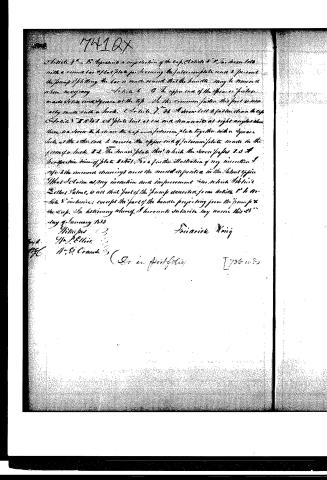
Article 4th. To represent a completion of the cap. Article 5th. The screw hole with a remoter plate for forming the intermediate cone & prevent the pump splitting the bar is made round that the handle may be turned when necessary. Article 6th. The upper end of the spout or spout is made to be a cone square at the top. In the common spout this part is usually made with a hook. Article 7th. The screw hole is fastened down the cap. Article 8th. The plate bent at one end is denoted at right angles to the screw & is used to keep the intermediate plate together with a spout hole at the other end to receive the upper end of the intermediate made in the form of a hook. Article 9th. The inner plate that holds the screw passes 10th. A perspective view of plate 8th. For a further illustration of my invention I refer to the annexed drawings and the model deposited in the Patent Office. What I claim as my invention and improvement to which Article 1st to Article 8th inclusive, except the part of the handle projecting from the pump & the cap. In testimony whereof I have subscribed my name this 23rd day of January 1833.
Witnesses:
Wm. P. Elliot
Wm. G. Crandall
(Seal in Portfolio)
[736 in 8vo]
Published accounts: journal notice
Notice in the monthly list of patents, with remarks
Journal of the Franklin Institute, new ser., vol. 12 (1833), p. 88 · View the page
11. For an improvement in Pumps, intended to prevent the introduction of foreign substances into them; Frederick Kreig, Baltimore, Maryland, February 7.
Remarks. We formerly noticed two patents for a similar object, which were obtained by a person of the name of Mettee, residing in Baltimore. The present is a very similar contrivance, intended to accomplish the same end by means nearly identical. The pump handle, where it passes through the pump tree, has a circular enlargement, working upon a pin in the usual way, and rendering a long slot unnecessary. The opening in the spout is made tortuous, to prevent the introduction of extraneous substances through that channel, and the cap is fastened down by a screw bolt. The things claimed consist of eight particulars, neither of which will give the slightest security to the patentee, as they are merely precise modes of making bolts, fixing parts together, &c., either of which could be just as well done in other ways.
About this record
- Patentee
- DATAMP
- Date
- DATAMP, USPTO records, Burke's List of Patents (1847)
- Invention
- DATAMP
- Listed in
- the Name and Date index of patents, DATAMP, USPTO records, Jim Shaw's X-patent list, the Journal of the Franklin Institute, Burke's List of Patents (1847)
- The sources give different dates; the date shown is the one most of them agree on.
- The Franklin Institute's journal spells the name differently.
- The Franklin Institute's journal gives a different date.
- Burke's 1847 Patent Office list gives the same patent.