

Drawings and documents
National Archives restored drawings: drawing
James Riley's Patent Drawing for a Suction Hose

National Archives, Restored Patent Drawings (Record Group 241) · Full-size scan at the National Archives · Catalog record
Show the text on the drawing Hide (94 words)
Words on the drawing as machine-read by the National Archives; not checked. Useful mainly for searching.
102. / 60 HOSE & BELTING, / Hose & Tubing. / Pipi leauhting- / DIV. XI. / $2.50 / Myd. / MATTON / 7413.4 / DIVISION / JAMES RILEY / Suction Hose / Patented 6th Feb 1833. / B. Outside Leather. opened. B. Closed. / C. Inside Z eather / A. Spira S/2 TO Z We re / E. Femole screw / louis then here / OIR / S Section the he oursher / this / Geo, Shicklan d Del / Patent office april 21 1838. / Made under the direction of the Commissioner of Latents in conformity / with the act of 3d march 1837 / HenryL / Commifsioner of Patents.
USPTO scan
The patent as scanned by the USPTO
-
 Page 1
-
 Page 2
-
 Page 3
-
 Page 4


U.S. Patent and Trademark Office · Google Patents
Show the transcription Hide (858 words)
Machine transcription (LightOnOCR) of the pages as scanned by the USPTO, most of them the handwritten copies made when the records were restored after the 1836 fire. Not checked; it can misread handwriting, so compare it with the scan.
Page 1.
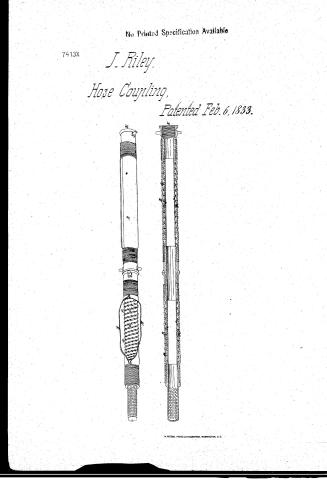
No Printed Specification Available
7413X
J. Riley,
Hose Coupling,
Patented Feb. 6, 1833.
Page 2.
Feb 6 1833
James Riley,
Letters Patent.
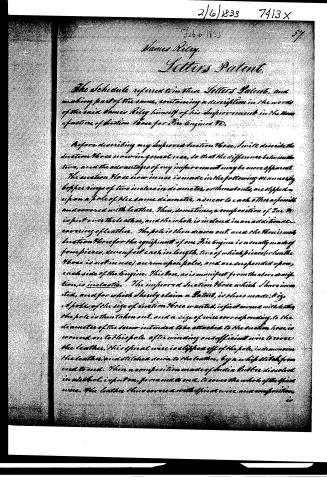
The schedule referred to in these Letters Patent, and making part of the same, containing a description in the words of the said James Riley himself of his improvement in the mode of fastening of suction hose for fire engines &c.
Before describing my improved suction hose, I will describe the suction hose now in general use, so that the difference between the two, and the advantages of my improvement may be more apparent. The suction hose now in use is made in the following manner; copper rings of two inches in diameter, or thereabouts, are slipped upon a pole of the same diameter, a scarf to each other a foot and covered with leather. Then, sometimes, a composition of Tar & is put over the leather, and the whole is enclosed in an additional covering of leather. The pole is then drawn out, and the hose is made. The suction hose for the equipment of one fire engine is usually made of four pieces, seven feet each in length, two of which pieces (when the hose is not in use) are run upon poles, and are suspended upon each side of the engine. This hose, as is manifest from the above description, is inelastic. The improved suction hose which I have invented, and for which I hereby claim a Patent, is thus made; first, a pole of the size of suction hose wanted, is first covered with leather. The pole is then taken out, and a size of wire corresponding to the diameter of the hose intended to be attached to the suction hose is wound on to this pole, after winding on sufficient wire to cover the leather. This final wire is slipped off of the pole, is run over the leather, and is stitched down to the leather, by a whip stitch from end to end. Then a composition made of India Rubber dissolved in alcohol, is put on, from end to end, to cover the whole of the final wire. The leather thus covered with final wire and composition is
Page 3.
is then enclosed in a covering of leather, which completes those hoses. This hose can be made of any length required.
The great advantages, which my improved suction hose possesses over the hose now in use, are, 1st. That it is elastic, and is capable of being easily wound up upon a reel, whereas the common suction hose is inelastic, cannot be wound up, and must be made in short pieces, of about 20 or 30 feet each in length which pieces must be screwed together before commencing operations. This operation of screwing together of pipe, in cold weather, often occupies a half an hour which is great loss of time. 2d. The suction hose now in use, in its different sizes as above mentioned, must be slipped upon poles suspended on each side of the fire engine, which are no burden and in many cases an appendage to the engines or must (when not in actual use) be otherwise disposed of in some manner equally as inconvenient. Whereas my improved suction hose can always remain secured at one of its extremities to the aperture leading into the interior of the engine, and the hose be twisted around some convenient part of the engine, thus being at all times ready for instant use or action, by dropping it into the reservoir, without losing any time in screwing it together, it being in one piece. In cold, freezing weather, this is a very important advantage.
3d. Referring to the suction hose now in use being nearly made in such short pieces, not more than two or six engines can conveniently be stationed at one reservoir of water, for suction, at one time. I mean such reservoirs as are constructed under ground, in Boston, in the different streets, containing large quantities of water to be used in the extinguishing of fires. Many improved suction hoses can be made of any required length, so that any number of engines may be drawing water simultaneously from the same reservoir; the great length of the suction hose admitting them to stand at various distances from the reservoir without interfering with each other. To conclude, I claim
Page 4.
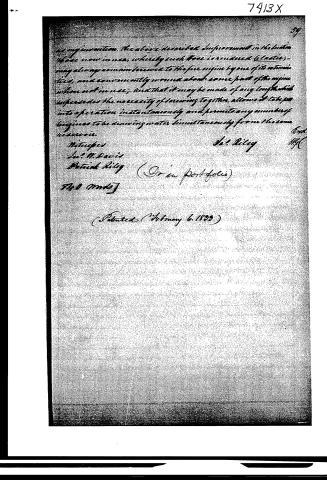
as an improvement. The above described improvement in the suction hose now in use, whereby such hose is rendered elastic, may always remain secured to the fire engine by one of its extremities, and conveniently wound about some part of the engine when not in use; and that it may be made of any length which supersedes the necessity of screwing together, allows it to be put into operation instantaneously and permits any number of engines to be drawing water simultaneously from the same reservoir.
Witnesses
Jas. M. Davis
Patrick Riley (Or in portfolio)
Patented February 6, 1839
Published accounts: journal notice
Notice in the monthly list of patents, with remarks
Journal of the Franklin Institute, new ser., vol. 12 (1833), p. 87 · View the page
10. For a Suction Hose for Fire Engines; James Riley, Boston, Massachusetts, February 6.
Remarks. After describing the construction of the common suction hose, which is made in pieces of about seven feet in length, and kept distended by copper ferules placed near together, an arrangement allowing of but little elasticity, and requiring much trouble in screwing the parts together, the patentee goes on to describe his improved suction hose, which is thus made:A leather hose is formed in the usual way, and over this is wound wire of a suitable size, running spirally from end to end. The wire is to be stitched to the leather, and the whole then covered with a varnish, formed by dissolving gum elastic in spirits of wine: a second tube of leather drawn over this completes the hose. We are told that thus constructed it will be elastic, may be made of any required length, and wound round some part of the engine when not in use. The objections to the old plan will, in this supposed new mode, be succeeded by others, at least equally formidable. The coiled wire will soon break; in bending the hose, the wires on one side recede from, and on the opposite side approach each other, and will not resume their proper positions; when bent out of shape, the cylindrical form cannot be restored, and to such bending they are constantly liable. These and other objections caused such hose to be abandoned after a full trial seventeen or eighteen years ago, in the fire engine manufactory of Mr. Jacob Perkins, now Merrick & Agnew's, Philadelphia. How many other abortions this scheme may have undergone we know not, that which we have noticed was, probably, not the first, and it is likely that the present will not be the last. Notwithstanding the utter absence of novelty in the general plan, there is something entirely original in the varnish made by dissolving gum elastic in alcohol; if the patentee has a good recipe for doing this, we hereby bespeak a right to it, either for love or money.
About this record
- Patentee
- DATAMP
- Date
- DATAMP, USPTO records, Burke's List of Patents (1847)
- Invention
- DATAMP
- Listed in
- the Name and Date index of patents, DATAMP, USPTO records, Jim Shaw's X-patent list, the Journal of the Franklin Institute, Burke's List of Patents (1847)
- The sources give different dates; the date shown is the one most of them agree on.
- The Franklin Institute's journal confirms the date shown.
- Burke's 1847 Patent Office list gives the same patent.