

Drawings and documents
National Archives restored drawings: drawing
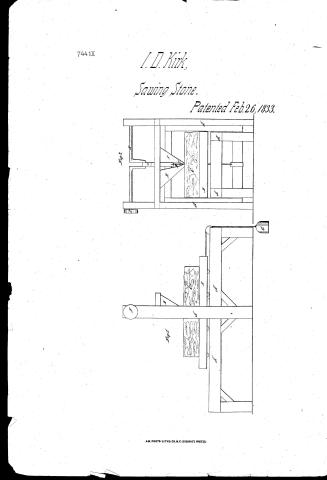
Isaac D. Kirk's Patent Drawing for a Stone Sawing Machine

National Archives, Restored Patent Drawings (Record Group 241) · Full-size scan at the National Archives · Catalog record
Show the text on the drawing Hide (95 words)
Words on the drawing as machine-read by the National Archives; not checked. Useful mainly for searching.
WORKING. / Sawing Stone / Baac D. Kirk / Vol.16.p.5. / DIV. 15 / CLASSIFICATION / f2 / SD / 4441- X / DIVISION. / Stone Lawing machine / Patented 20 / Fif.2, / Refere nees, / I' / E' / Fig1. side elevation, / Fidid. front / A. fram e.B. carriage. C.stone, / D. saw, E. crank. Epuney / G. weight, H. and hopper I water / Fif / D. / Patent office December %- 1831 / Made under the direction of the bo frimer of Patents m conformity / with the Act of bongrefs of thind march 1837 / WL Ellmorth / Corussiftemer of P
USPTO scan
The patent as scanned by the USPTO
-
 Page 1
-
 Page 2


U.S. Patent and Trademark Office · Google Patents
Show the transcription Hide (415 words)
Machine transcription (LightOnOCR) of the pages as scanned by the USPTO, most of them the handwritten copies made when the records were restored after the 1836 fire. Not checked; it can misread handwriting, so compare it with the scan.
Page 1.
7441X
I. D. Kirk,
Sawing Stone.
Patented Feb. 26, 1833.
AM. PHOTO-LITHO. CO. N.Y. (OSBORNE'S PROCESS)
Page 2.
Isaac D. Hick
Letter Patent
The Solicitor referred to in these Letters Patent and annexing part of the same containing a description in the words of the said Isaac D. Hick himself of his improvement for sawing, moulding, & polishing marble & other stone.
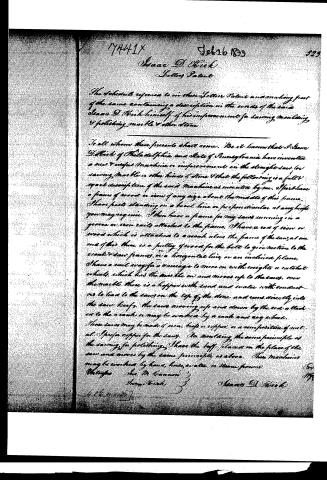
To all whom these presents shall come, Be it known that I Isaac D. Hick of Philadelphia and State of Pennsylvania have invented a new & useful Machine or improvement in the straight saw for sawing marble or other kinds of stone & that the following is a full & exact description of the said Machine as invented by me. I first have a frame of wood or iron of any size about the middle of this frame, I have posts standing on a level line or perpendicular at any height you may require. I then have a frame for my saws running on a groove or iron rails attached to the frame. I have a sort of iron or wood which is attached to a crank above the frame of the saw, at one end of this there is a pulley of wood for the belt to give motion to the crank & saw frames, on a horizontal line or an inclined plane. I have a rail way for a carriage to move on with weights or what wheels, which has the marble on and moves up to the saws, over the marble there is a hopper with sand and water with conduits to lead to the saws on the top of the stone and runs directly into the saw leaf, the saws moving up and down by the rod attached to the crank or may be worked by a rack and cog wheel. These saws may be made of iron, brass or copper, or a composition of metal. I prefer copper for the saws. For moulding the same principle as the sawing for polishing I have the buff placed in the place of the saw and moves by the same principle as above. These Machines may be worked by hand, horse, water, or steam power.
Witness
Sho. M. Cannon
Isaac D. Hick
406 words
Published accounts: journal notice
Notice in the monthly list of patents, with remarks
Journal of the Franklin Institute, new ser., vol. 12 (1833), p. 102 · View the page
42. For Machinery for Sawing, Moulding, and Polishing Marble and other Stone; Isaac D. Kirk, city of Philadelphia, February 26.
Remarks. The marble to be sawed is placed upon a frame, or carriage, which is to slide on horizontal, or inclined ways, and is to be drawn on by a weight over a pulley, or otherwise. The saw is to work vertically, like a saw mill saw, and is to be made of copper or other metal. Sand and water are to drop from a hopper on to the kerf. So much for the sawing part, and respecting the moulding and polishing, we hear but little, all that is said being "For moulding the same principle as for sawing; for polishing I have the buffs placed in the place of the saw." There is no claim made, and the whole description is meagre, crude, and undigested. All we have learnt of the mode of sawing is derived from the drawing, but this throws no light upon the other processes mentioned.
About this record
- Patentee
- DATAMP
- Date
- DATAMP, USPTO records
- Invention
- DATAMP
- Listed in
- the Name and Date index of patents, DATAMP, USPTO records, Jim Shaw's X-patent list, the Journal of the Franklin Institute, Burke's List of Patents (1847)
- The sources give different dates; the date shown is the one most of them agree on.
- The Franklin Institute's journal confirms the date shown.
- Burke's 1847 Patent Office list gives the same patent.