

Drawings and documents
National Archives restored drawings: drawing
Sereno Newton's Patent Drawing for a Double Napier Printing Press


National Archives, Restored Patent Drawings (Record Group 241) · Full-size scan at the National Archives · Catalog record
Show the text on the drawing Hide (69 words)
Words on the drawing as machine-read by the National Archives; not checked. Useful mainly for searching.
Sheet 1. 00 / 101. PRINTING / Bed & Cylinder Machiness / Perfecting / SERENO NEWTON'S / CLASSIFICATION / 7442-X / Double Napier Printing-profs. / 7442-X / Patented / DIVISION. / EIG.1. / IIII / 0 ) / (Gostra)
Sheet 2. CLASSIFICATION / 101. PRINTING. / Cyltwier Machines / Bed & Cyllnder Machines / 7442 / -lievolution. / Multi-Revolution, / 74421X X / Drawing 1:2 / DIV ISION. / S Newton Feb 26 1133 / FIG.2. / to / DP / Oi / rv / J® / 0.0 / nhnn / 000 / FIG.4. / FIG.5 / FIG.6 / RF / FIG.3. / mm
USPTO scan
The patent as scanned by the USPTO
-
 Page 1
-
 Page 2
-
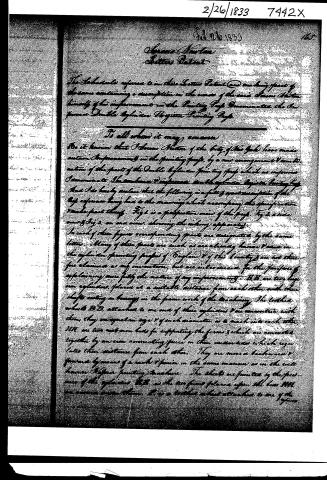 Page 3
-
 Page 4


U.S. Patent and Trademark Office · Google Patents
Show the transcription Hide (769 words)
Machine transcription (LightOnOCR) of the pages as scanned by the USPTO, most of them the handwritten copies made when the records were restored after the 1836 fire. Not checked; it can misread handwriting, so compare it with the scan.
Page 1.
7442X S. Newton. Sheet 1.2 Sheets.
No Printing Press. Patented Feb. 26. 1833.
FIG. 1.
FIG. 3.
Page 2.
7442X
S. Newton.
Printing Press.
Patented Feb. 26, 1833.
Sheet 2 of 2 Sheets.
No.
FIG. 2.
Page 3.
2/26/1833 7442X
Feb 26 1833 165
Chasas Newton
Letters Patent
The Solemnly refers to in these Letters Patent and making part of
the same containing a description in the words of the said James Newton
himself of his improvements in the Printing Press Denominated the Sim
press Double Cylinder Register Printing Press.
To all whom it may concern
Be it known that I Chasas Newton of the City of New York have made
certain Improvements in the printing press, by a new arrangement I am to
describe of the parts of the Double Cylinder printing press which as improves
Denominated the Simpress Double Cylinder Register Printing Press
And I do hereby declare that the following is a full & exact description of the
Press reference being had to the drawing which accompany this specification
which part thereof Fig 1 is a perspective view of the press Fig 2 a side
view of Fig 3 an end view showing the working apparatus.
In each of these figures corresponding parts are designated by the same
letters. Many of these parts are such as are already known & used in
the cylinder printing presses of England & of this country & are not there
for obvious as my invention, but are introduced for the purpose of
explaining more fully the nature of my improvements. B.B. are two large
iron cylinders placed at a suitable distance from each other with their
shafts resting or bearing on the frame work of the machinery. The tool box
which B.B. attached to one end of these cylinders & are concentric with
them, they are equal in size & of such diameter as to match into each other.
H.H. are two cast iron bars for supporting the forms which are connected
together by an iron connecting piece on their ends which regulates their distance from each other. They are moved backward &
forward by means of a rack & pinion in the same manner as in the well
known Mifflin printing machine. The sheets are printed by the first
one of the cylinders B.B. as the two forms placed upon the bars H.H.
are moved under them. L is a tool box which attaches to one of the
Page 4.
7442X
cylinders of which the same are connected with the wheel. The teeth engage with those of the wheel D, on the cylinder D, and into those of the wheel C, on the cylinder C, which turns the cylinder C. From the cylinder C, C, for the paper which carry the sheet from the board T, to the cylinder T, around which it receives its first impression, T, is a segment which is attached to the front cylinder T, which is acted on by a cross-forming segment near the periphery of the wheel D. A is a pinion fastened to the shaft which is turned by the power intended to move the machine. The pulleys & rollers marked C C C C, are for conveying the paper & other materials & h, some bolts to connect & tighten them. B is the back board on which the pile of paper is piled, and whence the sheet are removed to T, to be arranged in succession to the cylinders, in advance afterwards on to the board R. The bars with the number of communicating motion to them, the inkings etc. etc. — If the wheels are the same in principle as those employed in the Napier press. The gearing of the driving wheel A, of the two large cylinder wheels D, D, as well as of the cylinders D D D D, the mode of using the paper and some other parts, are the same in principle with those machines in use in England & elsewhere & known under the name of Bower & Appleby's printing machine.
What I claim as new in my prop is the combining that part of the Napier printing machine which constitutes the bed & its appurtenances with the cylinders & such other parts of the superstructure of the bower & Appleby's printing press as are employed in the receiving & conveying of the sheets.
Geo. Washington
Thos. P. Jones
Chas. Ballfinch Jr.
Dennis Newton
(See in Portfolio.)
7442 (cont'd)
Published accounts: journal notice
Notice in the monthly list of patents, with remarks
Journal of the Franklin Institute, new ser., vol. 12 (1833), p. 101 · View the page
It will be readily seen that the power which is to cant the buckets being the gravity of the contained water, it must ascend to a sensible height on the inclined wheel, before it will be discharged, and that there must necessarily be a proportionate loss of power. This, however, is not the only objection which may be urged against the present contrivance; but as we think that its defects will be obvious to the experienced mechanist, we deem it unnecessary to say more. 40. For Improvements in the Double Napier Printing Machine; Sereno Newton, city of New York, February 26.
Remarks. Without the use of engravings, we cannot show the manner in which the patentee has constructed those parts of the double Napier printing machine, which constitute his improvements; they, however, have been fairly tested, and are approved. One of the improvements consists in the application of grippers, in the manner described, for the purpose of seizing the paper, and carrying it forward to receive the impression, in " a printing machine the cylinders of which make three revolutions to one impression." The apparatus which acts upon the grippers is withdrawn, laterally, during two revolutions of the cylinder, but it may also be applied to printing machines the cylinders of which make but two revolutions to each impression, and this application of it is also claimed. Another of the improvements consists in a mode of perfecting the sheets, or making register, in book work. The points which pass through the sheets are withdrawn, at the proper time, by the action of an eccentric attached to the end of the arbor which supports the grippers, and this particular arrangement is claimed in its application both to the double and single cylinder printing machine.
About this record
- Patentee
- DATAMP
- Date
- DATAMP, USPTO records, Burke's List of Patents (1847)
- Invention
- DATAMP
- Listed in
- the Name and Date index of patents, DATAMP, USPTO records, Jim Shaw's X-patent list, the Journal of the Franklin Institute, Burke's List of Patents (1847)
- The sources give different dates; the date shown is the one most of them agree on.
- The Franklin Institute's journal confirms the date shown.
- Burke's 1847 Patent Office list gives the same patent.