

Drawings and documents
National Archives restored drawings: drawing
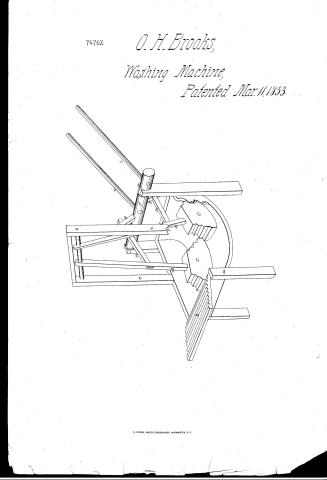
Oliver H. Brook's Patent Drawing for a Washing and Churning Machine

National Archives, Restored Patent Drawings (Record Group 241) · Full-size scan at the National Archives · Catalog record
Show the text on the drawing Hide (94 words)
Words on the drawing as machine-read by the National Archives; not checked. Useful mainly for searching.
68, LAUNDRY. / [91] Washing Mach's / Washing Machines. Herischo / POUNDERS. / $1,50 / Oliver H Brooh's / Val ty ps. 149 / Patented March 11. 1833. / Washing Churning Mehe. / CLASSIFICATION / 7476-X / DIV ISION. / a the Preferences. box with 4 legs. / EE perpendicular posts / f. shaft / B washboard / g.g. arms. / C.C. double headed hammers. / h h reaches. / dd handles. / i.i levers. / 01 / Patent affice Deefg. 1841. / made under the direction ofthe Comminioner of / Patents in conformity with act of 32d march 1837 / It L elemonth / Commissioner of Patents / freit.
USPTO scan
The patent as scanned by the USPTO
-
 Page 1
-
 Page 2
-
 Page 3


U.S. Patent and Trademark Office · Google Patents
Show the transcription Hide (845 words)
Machine transcription (LightOnOCR) of the pages as scanned by the USPTO, most of them the handwritten copies made when the records were restored after the 1836 fire. Not checked; it can misread handwriting, so compare it with the scan.
Page 1.
7476X
O. H. Brooks,
Washing Machine,
Patented Mar. 11, 1833
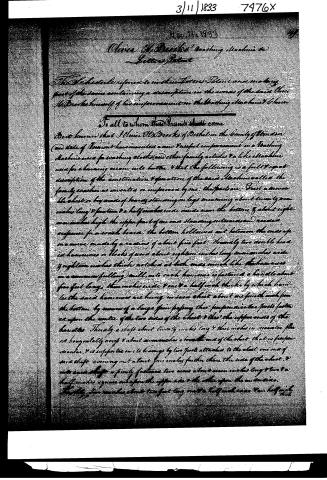
Page 2.
3/11/1833 7976X
Nov 31, 1833
Alice M. Brooks' Washing Machine & Better Patent
The Schedule referred to in these Letters Patent contains a part of the same containing a description in the words of the said Alice M. Brooks herself of her improvement in the washing machine & linen
To all to whom these Presents shall come
Be it known that I Alice M. Brooks of Othello in the county of Hindson and state of Missouri have invented a new Useful improvement in a Washing Machine used for washing clothes and other family articles and like articles used for cleaning or scouring butts. And that the following is a full & exact description of the construction & operation of the said Machine called the family washer as invented or improved by me, the said one. First a common like chest or box made of boards standing on legs measuring about twenty-two inches long & fourteen & a half inches wide inside near the bottom & about eight inches high the upper part of one end standing out towards and raised or raised for a wash board. The bottom hollowed out between the ends of a common made by a series of about five feet. Secondly two double hooks or hammocks or blocks of wood about eighteen inches long twenty inches wide & eighteen inches thick notched at both ends much like the hammocks in a common pulling mill. Into each hammock is fastened a handle about five feet long, three inches wide & one & a half inch thick by which hand (as the said hammocks are hung in said chest about six feet each from the bottom by means of a large iron passing through the hammocks & fastened as upon the centre of the two sides of the chest & then the upper ends of the handles. Thirdly a shaft about twenty inches long & three inches in diameter placed horizontally across & about seven inches above one of the chest that is perpendicular & is supported on its bearings by two posts attached to the chest, one end of said shaft coming out about four inches further than the side of the chest & into said shaft is firmly fastened two arms about seven inches long & two & a half inches square each upon the upper side & the other upon the under side. Fourthly two wheels about two feet long one & a half inch wide & one half inch
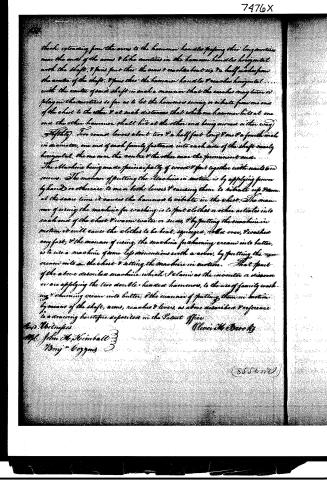
Page 3.
7476X
thick; extending from the arms to the hammer handles passing their long centers near the end of the arms & like centers in the hammer handles horizontal with the shaft, & pins fast thereto arms & reaches about six & a half inches from the center of the shaft, & pins thereto the hammer handles & reaches horizontal with the center of said shaft in such a manner that the reaches may turn & play in the centers so far as to let the hammer swing & vibrate from one end of the chest to the other & at such distance that while one hammer hits at one end the other hammer shall hit at the other end being moved in the way.
Fifthly. Two round levers about two & a half feet long & one & a fourth inch in diameter, one end of each firmly fastened into each side of the shaft nearly horizontal, the one near the center & the other near the prominent end.
The machine being made principally of wood & put together with nails & screws. The manner of putting the machine in motion is by applying power by hand or otherwise to one both levers & causing them to vibrate up & down at the same time it causes the hammers to vibrate in the chest. The manner of using the machine for washing is to put clothes or other articles into each end of the chest & warm water or scum, & by putting the machine in motion it will cause the clothes to be beat, squeezed, rolled over, & washed very fast, & the manner of using the machine for churning cream into butter, is to use a machine of some top dimensions with a cover, by putting the cream into the chest & setting the machine in motion. That part of the above described machine which I claim as the inventor or discoverer are applying the two double-headed hammers, to the use of family washing & churning cream into butter, & the manner of putting them in motion by means of the shaft, arms, reaches & levers, as above described & reference to a drawing heretofore deposited in the Patent Office.
Clive H. Brooks
Wm. John M. Kimball
"Boy" Briggs
(555th)
Published accounts: journal notice
Notice in the monthly list of patents, with remarks
Journal of the Franklin Institute, new ser., vol. 12 (1833), p. 176 · View the page
22. For a Washing Machine, to be used also as a Churn; Oliver H. Brooks, Bethel, Windsor county, Vermont, March 11.
Remarks. A trough is to be made in which there are to be two sliding blocks of wood, nearly touching its bottom; each of them attached to rods by which they swing from end to end of the trough, like pendulums. The ends of the trough are to be fluted or reeded like wash-boards. The pendulous pieces are made to vibrate in opposite directions, by means of a compound lever fixed at one end of the trough. We do not think this a good washing machine, and view it with still less favour as a churn: there is, moreover, little novelty in its construction, double blocks having been before made to vibrate in a trough in reversed directions.
About this record
- Patentee
- DATAMP
- Date
- the Name and Date index of patents, DATAMP, USPTO records
- Invention
- DATAMP
- Listed in
- the Name and Date index of patents, DATAMP, USPTO records, Jim Shaw's X-patent list, the Journal of the Franklin Institute, Burke's List of Patents (1847)
- Burke's 1847 Patent Office list gives the same patent.