

Drawings and documents
National Archives restored drawings: drawing
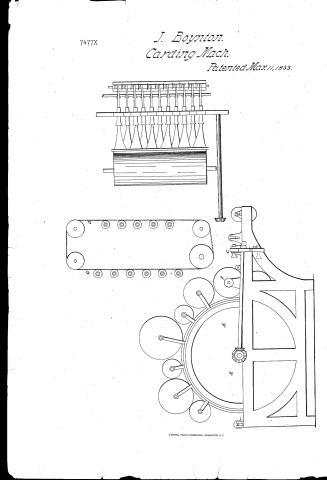
John Boynton's Patent Drawing for a Machine for Wool Carding and Condensing

National Archives, Restored Patent Drawings (Record Group 241) · Full-size scan at the National Archives · Catalog record
Show the text on the drawing Hide (81 words)
Words on the drawing as machine-read by the National Archives; not checked. Useful mainly for searching.
work Fex / John Boynton / whin, / CLASSIFICATION / Woob Carding Condensing / Patented 11.March 1833, / 7477.+ / DIV ISION. / References, / Fig.1. side view Fied. Topriew, Fife 3, manus of banding / A.A. Carding machine, B. Doffer, C, Condensing tubes, / D. Driving pullay. Fiberel gear. / G. endless strap for turning the tubes, / Patent Office Febru (I22 1842 / Made under me the direction of the Commifsion atentents / in conformity with act of bongrep 3 March 1841, / lower
USPTO scan
The patent as scanned by the USPTO
-
 Page 1
-
 Page 2
-
 Page 3


U.S. Patent and Trademark Office · Google Patents
Show the transcription Hide (745 words)
Machine transcription (LightOnOCR) of the pages as scanned by the USPTO, most of them the handwritten copies made when the records were restored after the 1836 fire. Not checked; it can misread handwriting, so compare it with the scan.
Page 1.
7477X
J. Boynton.
Carding Mach.
Patented Mar. 11, 1833.
Page 2.
John Boynton
March 11, 1833
Letting Patent
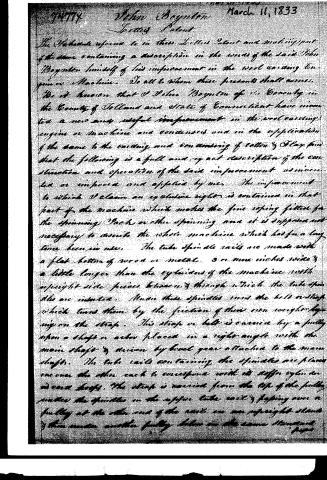
The Petitioner referred to in these Letters Patent and making part of the same containing a description in the words of the said John Boynton himself of his improvement in the wool carding engine or machine. To all to whom these presents shall come.
Be it known that I John Boynton of the County in the County of Holland and State of Connecticut have invented a new and useful improvement in the wool carding engine or machine and concur and in the application of the same to the carding and condensing of cotton & flax and that the following is a full and exact description of the construction and operation of the said improvement as invented or improved and applied by me. The improvement to which I claim an exclusive right is contained in that part of the machine which makes the fine roving fitted for the spinning Jack or other spinning and it is supposed not necessary to describe the whole machine which has for a long time been in use. The tube spindle rails are made with a flat bottom of wood or metal 3 or more inches wide & a little longer than the cylinders of the machine with upright side pieces between & through which the tube spin-dles are inserted. When these spindles turn the belt or strap which turns them by the friction of their own weight lying on the strap. This strap or belt is carried by a pulley upon a shaft or axis placed in a right angle with the main shaft & driven by bevel gear attached to the main shaft. The tube rails containing the spindles are placed one over the other each to correspond with its proper cylinder and card heaps. The strap is received from the top of the pulley under the spindles in the upper tube and passing over a pulley at the other end of the rails on an upright stand & then under another pulley below on the same stand.
Page 3.
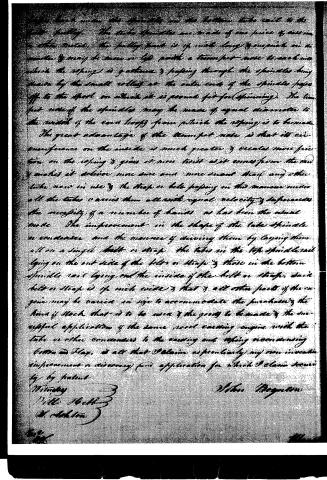
tubes, each under the spindles on the bottom tube next to the lower pulley. The tube spindles are made of one piece of cast iron or other metal; the pulley shaft is of such length & one piece in diameter & may be run on its path with a trumpet nose to each end which the rifling is of thickness & proper through the spindles being driven by the small wheels at the outer ends of the spindles pass off to the spool on which it is wound for spinning. The trumpet nose of the spindles may be made of equal diameter to the width of the cord being from which the rifling is to be made.
The great advantage of the trumpet nose is that its circumference on the inside is much greater & creates more friction on the rifling & gives it more twist as it comes from the end & makes it deliver more sure and more sweet than any other tube now in use & the strap or belt passing in this manner makes all the tubes carries them all with equal velocity & supercedes the necessity of a number of hands as has been the usual mode. The improvement in the shape of the tube spindle as condenser and the manner of driving them by laying them all on a single belt or strap. The tubes in the top spindle will lying on the out side of the belt or strap & those in the bottom spindle will lying on the inside of the belt or strap, said belt or strap is so much wider & that if all other parts of the engine may be varied in size to accommodate the purchaser & the kind of stock that is to be used & the goods to be made & the successful application of the same novel casing engine with the tube or other condenser to the casing and rifling recondensing cotton or flax, is all that I claim as principally my own invention improvement or discovery and application for which I claim secured by by patent.
Witness
Will. Heath
H. Ashton
John Magneton
Published accounts: journal notice
Notice in the monthly list of patents, with remarks
Journal of the Franklin Institute, new ser., vol. 12 (1833), p. 177 · View the page
(See specification at p. 320 of the last volume.) 24. For an improvement in the Wool Carding Machine; John Boynton, Coventry, Tolland county, Connecticut, March 11.
Remarks. The improvement here patented is in the form, and the manner of driving the tubes for giving the countertwist to, or condensing wool or cotton roping. The tubes are to be trumpet mouthed, and in this consists their improvement in form. They are to be made of cast iron, about one inch in diameter, and the outsides of them are to be cylindrical. They rest upon a revolving strap, which passes over a rail beneath them, their friction upon this strap, from their own gravity, being sufficient to drive them. These two points only are claimed; but as the tubes have been already patented, as long ago, at least, as the year 1826, and have been made by Mr. Goulding and others in a great variety of forms, we are apprehensive that a variation in the mode of driving them will not enable its contriver to take the invention of another, and apply it to his own use, unless this invention may, from some cause, have become public property. The patent law, and the practice under it, discountenance such a procedure, which, if tolerated, would leave the "true and original inventor" at the mercy of every one who had ingenuity enough to vary the form of a thing, whilst it remained substantially unchanged.
About this record
- Patentee
- DATAMP
- Date
- the Name and Date index of patents, DATAMP, USPTO records
- Invention
- DATAMP
- Listed in
- the Name and Date index of patents, DATAMP, USPTO records, Jim Shaw's X-patent list, the Journal of the Franklin Institute, Burke's List of Patents (1847)
- Burke's 1847 Patent Office list gives the same patent.