

Drawings and documents
National Archives restored drawings: drawing
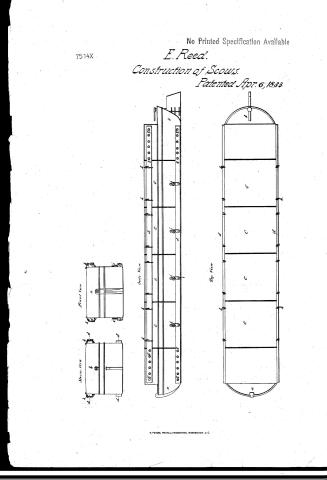
Ezra Reed's Patent Drawing for a Canal Boat

National Archives, Restored Patent Drawings (Record Group 241) · Full-size scan at the National Archives · Catalog record
Show the text on the drawing Hide (101 words)
Words on the drawing as machine-read by the National Archives; not checked. Useful mainly for searching.
SHIPS. / ONSTRUCTION. / 01 / Scows / CLASSIFICATION / 7514-1 / DIVISION. / Ezra Prud. / Ganal Boat. / Vociy pg. 441 / Patented april 6th 1833. / Tide Tideview / Front view. / ...... / ...... / C. / Top view. / go / pt / to / of / hern view / Patent offic 1541 / Puferences. a the bow. b the stern C.C.C.C middle parts 02 sections. d.d.d.d longitu dinal pieces of timber S Se. botts h.h.h.Se chains 1.2. hooks and straps. made under the direction of the Commissioner / of Patents in conformits with act 3.march 1837. / sh. L. Minhmann del: / Commisioner of Patents
USPTO scan
The patent as scanned by the USPTO
-
 Page 1
-
 Page 2
-
 Page 3


U.S. Patent and Trademark Office · Google Patents
Show the transcription Hide (453 words)
Machine transcription (LightOnOCR) of the pages as scanned by the USPTO, most of them the handwritten copies made when the records were restored after the 1836 fire. Not checked; it can misread handwriting, so compare it with the scan.
Page 1.
No Printed Specification Available
7514X
E. Reed.
Construction of Scows.
Patented Apr. 6, 1833

Page 2.
7314X April 6, 1833
Ezra Reed.
Letters Patent. Patented April 6, 1833.
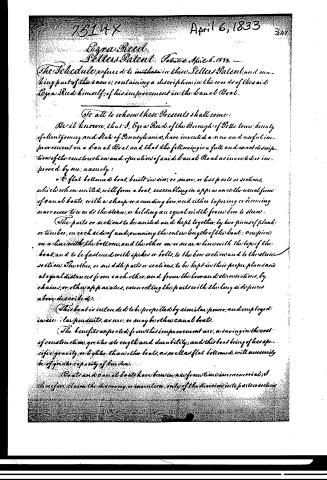
The Schedule referred to in those in these Letters Patent, and making part of the same, containing a description in the words of those said Ezra Reed himself, of his improvement in the Canal Boat.
To all to whom these Presents shall come:
Be it known, that I, Ezra Reed, of the Borough of Pottstown, County of Montgomery, and State of Pennsylvania, have invented a new and useful improvement on a Canal Boat, and that the following is a full and exact description of the construction and operation of said Canal Boat as invented or improved by me; namely:
A flat bottomed boat, built in two, or more, or less parts or sections, which when united, will form a boat, resembling in appearance the usual form of canal boats, with a sharp or rounding bow, and either tapering or becoming narrower towards the stern, or holding an equal width from bow to stern.
The parts or sections to be united and kept together, by two pieces of plank or timber, on each side of and running the entire length of the boat: one piece on a line with the bottom, and the other on or near a line with the top of the boat, and to be fastened with spikes or bolts, to the bow section and to the stern section. The other, or middle parts or sections, to be kept in their proper place, and at equal distances from each other, and from the bow and stern sections, by chains, or other apparatus, connecting the parts with the long side pieces above described.
This boat is intended to be propelled by similar power, and employed in similar pursuits, as are, or may be other canal boats.
The benefits expected from this improvement are, a saving in the cost of construction, greater strength and durability; and this boat being of less specific gravity, or lighter, than other boats, as well as flat bottomed, will necessarily be of greater capacity of burden.
Boats and canal boats have been in use from time immemorial; I therefore claim the discovery or invention, only of the division into parts or sections.
Page 3.
and uniting them in the manner and for the purposes above described.
Filed March 23, 1833
Witness:
David Hills
John Hills
Ezra Reed
Published accounts: journal notice
Notice in the monthly list of patents, with remarks
Journal of the Franklin Institute, new ser., vol. 12 (1833), p. 235 · View the page
7. For a Canal Boat; Ezra Reed, Pottstown, Montgomery county, Pennsylvania, April 6.
Remarks. This canal boat is to be built in parts, or sections, each having its four sides, and bottom. Of these sections there may be six, or more; the two forming the stem and stern may differ in shape from the others, which may be nearly, or quite, alike. The separate parts are to be united by two pieces of plank on each side, extending from stem to stern, fastened by spikes, or bolts, to the bow and stern sections; the intermediate ones to be kept in their places by chains. The advantages contemplated are, saving of cost in construction; greater strength and durability; less specific gravity than other boats, and consequently a greater capacity, or burthen. The claim is to "the division of canal boats into parts, or sections, and uniting them in the manner, and for the purposes described." If any of the contemplated advantages are realized, it certainly will not be the result of the principles assumed. Less specific gravity! The writer of the specification certainly does not know what specific gravity means, or he would not have used the term as he has here done. His boat, unloaded, will sink deeper into the water, than an ordinary canal boat of the same dimensions, because its absolute gravity, or weight, will be greater. Suppose it to be in six sections, there are five double ends at the junctions, employing a large quantity of timber, increasing the weight, and diminishing the room; all which is to augment the capacity, and to render the article cheap.
About this record
- Patentee
- DATAMP
- Date
- the Name and Date index of patents, DATAMP, USPTO records
- Invention
- DATAMP
- Listed in
- the Name and Date index of patents, DATAMP, USPTO records, Jim Shaw's X-patent list, the Journal of the Franklin Institute, Burke's List of Patents (1847)
- Burke's 1847 Patent Office list gives the same patent.