

Drawings and documents
USPTO scan
The patent as scanned by the USPTO
-
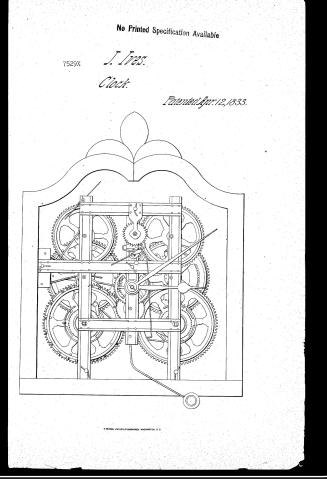 Page 1
-
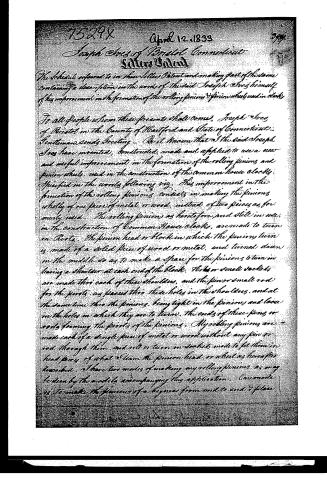 Page 2
-
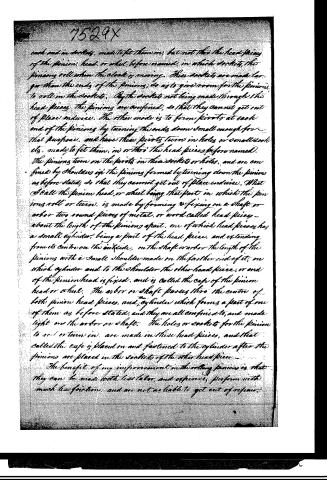 Page 3
-
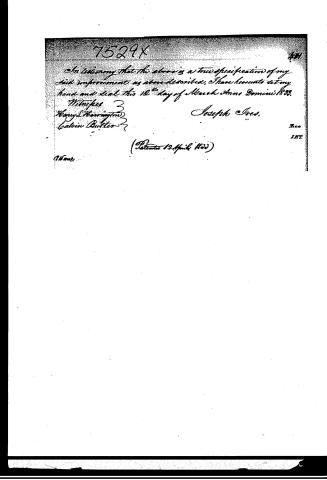 Page 4


U.S. Patent and Trademark Office · Google Patents
Show the transcription Hide (863 words)
Machine transcription (LightOnOCR) of the pages as scanned by the USPTO, most of them the handwritten copies made when the records were restored after the 1836 fire. Not checked; it can misread handwriting, so compare it with the scan.
Page 1.
No Printed Specification Available
7529X
J. Ives.
Clock.
Patented Apr. 12, 1833.
Page 2.
7529X April 12, 1833
Joseph Sves of Bristol, Connecticut
Sellers Patent
The schedule referred to in the Letters Patent and making part of the same containing a description in the words of the said Joseph Sves himself of his improvement in the formation of the rolling pinions & pinion wheels used in clocks.
To all people whom these presents shall come, Joseph Sves of Bristol in the County of Hartford and State of Connecticut: Gentleman sends Greeting — Be it known that I the said Joseph Sves have invented, constructed, made and applied to use a new and useful improvement in the formation of the rolling pinions and pinion wheels, used in the construction of the common house clocks. Specified in the words following viz: This improvement in the formation of the rolling pinions consists in making the pinions wholly of one piece of metal or wood, instead of two pieces as formerly used. The rolling pinions as heretofore and still in use, in the construction of common house clocks, are made to turn on Arrets. The pinion head or block in which the pinions turn is made of a solid piece of wood or metal, and turned down in the middle so as to make a space for the pinions to turn in leaving a shoulder at each end of the block. Holes or small sockets are made thro’ each of these shoulders, and the pin or small rod for the pivots, as pleased thro’ these holes in the shoulders, and at the same time thro’ the pinions, being tight in the pinions and loose in the holes in which they are to turn. The ends of these pins or rods forming the pivots of the pinions. My rolling pinions are made each of a single piece of metal or wood without any pin or rod thro’ them, and will to turn in sockets made to fit them in head pieces of what I term the pinion head, or wheel as hereafter described. I have two modes of making my rolling pinions, as may be seen by the models accompanying this application. One mode is to make the pinions of a bigness from end to end, I place
Page 3.
each end in sockets, made to fit them in, but not thro' the head pieces of the pinion, head, or wheel before named, in which sockets, the pinions roll when the clock is moving. These sockets are made larger than the ends of the pinions, so as to give room for the pinions to roll in the sockets. By the sockets not being made through the head pieces, the pinions are confined, so that they cannot get out of place undivine. The other mode is to form pivots at each end of the pinions by turning the ends down small enough for that purpose, and have these pivots turn in holes or small sockets, made to fit them, in or thro' the head pieces before named. The pinions turn on the pivots in their sockets or holes, and are confined by shoulders of the pinions formed by turning down the pinions as before stated, so that they cannot get out of place undivine. What I call the pinion head, or wheel being that part in which the pinions roll or turn, is made by forming & fixing on a shaft or arbor two round pieces of metal, or wood called head pieces—about the length of the pinions apart, one of which head pieces has a small cylinder, being a part of the head piece, and extending from its centre on the outside, on the shaft or arbor the length of the pinions with a small shoulder made on the farther end of it, on which cylinder and to the shoulder the other head piece, or end of the pinion head is fixed, and is called the cap of the pinion head or wheel. The arbor or shaft passes thro' the centre of both pinion head pieces, and cylinder which forms a part of one of them as before stated, and they are all confined to, and made tight on the arbor or shaft. The holes or sockets for the pinions to roll or turn in, are made in these head pieces, and that called the cap is placed on and fastened to the cylinder after the pinions are placed in the sockets of the other head piece.
The benefit of my improvement in the rolling pinions is that they can be made with less labor, and expense, perform with much less friction, and are not as liable to get out of repair.
Page 4.
7529X
In testimony that the above is a true specification of my said improvement as above described, I have hereunto set my hand and seal this 12th day of March Anno Domini 1833.
Witness
Henry S. Harrington
Calvin Butler
Joseph Trow.
(Patented 12 April 1833)
Published accounts: journal notice
Notice in the monthly list of patents, with remarks
Journal of the Franklin Institute, new ser., vol. 12 (1833), p. 242 · View the page
25. For an improvement in Clocks, consisting in Rolling Pinions, and Pinion Wheels; Joseph Ives, Bristol, Hartford county, Connecticut, April 12.
Remarks. The patentee does not pretend that the rolling, or revolving, of the wires, which are sometimes substituted for leaves in the pinions of wooden or brass clocks, is new, but he claims to have made an improvement in the mode of fixing them, the value of which, however, we are unable to perceive. The holes in which the pinions turn in the heads at each end, are to be drilled of such size as will allow the wire to revolve freely, without turning it down; or the holes may be drilled smaller, and pivots turned on the end of each wire. The information given amounts to no more than this.
About this record
- Patentee
- DATAMP
- Date
- the Name and Date index of patents, DATAMP, USPTO records
- Invention
- DATAMP
- Listed in
- the Name and Date index of patents, DATAMP, USPTO records, Jim Shaw's X-patent list, the Journal of the Franklin Institute, Burke's List of Patents (1847)
- Burke's 1847 Patent Office list gives the same patent.