

Drawings and documents
National Archives restored drawings: drawing
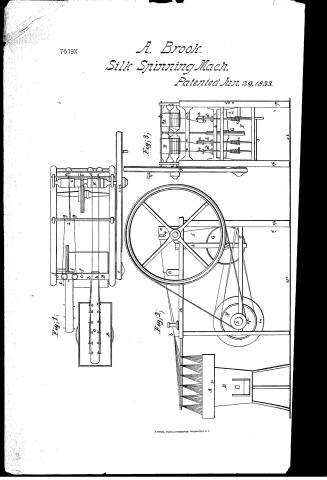
Adam Brook's Patent Drawing for a Machine for Spinning Silk

National Archives, Restored Patent Drawings (Record Group 241) · Full-size scan at the National Archives · Catalog record
Show the text on the drawing Hide (49 words)
Words on the drawing as machine-read by the National Archives; not checked. Useful mainly for searching.
CIC / 2564 / NOISIAIT / + t-6196 / Winding. / SILK, ₹. / A 21 2 1 / D. / of / of / fo / 111/2 / 5. / Fig 2 / o, / 1.4 / Fig 1 / 11/4 / 3ft / III / D. / Machine for Spinning Silk / ADAM BROOK'S. / 1fE / 2.71/2 / of / +1 / 214 1.2 / 20 / 00 / d. / 8/11 / 8/21 / 0000000 / Dd / 81 / Fig 5 / 1000000 / 14 or Not / 8 1/2 / 11 / 8/42 / 17/8 / Patented 29 29th June 1833
USPTO scan
The patent as scanned by the USPTO
-
 Page 1
-
 Page 2
-
 Page 3
-
 Page 4


U.S. Patent and Trademark Office · Google Patents
Show the transcription Hide (819 words)
Machine transcription (LightOnOCR) of the pages as scanned by the USPTO, most of them the handwritten copies made when the records were restored after the 1836 fire. Not checked; it can misread handwriting, so compare it with the scan.
Page 1.
7619X
A. Brook.
Silk Spinning Mach.
Patented Jun. 29, 1833.
Fig. 1;
Fig. 2;
Fig. 3;
Page 2.
7619X Adam Brooks
The Schedule referred to in these Letters Patent and making part of the same containing a description in the words of the said Adam Brooks himself of his improvement in the machine for spinning Silk.
To all to whom these presents shall come, We of the County of Plymouth and State of Massachusetts have invented a new and useful improvement in the art of spinning silk and the following is a full and exact description of the construction and operation of the said machine as invented or improved by me. Figure 1 represents the top of the machine, Figure 2, the side, and Figure 3 the front. A, a tin pan about 21 inches long, 10 inches wide and four inches deep filled with boiling water into which the cocoons are put after being prepared for spinning. B, a common stove furnace filled with coals to keep the water hot. C, is a strip of board about 2½ inches wide and 2½ feet long passing through a hole in the bar D, on the sides of which are placed curved wires through which the fibers are collected and carried through the leading wires f, f, to hook c, (one back from thence over the top roller B, and then between the rollers through the curved wires, the fibers are, to the spools a, a, (which are similar to those common in cotton mills) where Spindles are turned by the wheels e, e, with bands from thence to the drum B, which has a large shaft on one end of its axle connected by bands or belts, to the large wheel which may be turned by hand, or if required to do more business the number of spindles may be increased, and here, steam or water power applied, this process turns the silk into a perfect thread suitable for the warp or filling for cloth, or for combing and twisting for drawing, which is done by taking the spools a, a, off.
Page 3.
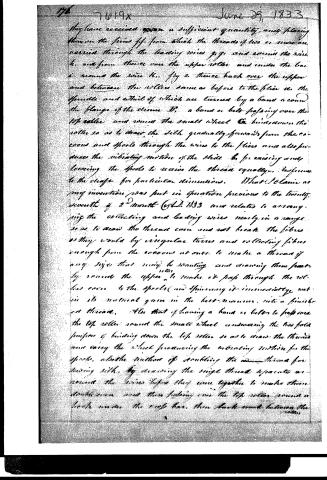
they have received upon a sufficient quantity and placing them on the pins ff. from which the threads of two or more are carried through the leading wires gg, and around the wire h, and from thence over the upper roller and under the bar i, around the wire k, by s, thence back over the upper and between the rollers same as before to the pins cc, the spinnets and attil of which are turned by a band around the flange of the drum D, a band or belt passing over the top roller and round the small wheel C, binds down the roller so as to draw the silk gradually forward from the cocoons and spools through the wires to the pins and also produces the vibrating motion of the slide b, for raising and lowering the spools to receive the threads equally, reference to the draft for particular dimensions. What I claim as my invention was put in operation previous to the twenty-seventh of 2nd month (A.D.) 1833 and relates to arranging the collecting and leading wires nearly in a range so as to draw the thread even and not break the fibres as they would by irregular turns and collecting fibres enough from the cocoons at once to make a thread of any size that may be wanting and drawing them partly round the upper roller to make it pass through the rollers even to the spools (and spinning it immediately not in its natural gum in the best manner, into a finished thread. Also that of having a band or belt to pass over the top roller round the small wheel and drawing the two fold function of binding down the top roller so as to draw the threads more easy the wheel producing the vibrating motion for the spools, also the method of doubling the silk threads for drawing silk, by drawing the single thread separate around the wires before they come together to make them double over and then passing over the top roller round a fork under the cross bar, then back round between the wires.
Page 4.
7619x June 29, 1833
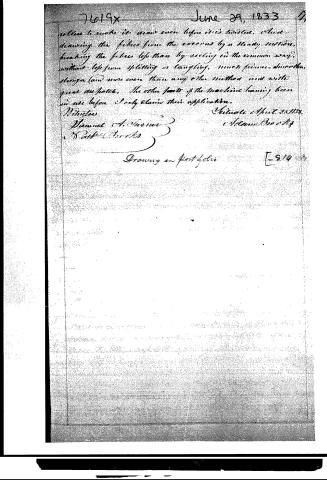
willing to make it draw even before it is twisted. And drawing the fibres from the cocoons by a steady motion, breaking the fibres less than by acting in the common way, without loss from splitting or tangling, much finer, smoother, stronger (and more even than any other method) and with great ease. The other parts of the machine having been in use before I only claim their application.
Witness
Samuel A. Turner
& John Brooks
Patented April 23, 1833.
William Brooks
Drawing an Post 4000 [8/14]
Published accounts: journal notice
Notice in the monthly list of patents, with remarks
Journal of the Franklin Institute, new ser., vol. 12 (1833), p. 400 · View the page
15. For a Machine for Spinning Silk; Adam Brooks, Scituate, Plymouth county, Massachusetts, June 29.
Remarks. This machine is intended to draw the threads from the cocoons, and unite them without reeling, in sufficient numbers to carry them over a cylinder to spindles, where they are spun into a thread ready for filling in weaving, or for doubling and twisting for sewing silk. The apparatus, as represented, is simple, and the patentee avers that it facilitates the business of preparing the silk in various ways, “drawing the fibres from the cocoons by a steady motion, breaking the fibres less than by reeling in the common way: without loss from splitting or tangling; much firmer, smoother, stronger, and more even than by any other method, and with greater despatch."
About this record
- Patentee
- DATAMP
- Date
- the Name and Date index of patents, DATAMP, USPTO records
- Invention
- DATAMP
- Listed in
- the Name and Date index of patents, DATAMP, USPTO records, Jim Shaw's X-patent list, the Journal of the Franklin Institute, Burke's List of Patents (1847)
- Burke's 1847 Patent Office list gives the same patent.