

Drawings and documents
National Archives restored drawings: drawing
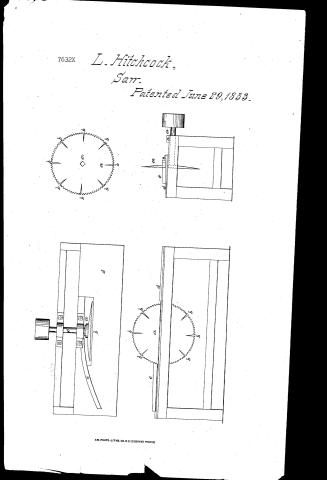
Levi Hitcock's Patent Drawing for a Circular Saw

National Archives, Restored Patent Drawings (Record Group 241) · Full-size scan at the National Archives · Catalog record
Show the text on the drawing Hide (84 words)
Words on the drawing as machine-read by the National Archives; not checked. Useful mainly for searching.
110. saws. / [131] Saws. / $150 / CLASSI FICATION / Levi Hitchooch. / DIV 7632-X ISION. / bircular Law. / Vol.17 pg. 337 / Patented. line 29th 1833 / Preferences. / a circular salo in the shape / Tront view of the law. / of a small section ofa hallow globe / triangular slits. / C axis / d platform inclined / e the curved guide. / Patent ) / made under the direction of the Commissioner of Patents / in conformity with act of 3d march 1834 / N Sumorth / Commissiones of Patents.
USPTO scan
The patent as scanned by the USPTO
-
 Page 1
-
 Page 2
-
 Page 3


U.S. Patent and Trademark Office · Google Patents
Show the transcription Hide (599 words)
Machine transcription (LightOnOCR) of the pages as scanned by the USPTO, most of them the handwritten copies made when the records were restored after the 1836 fire. Not checked; it can misread handwriting, so compare it with the scan.
Page 1.
7632X
L. Hitchcock,
Sarr.
Patented June 29, 1833.

A.M. PHOTO-LITHO. CO. N.Y. (OSBORNE'S PROCESS)
Page 2.
7632X June 29, 1873 337
Lori Hitchcock of Springfield, Massachusetts
Letters Patent
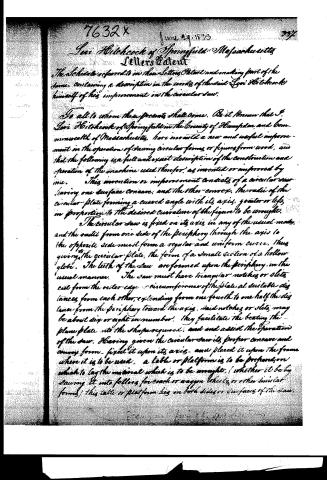
The Schedule referred to in these Letters Patent and making part of the same, containing a description in the words of the said Lori Hitchcock himself of his improvement in the circular saw.
To all to whom these presents shall come. Be it known that I, Lori Hitchcock of Springfield in the County of Hampden and Commonwealth of Massachusetts, have invented a new and useful improvement in the operation of sawing circular forms or figures from wood, and that the following is a full and exact description of the construction and operation of the machine used therefor, as invented or improved by me.
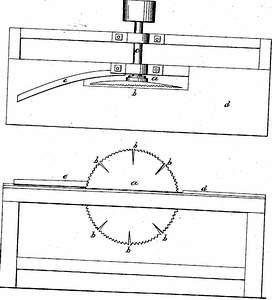
This invention or improvement consists of a circular saw having one surface concave, and the other convex, the radii of the circular plate forming a curved angle with its axis, greater or less in proportion to the desired curvature of the figure to be wrought.
The circular saw is fixed on its axis in any of the usual modes, and the radii from one side of the periphery through the axis to the opposite side must form a regular and uniform curve, thus giving the circular plate, the form of a small section of a hollow globe. The teeth of the saw are formed upon the periphery, in the usual manner. The saw must have triangular notches or slits cut from the outer edge circumference of the plate at suitable distances from each other, extending from one-fourth to one-half the distance from the periphery toward the axis. Said notches or slits may be about six or eight in number. They facilitate the beating the plane plate into the shape required, and aid the operation of the saw. Having given the circular saw its proper concave and convex form, fix it upon its axis and place it upon the frame where it is to be used. A table or platform is to be prepared on which to lay the material which is to be wrought, (whether it be by sawing it into fellows for coach or wagon wheels, or other similar forms) this table or platform lies on both sides or surfaces of the saw.
Page 3.
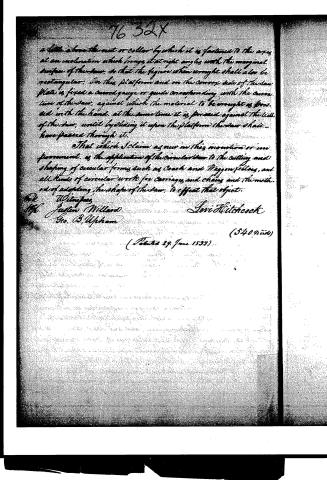
a little above the nut or collar by which it is fastened to the axis at an inclination which brings it at right angles with the marginal surface of the saw, so that the figure when wrought shall also be rectangular. On this platform and on the convex side of the saw plate is fixed a curved gauge or guide corresponding with the curvature of the saw, against which the material to be wrought is pressed with the hand, at the same time it is pressed against the teeth of the saw, until by sliding it upon the platform the saw shall have passed through it.
That which I claim as new in this invention or improvement, is the application of the circular saw to the cutting and shaping of circular forms such as Coach and Wagon felloes, and all kinds of circular work for Carriages and Chairs and the method of adapting the shape of the saw to effect that object.
Pat. Witnesses
Mr. Justin Willard
Geo. B. Upham
Lori Hitchcock
(5409754)
(Patented 29 June 1833)
Published accounts: journal notice
Notice in the monthly list of patents, with remarks
Journal of the Franklin Institute, new ser., vol. 12 (1833), p. 403 · View the page
24. For Machinery for Sawing Circular Forms or Figures from Wood; Levi Hitchcock, Springfield, Hampden county, Massachusetts, June 29.
Remarks. The machine described consists, mainly, of a circular saw, which is to be concavo-convex, or, in other words, to be a segment of a hollow sphere, suiting the curvature of the article to be cut. The saw is to be fixed upon an axis, like other circular saws, and the stuff to be cut fed to it by suitable fixtures which gauge and guide it. The claim made is to "the application of the circular saw to the cutting and shaping of circular forms, such as coach and wagon felloes, and all sorts of circular work for carriages and chairs; and to the method of adapting the shape of the saw to effect this object." It is said that pieces should be cut out of the circular plate, form-ing notches half an inch, or more, wide, extending from the periphery some way in towards the centre, which will facilitate the raising of the plate into the proper form; this, we suppose, is what is intended by the method of adopting the shape," &c. It appears rather singular that the articles to which this mode of sawing is better adapted than to most others, is not at all mentioned in the specification, that of staves, which require to be rounded in every direction, as stuff cut by such a saw will necessarily be; perhaps the cause of this omission may be found in the fact that a patent was obtained by Philip Cornell on the 11th of April, 1832, for sawing bulging staves with a plano-convex saw, such as is above described, (see vol. x. p. 236.) It is a mistake, however, to suppose that another man's machine can be taken and applied to a new purpose, and thus become the subject of a new patent; yet this is all that is attempted in the present instance.
DATAMP: illustration
Illustrations from DATAMP

DATAMP (Directory of American Tool and Machinery Patents), via the Internet Archive · Archived DATAMP page
About this record
- Patentee
- the Journal of the Franklin Institute, Journal
- Date
- DATAMP, USPTO records
- Invention
- DATAMP
- Listed in
- the Name and Date index of patents, DATAMP, USPTO records, Jim Shaw's X-patent list, the Journal of the Franklin Institute, Burke's List of Patents (1847)
- The sources give different dates; the date shown is the one most of them agree on.
- The patentee's full name comes from the Franklin Institute's journal.
- The Franklin Institute's journal confirms the date shown.
- Burke's 1847 Patent Office list gives the same patent.