

Drawings and documents
National Archives restored drawings: drawing
John L. Williams' Patent Drawing for a Track Road

National Archives, Restored Patent Drawings (Record Group 241) · Full-size scan at the National Archives · Catalog record
Show the text on the drawing Hide (107 words)
Words on the drawing as machine-read by the National Archives; not checked. Useful mainly for searching.
200 / CLASSIFICATION / 7656x / DIVISION. / John Polliamo / Track Road. / Patented June 29th 1833 / Restored. Patents / Frig.1. / vol.16. p-67. / Missellaneous. / Track, / 104-RAILWAYS. / References. / Section / Fig1. Topview of the Road. / Fig.2. a-a Timber with gutters. / a.a. Timber with grooves gutters. / b.b. / with plaine face / b.b. Timber with plain face. / dan a track of wood or other suitable material one side of which is / ground and the other side plain. / I.ig. 2. / Patent office 14th July 1838 / Made under the direction of the Commipioner of / Patents ts in conformity with act 3 March 18372 / your / of Patents
USPTO scan
The patent as scanned by the USPTO
-
 Page 1
-
 Page 2
-
 Page 3


U.S. Patent and Trademark Office · Google Patents
Show the transcription Hide (660 words)
Machine transcription (LightOnOCR) of the pages as scanned by the USPTO, most of them the handwritten copies made when the records were restored after the 1836 fire. Not checked; it can misread handwriting, so compare it with the scan.
Page 1.
7656X
J. S. WILLIAMS.
TRACK ROAD.
Patented June 29, 1833.
Fig. 1.

Fig. 2.

THE NORRIS PETERS CO., PHOTO-LITHO., WASHINGTON, D.C.
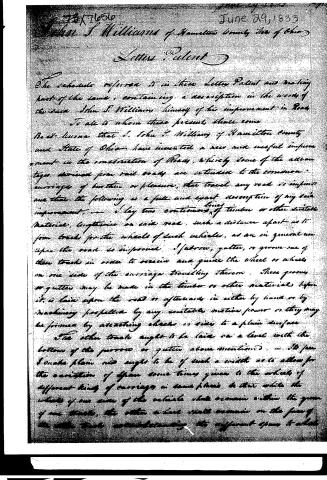
Page 2.
June 29, 1833
S. John S. Williams of Hamilton County, State of Ohio
Letters Patent
The schedule referred to in these Letters Patent and making part of the same, containing a description in the words of the said John S. Williams himself of his improvement in Roads.
To all to whom these presents shall come,
Be it known that S. John S. Williams of Hamilton County and State of Ohio have invented a new and useful improvement in the construction of Roads, whereby some of the advantages derived from rail roads are extended to the common carriage of burden or pleasure, that travel any road so improved and that the following is a full and exact description of my said improvement, — I lay two continuous lines of timber or other suitable material, lengthwise on said road, such a distance apart as to form tracks for the wheels of such vehicles, as are in general use upon the road so improved. I furrow, gutter, or groove one of these tracks in order to receive and guide the wheel or wheels on one side of the carriage travelling thereon. These grooves or gutters may be made in the timber or other material before it is laid upon the road or afterwards in either by hand or by machinery propelled by any suitable motive power or they may be formed by stretching chocks or sides to a plain surface.
The other track ought to be laid on a level with the bottom of the furrow or gutter above mentioned. — It is I make plain and ought to be of such a width as to allow for the variation of space sometimes given to the wheels of different kinds of carriages in some places, so that while the wheels of one side of the vehicle shall remain within the groove of one track, the other side shall remain on the face of the other track accommodating the different spaces to which
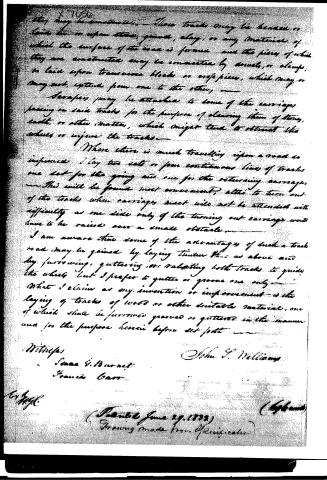
Page 3.
X 7056
they may be constructed. These tracks may be hewn or laid in or upon stone, ground, clay, or any materials of which the surface of the road is formed, and the pieces of which they are constructed may be connected by dowels, or clamps, or laid upon transverse blocks or edge pieces, which may or may not, extend from one to the other.
Scrapers may be attached to some of the carriages passing on said tracks for the purpose of cleaning them of stones, earth, or other matter, which might tend to obstruct the wheels or injure the tracks.
Where there is much travelling upon a road so improved, I lay two sets or four continuous lines of tracks, one set for the going and one for the returning carriage, and this will be found most convenient, as to turn out of the tracks when carriages meet will not be attended with difficulty as one side only of the turning out carriage would have to be raised over a small obstacle.
I am aware that some of the advantages of such a track road may be gained by laying timber there as above and by furrowing, guttering, or saluting both tracks to guide the wheels, but I prefer to gutter or groove one only.
What I claim as my invention or improvement is the laying of tracks of wood or other suitable material, one of which shall be furrowed, grooved or guttered in the manner and for the purpose herein before set forth.
Witnesses
John T. Williams
Samuel S. Burnet
Francis Carr
(4 by 6)
(Patented June 29, 1852)
Drawing made from Specification
Published accounts: journal notice
Notice in the monthly list of patents, with remarks
Journal of the Franklin Institute, new ser., vol. 12 (1833), p. 409 · View the page
42. For an improvement in roads, denominated the Track Road; John S. Williams, Cincinnati, Hamilton county, Ohio, June 29.
Remarks. (See the specification.)
Published accounts: journal notice
Notice in the monthly list of patents, with remarks
Journal of the Franklin Institute, new ser., vol. 12 (1833), p. 411 · View the page
47. For an improvement in Locks for Doors; William How, city of New York, June 29.
Remarks. This lock is to be made in most respects like the common door lock, but there are to be five, or any other number, of cylindrical pieces, which are called drums, ranged on the side of the bolt, and made in such a way that excepting they are all placed in the proper direction the bolt cannot be turned by the key. The drums may be of brass, about one inch in diameter, and three-eighths of an inch thick: a spindle passes through each of them to retain them in their places, and to receive the pipe of a key by which they are to be turned. They have each of them a groove on one edge to admit a wing projecting from the bolt to pass through, when rightly placed for that purpose, but they stop its motion when not so placed. The door must have a round key hole for each of these drums, in order to their being turned in the proper position preparatory to unlocking the door with the ordinary key. When unlocked, pieces projecting from the bolt cover the ends of the pins by which the drums are to be turned. The point claimed is "the movable indices applied to door and other locks as above specified." We do not perceive the superiority of this lock to many others which have been devised for special security, and we think that the adjustment of the five drums will exact more attention than most persons will be willing to give, excepting during the period when they are satisfying their curiosity concerning them.
Published accounts: journal notice
Notice in the monthly list of patents, with remarks
Journal of the Franklin Institute, new ser., vol. 12 (1833), p. 412 · View the page
51. For a Planting Machine, for making a ridge, opening it, and dropping cotton or other seeds; John J. Goodman, and William S. M'Donald, Wilson county, Tennessee, June 29.
Remarks. There is no small resemblance between this planting machine and several others which have preceded it, and there is not any thing in the specification setting forth the improvement supposed to be made. The ground is to be opened by a share; the seed is dropped from a hopper, the quantity discharged being governed by the motion of the wheels; and a contrivance in the rear of the machine is intended to close the ground over the seed. All these objects have been previously accomplished by contrivances very similar to those described by the patentees, who should, therefore, have shown clearly the points of novelty in their arrangement.
Published accounts: journal notice
Notice in the monthly list of patents, with remarks
Journal of the Franklin Institute, new ser., vol. 12 (1833), p. 416 · View the page
The grooves or creases in the face of each die must, of course, be deep, and the ridges between them sharp, according to the desired depth and sharpness of the thread; and one or both of the dies or plates must be so constructed that their faces shall gradually come to each other as the cylinder is carried between them, till it has reached about the middle of the plates, and from that point that their faces shall be parallel to each other during the rest of their motion, their motion being always in right lines, and the sides of the dies that correspond to each other, always moving upon the same line or upon parallel lines. From about the middle of the plate, measuring from end to end, WILLIAMS' Improved Construction of Roads. the ridges between the grooves gradually become wider at the top, and the grooves more sharp at the bottom in order to leave the spaces between the threads of the screws broad at the bottom, and the threads themselves thin and sharp at the top, if it is desired to give the screw that form or curvature, and small transverse cuts run across the ridges, at right angles with the sides of the die, and quite near to each other, in order to prevent the cylinder from sliding between the dies, and to give it a revolving motion. The plates, or dies, may be so arranged as to thread or form a screw in their motion either from right to left, or from left to right, or in each part of their reciprocating motion. The wire, or cylinder, is introduced at, or near, the end of one of the dies, and is seized by the other as it passes, and driven out at the other end, the screw being threaded or formed with entire accuracy, and with a degree of perfection that will always correspond with the fineness of the metal and the workmanship of the machinery. What I claim as my invention, and for the use of which I ask an exclusive privilege, is the improvement in the mode of manufacturing the wood screw, which consists in the method of raising or producing the thread, by forcing up the metal of the cylinder, or wire, of which the screw is made, so as to constitute the thread by rolling and compressing the cylinder between grooved plates, or dies, of the foregoing description, by whatever machinery the dies are worked, and in whatever way the motion is given, or the pressure applied. HAZARD KNOWLES. Specification of a patent for an improvement in the Construction of Roads, whereby some of the advantages derived from rail-roads are extended to common carriages of burthen or pleasure. Granted to JOHN S. WILLIAMS, Cincinnati, Hamilton county, Ohio, June 29, 1833.
Remarks. I lay two continuous lines of timber, or other suitable material, lengthwise, on said road, at such a distance apart as to form tracks for the wheels of such vehicles as are in general use upon the road so improved. I furrow, gutter, or groove, one of these tracks, in order to receive and guide the wheel, or wheels, on one side of the carriages travelling thereon. Those grooves, or gutters, may be made in the timber, or other material, before it is laid upon the road, or afterwards, either by hand or by machinery propelled by any suitable motive power, or they may be formed by attaching cheeks, or sides, to a plain surface. The other track ought to be laid on a level with the bottom of the furrow, or gutter, above mentioned. Its face I make plain, and it ought to be of such a width as to allow for the variation of span sometimes given to the wheels of different kinds of carriages in some places, so that while the wheels of one side of the vehicles shall remain within the groove of one track, the other wheel shall remain on the face of VOL. XII. No. 6. - DECEMBER, 1833. 53 ESPY'S Improved Chimney Cap. the other track, notwithstanding the different spans to which they may be constructed. These tracks may be bedded, or laid, in, or upon, stone, gravel, clay, or any material of which the surface of the road is formed, and the piece of which they are constructed, may be connected by dowels, or clamps, or laid upon transverse blocks, or cross pieces, which may, or may not, extend from one to the other. Scrapers may be attached to some of the carriages passing on said tracks for the purpose of cleansing them of stones, earth, or other matter, which might tend to obstruct the wheels, or injure the tracks.
About this record
- Patentee
- DATAMP
- Date
- the Name and Date index of patents, DATAMP, USPTO records
- Invention
- DATAMP
- Listed in
- the Name and Date index of patents, DATAMP, USPTO records, Jim Shaw's X-patent list, the Journal of the Franklin Institute, Burke's List of Patents (1847)
- Burke's 1847 Patent Office list gives the same patent.