

Drawings and documents
National Archives restored drawings: drawing
E.C. Spafford's Patent Drawing for a Machine for Pneumatic and Steam Power

National Archives, Restored Patent Drawings (Record Group 241) · Full-size scan at the National Archives · Catalog record
Show the text on the drawing Hide (144 words)
Words on the drawing as machine-read by the National Archives; not checked. Useful mainly for searching.
66. Spafford He of / to lizabeth Spafford administratrix / Vol,16, 423, / Plate 1. / H.G. spafford / 25 Rotary STEAM ENGINED Impite Ty admissions Asp offere / Patented 5'Suly 1833, / Incumatic & Steam Power & Decem / Figi2, / CLASSIFICATION / 76575 Enginies / DIVISION. / Fig.1. / B' / References, / Firl, wheel propelled byair, / Fig 2. " / " steam / A. air pump. B. cylender containing / wheel in section B.2 / wheel side view, C, water wheel, / Patent Cffin Mar 17.18.42 / D. stea m boiter. E. pipe leadind to eyhnder, / Esteam wheel, working in water, / Made under the direction of the Commission A Patients / Fid. transverse section of steam boiler / with wheel in the inside. / in conformity with act of Mongrefs 3 March 1837, / Fife4, side view of boiler, / A.boiler. B. wheel. C. funne l / D. tube to carry the steam down / under which / Commipionn of / E. furnace,
USPTO scan
The patent as scanned by the USPTO
-
 Page 1
-
 Page 2
-
 Page 3
-
 Page 4
-
 Page 5
-
 Page 6
-
 Page 7


U.S. Patent and Trademark Office · Google Patents
Show the transcription Hide (1,650 words)
Machine transcription (LightOnOCR) of the pages as scanned by the USPTO, most of them the handwritten copies made when the records were restored after the 1836 fire. Not checked; it can misread handwriting, so compare it with the scan.
Page 2.
United States Patent
Patent No.: X7657
Elizabeth C. Spafford, administratrix of H. G. Spafford, deceased
Letters Patent.
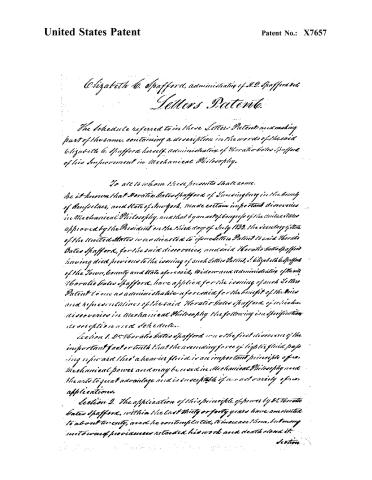
The schedule referred to in these Letters Patent and making part of the same, containing a description in the words of the said Elizabeth C. Spafford herself, administratrix of Horatio Bates Spafford of his Improvement in Mechanical Philosophy.
To all to whom these presents shall come.
Be it known that Horatio Bates Spafford of Luningburg in the county of Berks, and state of New York, made certain important discoveries in Mechanical Philosophy, and that by an act of Congress of the United States approved by the President on the third day of July 1833, the secretary of state of the United States was directed to issue Letters Patent to said Horatio Bates Spafford, for the said discoveries, and said Horatio Bates Spafford having died previous to the issuing of such Letters Patent, Elizabeth C. Spafford of the Town, County and State aforesaid, widow and administratrix of the said Horatio Bates Spafford, have applied for the issuing of such Letters Patent to me as administratrix aforesaid for the benefit of the heirs and representatives of the said Horatio Bates Spafford, of which discoveries in Mechanical Philosophy the following is a specification description and schedule.
Section 1. Dr. Horatio Bates Spafford was of the first discoveries of the important fact or truth that the ascending force of light or fluid passing upward and that a heavier fluid is an important principle of an Mechanical power and may be used in Mechanical Philosophy and the arts to great advantage and is susceptible of a vast variety of applications.
Section 2. The application of this principle of power by Dr. Horatio Bates Spafford, within the last thirty or forty years have amounted to about twenty, and he contemplated, to increase them, but many untoward providences retarded his work and death closed it.
Section
Page 3.
United States Patent
Patent No.: X7657
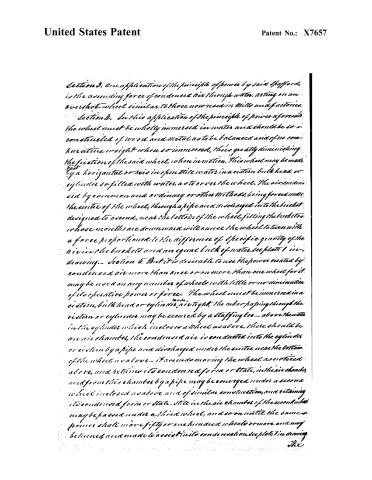
Section 3. One application of the principle of power by said Stafford, is the ascending force of condensed air through water, acting on an overshot wheel similar to those now used in Mills and factories.
Section 4. In this application of the principle of power aforesaid the wheel must be wholly immersed in water and should be so constructed of wood and metal as to be balanced and of no comparative weight when so immersed, this greatly diminishing the friction of the said wheel, when in motion. This wheel may be made by a horizontal or axis in open still water in a cistern bulk head or cylinder so filled with water as to cover the wheel. The air is condensed by common and ordinary or other methods, being forced under the centre of the wheel, through a pipe and discharged into the buckets designed to ascend, near the bottom of the wheel, filling the buckets whose mouths are downward will cause the wheel to turn with a force proportioned to the difference of specific gravity of the air in the buckets and an equal bulk of water see plate 1 in drawing.
Section 5. But it is desirable to use the power created by condensed air more than once or on more than one wheel for it may be used on any number of wheels with little or no diminution of its operative power or force. The wheel must be immersed in a cistern, bulk head or cylinder, airtight, the air or piping through the cistern or cylinder may be secured by a stuffing box. Above the water in the cylinder which encloses a wheel as above, there should be an air chamber, the condensed air is conducted into the cylinder or cistern by a pipe and discharged under the centre near the bottom of the wheel as above. It ascends moving the wheel as noticed above, and returns its condensed form or state, in the air chamber, and from this chamber by a pipe may be conveyed under a second wheel enclosed as above and of similar construction, and retaining its condensed form or state, still in the air chamber of the second wheel may be passed under a third wheel, and so on until the same power shall move fifty or one hundred wheels or more and may be turned and made to assist in its condensation, see plate 1 in drawing.
Page 4.
United States Patent
Patent No.: X7657
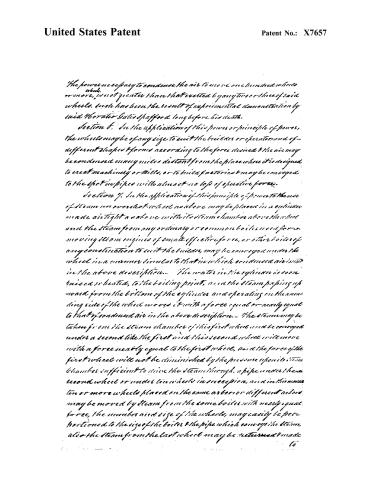
The power necessary to condense the air to move one hundred wheels or more, is not greater than that exerted by any two or three of said wheels. Such has been the result of experimental demonstration by said Horatio Gates Shafford long before his death.
Section 6. In the application of this power or principle of power, the wheels may be of any size to suit the builder or operator and of different shapes & forms according to the force desired & the air may be condensed many miles distant from the place where it is designed to erect machinery or mills, or to build factories & may be conveyed to the spot in pipes with almost no loss of operative force.
Section 7. In the application of this principle of power to the use of steam in overshot-wheel as above may be placed in a cylinder made airtight above with its steam chamber above the wheel and the steam from any ordinary or common boiler used for moving steam engines of small effective force, or other boilers of any construction to suit the builder, may be conveyed under the wheel in a manner similar to that in which condensed air is used in the above description. The water in the cylinder is soon raised or heated, to the boiling point, and the steam piping upward from the bottom of the cylinder and operating on the ascending side of the wheel moves it with a force equal or nearly equal to that of condensed air in the above description. The steam may be taken from the steam chamber of this first wheel and be conveyed under a second like the first and this second wheel will move with a force nearly equal to the first wheel, and the force of the first wheel will not be diminished by the pressure upon its steam chamber sufficient to drive the steam through a pipe under the second wheel or under ten wheels in succession, and in this manner ten or more wheels placed on the same arbor or different arbors may be moved by steam from the same boiler with nearly equal force, the number and size of the wheels, may easily be proportioned to the size of the boiler & the pipe which conveys the steam, also the steam from the last wheel may be returned & made
6
Page 5.
United States Patent
Patent No.: X7657
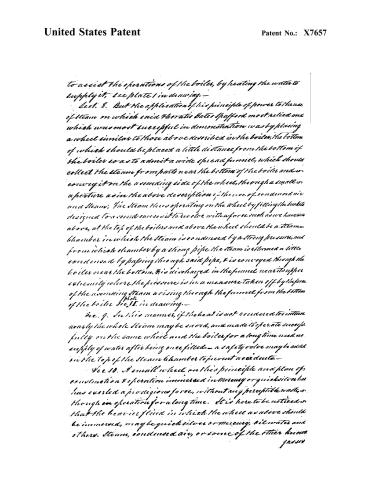
to assist the operations of the boiler, by heating the water to supply it, see plate I in drawing.
Sec. 8. But the application of his principle of power to the use of steam on which said Horatio Bates Spafford most relied and which was most successful in demonstration was by placing a wheel similar to those above described in the boiler, the bottom of which should be placed a little distance from the bottom of the boiler so as to admit a wide spread funnel, which should collect the steam from parts near the bottom of the boiler and convey it on the ascending side of the wheel, through a small aperture as in the above description of the use of condense air and steam. The steam then operating on the wheel by filling the buckets designed to a certain cause it to revolve with a force such as we have seen above, at the top of the boiler and above the wheel should be a steam chamber in which the steam is condensed by a strong pressure, and from which chamber by a strong pipe the steam is returned a little condensed by passing through said pipe, & is conveyed through the boiler near the bottom. This discharged in the funnel near its upper extremity where the pressure is in a measure taken off by the force of the ascending steam arising through the funnel from the bottom of the boiler. See II. in drawing.
Sec. 9. In this manner, if the heat is not rendered to sustain nearly the whole steam may be saved, and made to operate successfully on the same wheel and the boiler for a long time need no supply of water after being once filled. — a safety valve may be added on the top of the steam chamber to prevent accidents.
Sec. 10. A small wheel on this principle and plan of construction & operation immersed in mercury or quicksilver has exerted a prodigious force, without any perceptible waste, though in operation for a long time. It is here to be noticed that the heat in fluid in which the wheel as above should be immersed, may be quicksilver or mercury, oil water and others. Steam, condensed air, or some of the other known gases
Page 6.
United States Patent
Patent No.: X7657
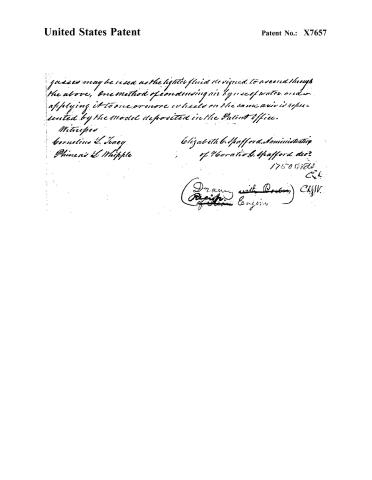
greases may be used as the light fluid designed to ascend through the above, one method of condensing air by use of water and applying it to one or more wheels on the same axis is represented by the model deposited in the Patent Office.
Inventors
Cornelius L. Tracy
Phineas L. Whipple
Assignee
Elizabeth L. Spafford, Administrator
of Horatio L. Spafford, decd.
1750 FIFTH ST.
Ex.
(Drawing with Patent)
Engine
Ch.W.
Page 7.
United States Patent
Patent No.: X7657
C.C. Spofford.
Steam Engine.
Patented July 2, 1833.
Sheet 2 of 2 Sheets
Fig. 4

Fig. 3

Published accounts: journal notice
Notice in the monthly list of patents
Journal of the Franklin Institute, new ser., vol. 13 (1834), p. 26 · View the page
Issued to his relict and administratrix, July 5.
About this record
- Patentee
- DATAMP
- Date
- DATAMP
- Invention
- DATAMP
- Listed in
- the Name and Date index of patents, DATAMP, USPTO records, Jim Shaw's X-patent list, the Journal of the Franklin Institute
- The sources give different dates; the date shown is the one most of them agree on.
- The Franklin Institute's journal gives a different date.