

Drawings and documents
USPTO scan
The patent as scanned by the USPTO
-
 Page 1
-
 Page 2
-
 Page 3


U.S. Patent and Trademark Office · Google Patents
Show the transcription Hide (596 words)
Machine transcription (LightOnOCR) of the pages as scanned by the USPTO, most of them the handwritten copies made when the records were restored after the 1836 fire. Not checked; it can misread handwriting, so compare it with the scan.
Page 1.
7658X
J. Buffington.
Meat and Fruit Cutter.
Patented Jul. 5, 1833.

Inventor;
Joseph Buffington
THE NORRIS PETERS CO., WASHINGTON, D.C.
Page 2.
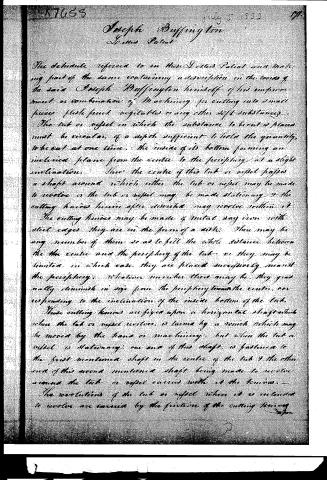
The delineation referred to in this Letters Patent and making part of the same containing a description in the words of the said Joseph Buffington himself of his improvement or combination of Machinery for cutting into small pieces flesh, fruit, vegetables or any other soft substances.
The tub or vessel in which the substance to be cut is placed must be circular, of a depth sufficient to hold the quantity to be cut at one time, the inside of its bottom forming an inclined plane from the centre to the periphery at a slight inclination. Thus the centre of this tub or vessel passes a shaft around which either the tub or vessel may be made to revolve or the tub or vessel may be made stationary & the cutting knives herein after described may revolve within it.
The cutting knives may be made of metal, say iron with steel edges, they are in the form of a disk. There may be any number of them so as to fill the whole distance between the the centre and the periphery of the tub, or they may be limited, in which case, they are placed successively nearest the periphery: whatever number there may be, they gradually diminish in size from the periphery towards the centre, corresponding to the inclination of the inside bottom of the tub.
These cutting knives are fixed upon a horizontal shaft which when the tub or vessel revolves, is turned by a wrist which may be moved by the hand or machinery, but when the tub or vessel is stationary, one end of this shaft is fastened to the first mentioned shaft in the centre of the tub & the other end of this second mentioned shaft being made to revolve around the tub or vessel carries with it the knives.
The revolutions of the tub or vessel when it is intended to revolve are caused by the friction of the cutting knives.
Page 3.
17658
upon the inside of the inclined bottom whatever number of cutting knives there may be they must be placed a short distance apart. This may vary according to the article to be cut. In cutting meat when the cutting knives are seven or a half inches in diameter I generally place the cutting knives five eighths of an inch apart. Between each knife I place a piece of metal one end of which being fixed to a horizontal cross piece in which the machine is fixed, the other slightly touches the cutting knife on the upper side the object of which is to clean off any part of the substance intended to be cut which may adhere to the knives. What I claim as my invention & discovery, is the new & useful improvement above described of cutting knives in the form of disks gradually diminishing in size revolving within the tub or vessel in which the substance to be cut is placed & when the tub or vessel is required to revolve causing it to revolve, by the friction of the cutting knives of the inclined bottom of the tub.
Witness:
Hor. T. Browne
Geo. A. Hushen
Joseph Buffington
Patented July 1833
(Do not post folio)
361 w7
Published accounts: journal notice
Notice in the monthly list of patents, with remarks
Journal of the Franklin Institute, new ser., vol. 13 (1834), p. 27 · View the page
4. For a Machine for Cutting Meat, Fruit, &c. into small pieces; Joseph Buffington, Chester county, Pennsylvania, July 5.
Remarks. A circular trough, having the general form of a tub, is made to receive the articles to be cut; a vertical shaft passes through its centre, upon which it is free to revolve. The cutting knives, are round plates or disks, fixed upon a horizontal shaft, which is to be turned by a winch; the disks decrease in size as they approach the centre, and the bottom of the tub rises so as to be adapted to them; this decrease in size is proportioned to the decreased circumference of the part in which they are to work. A piece of metal, with slots in it, is placed so that the knives pass through the slots, and are thus cleaned from the adhering matter. Instead of allowing the tub to revolve, it is stated that the cutting knives and frame may themselves revolve round in the tub, or trough. The claim is to "the above described cutting knives in the form of disks, gradually diminishing in size, revolving within the tub or vessel, in which the substance to be cut is placed; and where the tub, or vessel is required to revolve, causing it to be done by the friction of the cutting knives, on the inclined bottom of the tub."
About this record
- Patentee
- DATAMP
- Date
- the Name and Date index of patents, DATAMP, USPTO records
- Invention
- DATAMP
- Listed in
- the Name and Date index of patents, DATAMP, USPTO records, Jim Shaw's X-patent list, the Journal of the Franklin Institute, Burke's List of Patents (1847)
- Burke's 1847 Patent Office list gives the same patent.