

Drawings and documents
National Archives restored drawings: drawing
B. Hinckley's Patent Drawing for a Washing Machine

National Archives, Restored Patent Drawings (Record Group 241) · Full-size scan at the National Archives · Catalog record
Show the text on the drawing Hide (33 words)
Words on the drawing as machine-read by the National Archives; not checked. Useful mainly for searching.
68. LAUNDRY. / [91] Washing Mach's / ROLLER. / $1- / CLASSIFICATION / 7683-x X / DIV ISION. / B. Hinkleys / Patented 23 / WASHING MACHINE. / OIR
USPTO scan
The patent as scanned by the USPTO
-
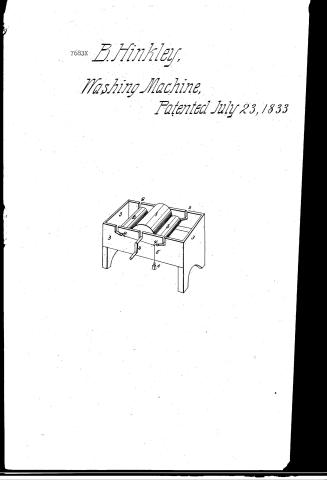 Page 1
-
 Page 2


U.S. Patent and Trademark Office · Google Patents
Show the transcription Hide (439 words)
Machine transcription (LightOnOCR) of the pages as scanned by the USPTO, most of them the handwritten copies made when the records were restored after the 1836 fire. Not checked; it can misread handwriting, so compare it with the scan.
Page 1.
7683X B. Hinkley,
Washing Machine,
Patented July 23, 1833

Page 2.
7/23/1833 7683x
Benjamin Franklin
The attached is referred to in their Patent Specification and making part of this now containing a description in the words of the said Benjamin Franklin himself of his improvement in the Washing machine.
Figs. 2.3.3.3. of the drawing annexed and are referred to as making a part of this description, represents the box, into which the works are put, and in which the machine is intended to operate. This maybe three feet long one foot and a half wide and one foot deep standing about two feet and a half high. On the centre of the side pieces of the box two grooves fitted with two small blocks and represented at Fig. 7, are cut about an inch wide, and four inches deep, to let in the shaft of the main cylinder, one end of which shaft is bent up to form a crank Fig. 6. Fig. 1. of the drawing represents the main cylinder to be ten inches in diameter and eighteen inches long. Figs. 2.2. of the drawing represents two small cylinders about four inches in diameter, and the same length of the main cylinder to one of them on each side of the main cylinder. The small cylinders are in iron gutters, headed and running out from the sides of the box about one half an inch. On these gutters are placed a hook Fig. 4. on one side and one Fig. 5. is fastened into a loop of one of these hooks and runs thru the loop of the other of these hooks and is drawn down by a weight. Fig. 6. sufficiently heavy to keep the smaller cylinders pressed against the larger cylinder. Grooves 9.9. running in an angle of about ninety degrees, and to the same depth of the grooves for the main cylinder, are prepared for the gutters of the smaller cylinders to work in. The box is filled with warm water as high as the bottom of the smaller cylinders. The clothes are laid on to the larger cylinder and the crank is turned, changing the motion backwards and forwards so as to clean the clothes. The size may be varied at pleasure. What I claim as my own is my own invention are the three cylinders laying horizontal and the general arrangement of the machine.
Witnesses
John Wiles
Wm. Henderson
Benjamin Franklin
By me
Patentee
About this record
- Patentee
- DATAMP
- Date
- the Name and Date index of patents, DATAMP, USPTO records
- Invention
- DATAMP
- Listed in
- the Name and Date index of patents, DATAMP, USPTO records, Jim Shaw's X-patent list, Burke's List of Patents (1847)
- Burke's 1847 Patent Office list gives the same patent.