

Drawings and documents
National Archives restored drawings: drawing
David Adams' Patent Drawing for an Improvement in the Wool Carder

National Archives, Restored Patent Drawings (Record Group 241) · Full-size scan at the National Archives · Catalog record
Show the text on the drawing Hide (33 words)
Words on the drawing as machine-read by the National Archives; not checked. Useful mainly for searching.
Wool-Tex: / 19. CARDING. / [28] Carding. / David Adams, / 7689x X / DIVISION. / Improved Wed barder / Latented 1933- 29th July / O/Q
USPTO scan
The patent as scanned by the USPTO
-
 Page 1
-
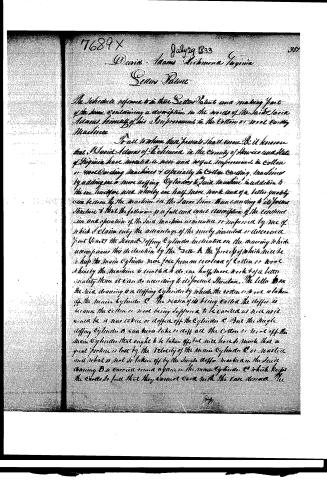 Page 2
-
 Page 3


U.S. Patent and Trademark Office · Google Patents
Show the transcription Hide (658 words)
Machine transcription (LightOnOCR) of the pages as scanned by the USPTO, most of them the handwritten copies made when the records were restored after the 1836 fire. Not checked; it can misread handwriting, so compare it with the scan.
Page 1.
7689X
D. Adams.
Carding Mach.
Patented Jul. 29, 1833.
No.

Page 2.
7689 X
July 29, 1833
David Adams Richmond Virginia
Seton Patent
The Schedule referred to in this Seton Patent and making part of the same, containing a description in the words of the said David Adams himself of his Improvement in the Cotton or Wool Carding Machine.
To all to whom these presents shall come: Be it known that David Adams of Richmond in the County of Henrico and State of Virginia have invented a new and useful Improvement in Cotton or Wool Carding Machines & especially in Cotton Carding Machines by adding one or more Offsetting Cylinders to said Machine in addition to the one heretofore used whereby one half more work and of a better quality can be done by the Machine in the same time than according to its present Structure & that the following is a full and exact description of the construction and operation of the said Machine as invented or improved by me of which I claim only the advantage of the newly invented or discovered part.
Now the second Offsetting Cylinder indicated on the drawing which accompanies this declaration by the Letter A the purpose of which will be to keep the main Cylinder more free from an overload of Cotton or Wool whereby the Machine is enabled to do one half more work & of a better quality than it can do according to its present Structure. The letter B on the said drawing is a Offsetting Cylinder by which the cotton or Wool is taken off the main Cylinder C. The reason of its being called the Offsetting is because the Cotton or Wool being supposed to be carried as well as it would be a new taken or Offsetting off the Cylinder C. But the single Offsetting Cylinder D can been taken or Offsetting all the Cotton or Wool off the main Cylinder that ought to be taken off but will have so much that a great portion is lost by the Velocity of the main Cylinder C or rather and what is not so taken off by the single Offsetting Marked on the said drawing D is carried round again on the main Cylinder C which keeps the Cards so full that they cannot work with the ease desired. The
Page 4
Page 3.
17689Y
The invention of this declaration is the addition of a second doffing cylinder indicated and marked on the drawing which accompanies the declaration by the letter A which catches and collects a sheet of Cotton or Wool indicated on the same drawing by the letter C and which being taken off at that particular point is the best part of the Carcass that can be made. Before the said invention of the said second doffing the sheet of Cotton C was on the main cylinder and could not be taken off in the ordinary way of Carding. The upper doffing B does as much work with the lower doffing A as it did before its addition and what is done by the lower doffing A is exactly so much additional work done by the machine.
The advantages to be derived from the use of the additional doffing are that a Carding, Wool or Cotton Machine will do twice as much work with it as it will without it—the work will be much better done there will be much less flying or waste and it will require but a trifle more power to drive the machine.
In testimony whereof I have hereunto set my hand and affixed my seal this 20th day of March 1832
Lucius James.
Witnesses
Jno Stone
Robert G Scott
For in portfolio
[660 m-5]
Published accounts: journal notice
Notice in the monthly list of patents, with remarks
Journal of the Franklin Institute, new ser., vol. 13 (1834), p. 39 · View the page
33. For an improvement in the Cotton and Wool Carding Machine; David Adams, Richmond, Henrico county, Virginia, July 29.
Remarks. The invention here claimed is the application of a second doffing cylinder to the carding machine, by which, it is said, one half more work can be done, than by a single doffing cylinder; that the work is better done, and with but little additional application of power. The single doffing cylinder, it is remarked, does not clear the main cylinder sufficiently, but leaves it much clogged with the carded fibre. The whole claim consists in the application of this second cylinder, with the requisite gearing to put it in action. How many patents have been taken for using two doffing cylinders, we cannot say, nor is it necessary to take the trouble to ascertain it, one being as effectual as twenty, in proving that the thing is not new. We, however, could refer to four or five, one of which was patented in 1810. We had supposed the use of them to be known to every man extensively engaged in carding and spinning, and particularly to those in the woollen business. In the specification before us, cotton and wool are both mentioned, but we have heard that it was the design of the patentee to confine himself to its application in the cotton carding machine, under an idea that this new application, as he supposed it to be, would enable him to sustain a claim to a patent. This, however, cannot be done; it having been decided in court that the application of an old machine to a new purpose, is not a proper subject for a patent.
About this record
- Patentee
- DATAMP
- Date
- the Name and Date index of patents, DATAMP, USPTO records
- Invention
- DATAMP
- Listed in
- the Name and Date index of patents, DATAMP, USPTO records, Jim Shaw's X-patent list, the Journal of the Franklin Institute, Burke's List of Patents (1847)
- Burke's 1847 Patent Office list gives the same patent.