

Drawings and documents
USPTO scan
The patent as scanned by the USPTO
-
 Page 1
-
 Page 2
-
 Page 3


U.S. Patent and Trademark Office · Google Patents
Show the transcription Hide (669 words)
Machine transcription (LightOnOCR) of the pages as scanned by the USPTO, most of them the handwritten copies made when the records were restored after the 1836 fire. Not checked; it can misread handwriting, so compare it with the scan.
Page 1.
CLASSIFICATION
7767-X
DIVISION
L. Gale & P. H. Curtis's
Washing Machine. 9-12-1833 Vol. 16, p. 371
Patented: 17th Sept. 1833.
References.
a. Frame.
b. Concave.
c. Hanger.
d. Bolts.
e. Cylinder.
f. Arbor.
g. Box.
h. Pulley.
i. Hopper.
k. Dust board.
113. Caps of cylinders removed.
Longitudinal Section.
Patent Office. 11 Sept. 1839.
Made under the direction of the Commissioner of Patents,
in conformity with Act. 3d. March 1837.
Comm. of Patents.
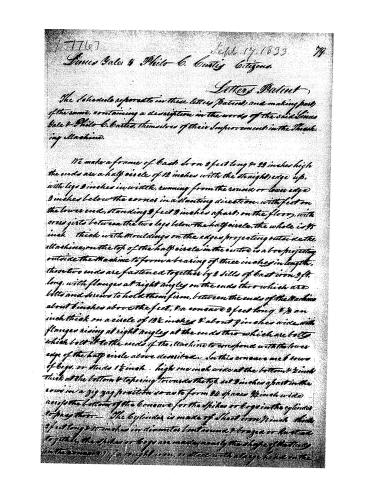
Page 2.
Sept. 17, 1833
James Gale & Philo C. Curtis, Citizens.
Letters Patent
The schedule referred to in these letters Patent, and making part of the same, containing a description in the words of the said James Gale & Philo C. Curtis, themselves of their Improvement in the Threshing Machine.
We make a frame of cast iron 3 feet long & 22 inches high, the ends are a half circle of 12 inches with the straight edge up, with legs 3 inches in width, running from the round or lower edge 3 inches below the corners in a slanting direction, with feet on the lower end, standing 3 feet 3 inches apart on the floor, with cross girts between the two legs below the half circle, the whole is 1/8 inch thick with mouldings on the edges projecting outside the machine, on the top of the half circle in the center is a box projecting outside the machine to form a bearing of three inches in length, these two ends are fastened together by 2 sills of cast iron 3 ft. long, with flanges at right angles on the ends thro which are bolts and screws to hold them firm, between the ends of the machine about 6 inches above the feet, is a concave 3 feet long & 1/2 an inch thick on a circle of 13 1/2 inches & about 7 inches wide, with flanges rising at right angles at the ends thro which are bolts which bolt it to the ends of the machine to correspond with the lower edge of the half circle above described. In this concave are 6 rows of bogs, or studs 1 1/2 inch high one inch wide at the bottom & 2 inch thick at the bottom & tapering towards the top, set 3 inches apart in the rows in a zig zag position so as to form 24 spaces 1/2 inch wide across the bottom of the concave for the spikes or bogs in the cylinder to pass thro. The cylinder is made of sheet iron 1/8 inch thick 3 feet long & 10 inches in diameter but round & hinged or hinged together, the spikes or bogs are made nearly the shape of that in the concave of wrought iron, milled with a large head on the
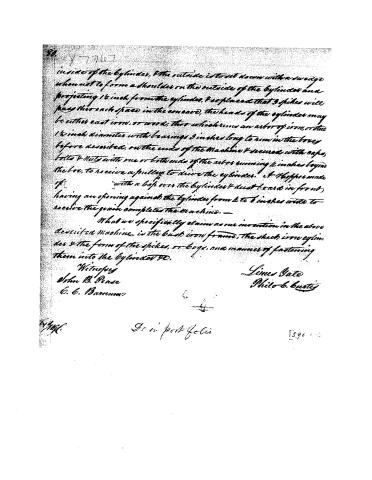
Page 3.
inside of the cylinder, & the outside is to set down with a swedge when not to form a shoulder on the outside of the cylinder and projecting 1½ inch from the cylinder, & so placed that 3 spikes will pass thru each space in the one and, the heads of the cylinder may be either cast iron, or wood, thru which runs an arbor of iron, or steel 1½ inch diameter with bearings 3 inches long to run in the boxes before described, on the ends of the Machine & secured with caps, bolts & Nuts with one or both ends of the arbor running 2 inches beyond the box, to receive a pulley to drive the cylinder. & the hopper made with a box over the cylinder & dust board in front, having an opening against the cylinder from 4 to 6 inches wide to receive the grain completes the machine.
What we specifically claim as our invention in the above described Machine, is the cast iron frame, the sheet iron cylinder & the form of the spikes, or boya, and manner of fastening them into the cylinder &c.
Witnesses
John B. Pease
C. C. Barrum
Limes Gale
Philo C. Burt
In n' port folio
[590]
About this record
- Patentee
- DATAMP
- Date
- the Name and Date index of patents, DATAMP
- Invention
- DATAMP
- Listed in
- the Name and Date index of patents, DATAMP, USPTO records, Jim Shaw's X-patent list, Burke's List of Patents (1847)
- The sources give different dates; the date shown is the one most of them agree on.
- Burke's 1847 Patent Office list gives the same patent.