

Drawings and documents
USPTO scan
The patent as scanned by the USPTO
-
 Page 1
-
 Page 2
-
 Page 3
-
 Page 4
-
 Page 5
-
 Page 6
-
 Page 7


U.S. Patent and Trademark Office · Google Patents
Show the transcription Hide (1,762 words)
Machine transcription (LightOnOCR) of the pages as scanned by the USPTO, most of them the handwritten copies made when the records were restored after the 1836 fire. Not checked; it can misread handwriting, so compare it with the scan.
Page 1.
7777X
L. Kidder,
Street Sweeper.
Patented Sep. 20, 1833.
Sheet 1-2, Sheets.
Page 2.
7777X
L. Kidder
Street Sweeper,
Patented Sep. 20, 1833.
Sheet 2-2 Sheets.
Page 3.
Sept 20, 1833
Leroi Widdow of New York City
Letters Patent
The schedules referred to in the Letters Patent and making part of the same containing a description in the words of the said Leroi Widdow himself of his improvement being a Machine for sweeping Streets and at the same time removing the dirt.
To all to whom these presents shall come, Be it known that Leroi Widdow of the City, County and State of New York have invented a new and useful improvement in a machine for sweeping streets and at the same time removing the dirt, and that the following is a full and exact description of the construction and operation of said Machine as invented by me.
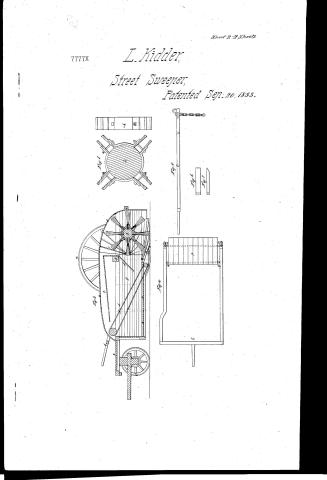
1st. It consists of a wagon the hind wheels of which being high for the purpose of giving elevation to the body or dirt receiver, are fastened to an iron axle which turns with them. The fore wheels are proportionably low and having a short axle they work beneath the frame or beams of the wagon. This arrangement of the fore wheels is designed to admit the wagon to make short turns. Upon the axles of these wheels rests the wagon frame much in the manner of other wagons, but unlike them, the receiver is built under instead of above the beams, bringing it near the ground thereby requiring only a small elevation for the dirt to be raised; for this purpose the receiver is framed into the side beams on the under side between the fore and hind axles as near the latter as other parts of the machine will allow; and at such distance from the frame as will admit the fore wheels in turning to pass without interfering. The bottom of the receiver is constructed of several loose doors, fitting the spaces between the cross beams of it. These doors are combined for the purpose of discharging the receiver when loaded, the bottom being far enough from the ground to assure this design. The hind board inclines forward forming an angle of about 45 degrees making an inclined plane.
Page 4.
The side boards extend beyond the rear of the carriage in rear of the hind axle as far as the shaft of the broom will admit, said broom to be hereafter described.
2nd. A revolving cylindrical broom resembling a water wheel and consisting of eight or any convenient number of combs of brush to one corner or any suitable substance made by weaving together the bristles with cord or other means and fastening them to the broom shaft by placing them between beveled or wedge shaped beams or plates, which beams are fastened to the shaft by bolts, which are fixed to collars on the shaft and passing through the beams, have on their upper ends screws on which nuts work forcing the beams to the centre and firmly wedging the combs.
There are other ways of making the broom as by confining the side bristles of the brush between the clamps by many bolts and fastening them to iron heads fixed on the shaft near the ends.
This broom is placed in a frame made of two strong arms, fastened at their ends by cross pieces of sufficient length to admit the combs between the arms. The frame with the broom parallel to the hind axle and as near to it as will admit is attached to the wagon by fastening one end of each arm to the axle between the beam and nave by means of a hinge box hinged for the purpose of admitting the broom to be detached from the wagon at pleasure, and the same time admitting the arms to rise or fall at the opposite ends, which arrangement allows the broom to be elevated or depressed so as to press lightly or heavily upon the streets, or be raised from them entirely as circumstances may require. And this is done by levers (it may be done by pulleys or other power) which levers one to each arm are fixed to the side wagon beams on the side by a kind of bolts which answer the fulcrum placed a little in the rear of the hind axle. The short ends of the levers with a caster on each work upon the under side of the broom arms. The long ends extend along the
Page 5.
sides of the wagon as far as the front of the receiver and are fastened by a cross piece into which is framed a broom or handle and with this handle the driver who stands upon a platform in front of the receiver controls the broom; on one end of the broom shaft outside of the arm is a pinion which into which works a cog wheel that is fastened upon and turns with the hand wagon axle by which a like motion is given to the broom reverse to the motion of the wagon which from which the power is communicated. The broom making about three revolutions to one of the wagon wheels. Similar gearing if necessary may be attached to both ends of the broom, or the same motion may be given to it by means of rope bands or similar contrivances.
3. An inclined plane or drag which is made in sections of many pieces of wood or any suitable substance; the sections about the dimensions of two and a half feet long two inches thick and three inches wide, all jointed and having the ends designed to drag on the ground beveled on the underside to nearly sharpness, and the other ends being perforated the sections are placed on an iron rod in such numbers as will together make a plane as wide as the broom is long, and are designed to work on the rod as a common center of motion adapting themselves to the inequalities of the ground or pavement, any part of them rising or falling without moving any of the others. The drag is placed under the fore part of the broom, the other end is fastened by the above named rod to the side boards of the receiver just over the lower end of the plane made by the hand board, thus made by the hand board thus making from the ground under the broom to the top of the receiver a continued plane which is designed as a way or passage for the dead. As an inclined plane is made from the drag by a moving upon working round a roller placed just under the upper end of the drag and round another roller fixed on two posts raised above the top of the receiver on the side beams. These rollers and
Page 6.
consequently the apron are turned by a band passing over a wheel on the end of the cylinder, and over another wheel on the kind axle where it receives its motion. The motion of the broom in turning sweeps the ground or pavement, and carrying the dirt along with it on the drag sweeps a large portion of that also and gives, the dirt, an impulse which carries it beyond the drag up the inclined plane of the kind board into the receiver, or it carries the dirt on to the apron (or other elevator) which turning carries itself into the receiver. Thus sweeping and taking up the dirt at the same time.
The operation of taking up the dirt is greatly assisted by the air which is formed into a strong current by the motion of the broom which acts as a fanning mill, and for this purpose a channel is made from the broom by connecting the extreme sections of the drag with the sides of the receiver by means of a gore of leather or other matter, and making a covering from the broom over the drag, and the receiver, the broom is also covered. But that the air may pass from the receiver without producing dust in sweeping, a kind of flue is made conducting the air which is driven a part of the top of the receiver through an opening for that purpose near the front back over the receiver cover to the broom thus forming a continued circuit.
Across the under side of the drag runs an iron rod fastened to the extreme sections, which rod is confined by a small chain to the lever above described in such a manner as to raise the drag from the ground with the broom at pleasure, as when it is not necessary to sweep.
The whole machine is to be worked by horse or other power the receiver being filled with dirt the broom is detached by means of the lever box above mentioned and placed on another wagon while the loaded one is taken away to be discharged. What I claim as my invention is the adaptation of the cylindrical revolving broom to the purpose of sweeping.
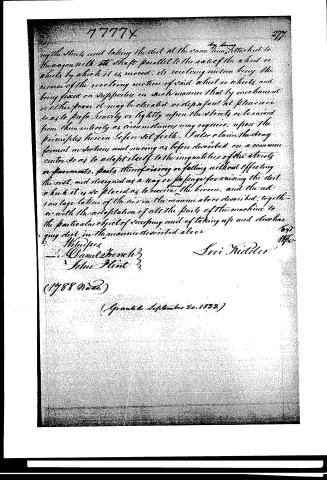
Page 7.
ing the streets, and taking the dirt at the same time, attached to the wagon with its shafts parallel to the axes of the wheel or wheels by which it is moved, its revolving motion being the cause of the revolving motion of said wheel or wheels, and being fixed on supports in such manner that by mechanical or other power it may be elevated or depressed at pleasure so as to press heavily or lightly upon the streets or be raised from them entirely as circumstances may require, upon the principles herein before set forth. I also claim the drag formed in section and moving as before described on a common center so as to adapt itself to the inequalities of the streets or pavements, parts therefor rising or falling without affecting the rest, and designed as a wagon or passage for raising the dirt which it is so placed as to receive the broom, and the advantage taken of the air in the manner above described, together with the adaptation of all the parts of the machine to the particular object of sweeping and of taking up and discharging dirt in the manner described above.
Witnesses:
Daniel Brench
John Flint
Leri Kiedler
(1788 Words)
(Granted September 20, 1833.)
Published accounts: journal notice
Notice in the monthly list of patents, with remarks
Journal of the Franklin Institute, new ser., vol. 13 (1834), p. 257 · View the page
46. For a Machine for Sweeping and removing the Dirt from Streets; Levi Kidder, city of New York, September 20.
Remarks. It was intended to publish the specification of this patent in the present number, but it is mislaid. When found it is probable that we shall present it to our readers. The machine was designed for the use of the city of New York, and it was anticipated that it would produce a great saving in the business to which it was to be applied. We have not heard the result of the trial in the large way. A cylindrical broom was to operate by means of the wheels of the machine, which was to be drawn on like a cart. This, and the receptacle for the dirt, were securely covered, the whole being managed in a manner that manifested much ingenuity. There are many difficulties, however, in the way of the successful operation of such a machine; among these may be mentioned deep holes, and other inequalities in the pavement of a city, against which it must be nearly, if not altogether, impossible to provide; others, equally formidable, might be mentioned, and we shall be glad to see that this machine has met with and conquered them.
About this record
- Patentee
- DATAMP
- Date
- the Name and Date index of patents, DATAMP, USPTO records
- Invention
- DATAMP
- Listed in
- the Name and Date index of patents, DATAMP, USPTO records, Jim Shaw's X-patent list, the Journal of the Franklin Institute, Burke's List of Patents (1847)
- Burke's 1847 Patent Office list gives the same patent.