

Drawings and documents
USPTO scan
The patent as scanned by the USPTO
-
 Page 1
-
 Page 2
-
 Page 3


U.S. Patent and Trademark Office · Google Patents
Show the transcription Hide (765 words)
Machine transcription (LightOnOCR) of the pages as scanned by the USPTO, most of them the handwritten copies made when the records were restored after the 1836 fire. Not checked; it can misread handwriting, so compare it with the scan.
Page 1.
254-279
OR X 7.785
SR
7785X E. C. BELLINGER
Steam-Flow.
Patented Nov. 19, 1833
Page 2.
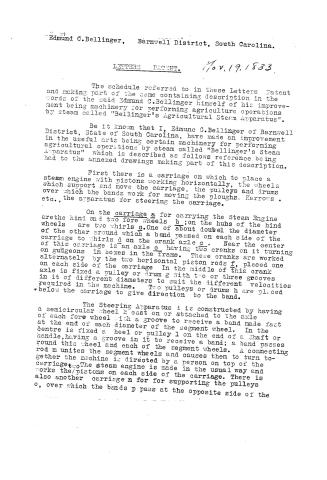
Edmund C. Bellinger, Barnwell District, South Carolina.
LETTERS PATENT. Nov. 19, 1833.
The schedule referred to in these Letters Patent and making part of the same containing description in the words of the said Edmund C. Bellinger himself of his improvement being machinery for performing agriculture operations by steam called "Bellinger's Agricultural Steam Apparatus".
Be it known that I, Edmund C. Bellinger of Barnwell District, State of South Carolina, have made an improvement in the useful arts being certain machinery for performing agricultural operations by steam called "Bellinger's Steam Apparatus" which is described as follows reference being had to the annexed drawings making part of this description.
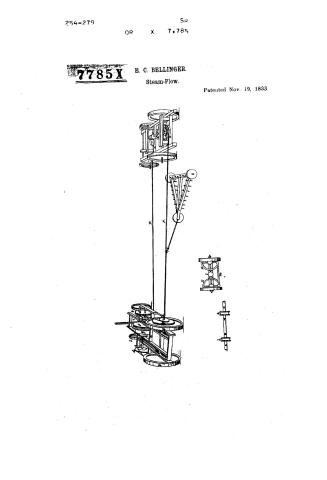
First there is a carriage on which to place a steam engine with pistons working horizontally, the wheels which support and move the carriage, the pulleys and drums over which the bands work for moving the ploughs. Harrows etc., the apparatus for steering the carriage.
On the carriage a for carrying the Steam Engine are the hind and two fore wheels b; on the hubs of the hind wheels are two whirls c. One of about double the diameter of the other around which a band passed on each side of the carriage to whirls d on the crank axle e. Near the center of this carriage is an axle e having two cranks on it turning on gudgeons in boxes in the frame. These cranks are worked alternately by the two horizontal piston rods f, placed one on each side of the carriage. In the middle of this crank axle is fixed a pulley or drum g with two or three grooves in it of different diameters to suit the different velocities required in the machine. Two pulleys or drums h are placed below the carriage to give direction to the band.
The Steering Apparatus i is constructed by having a semicircular wheel k cast on or attached to the axle of each fore wheel with a groove to receive a band made fast at the end of each diameter of the segment wheel. In the centre is fixed a heel or pulley l on the end of a Shaft or handle, having a groove in it to receive a band; a band passes round this wheel and each of the segment wheels. A connecting rod m unites the segment wheels and causes them to turn together the machine is directed by a person on top of the carriage. The steam engine is made in the usual way and works the pistons on each side of the carriage. There is also another carriage n for for supporting the pulleys o, over which the bands p pass at the opposite side of the
Page 3.
-2-
piece of ground required to be ploughed, harrowed, moved, rolled etc., a mitre or crown wheel q is fixed on one of the pulleys, an axle r with a fall wheel s working into it and an endless screw t fixed on the same axle and working into a cog wheel n fixed on the axle of the two hind wheels of the carriage; the two fore wheels serve to support the front of the carriage and aid in turning it.
OPERATION: the two carriages being placed in the field parallel to each other and the band passed round the several wheels or pulleys before described, the plows, harrows or instruments being attached to the band and the Steam Engine put in motion gives motion to the band with the instruments attached thereto performing the required operation. When one ridge of land is operated on both the carriages are moved forward and parallel and another ridge worked and so till the whole field is acted on.
The invention here claimed and required to be secured by Letters Patent consists in the peculiar construction of the before described agricultural steam apparatus with the arrangement of the several parts particularly the mode of carrying the machinery by a revolving bandworking over pulleys etc., placed on carriages parallel to each other on the opposite sides of the field for ploughing, harrowing, planting mowing etc., by the agency of steam. Done at the City of Washington, this 1st day of November 1837.
Witnesses
William P. Elliott,
Samuel P. Walker,
Edmund C. Bellinger,
Published accounts: journal notice
Notice in the monthly list of patents, with remarks
Journal of the Franklin Institute, new ser., vol. 13 (1834), p. 258 · View the page
1. For an Agricultural Steam Apparatus; Edmund C. Bellinger, Barnwell District, South Carolina, November 19.
Remarks. It has been repeatedly prophesied that the day would arrive when our farmers would plough their fields, and perform many other agricultural operations, by steam; and those wights who have supposed themselves inspired upon this subject will probably find "confirmation strong," in the title of the above named patent; it will be well, however, for them to recollect that "all signs fail in dry times," and that the weather-wise are then liable to find themselves deceived. It is one thing to take out a patent, and another to carry the thing patented into successful operation. Were we to begin to furnish exemplifications of this truth, we should not know where to stop, and shall therefore leave it to every one to supply his own proofs, which he may readily do by a moderate tax upon his recollection. In the plan before us there are to be two carriages, placed parallel to each other on opposite sides of the field to be ploughed, harrowed, rolled, sowed, or mowed; one of these carriages is to be furnished with a steam engine, having two cylinders placed horizontally, by which are to be turned drums, or whirls, that carry an endless band, crossing the field, and passing round pulleys on the opposite carriage. To this band the agricultural instruments are to be attached, and when one furrow has been ploughed, the two carriages are to be advanced a few inches, and the operation repeated. In one point of view, at least, we think this a most admirable contrivance; as it will not only furnish much business for our operatives * For a period of two months, including a part of September, and November, there were no patents issued, in consequence of a vacancy in the office of Attorney General. should the apparatus go into general use among the agriculturists, but it will give to the farmers the means of employing all those whom the pressure of the times have thrown out of work; as, to tend the said engines, to supply the fuel, guide the plough, and perform every other operation incident to cultivating the ground upon this improved plan, will demand three or four times as many hands as are necessary in the practice of the old mode; and not only will it require more hands, but more horses too, so that those thrown out of use by rail-roads and locomotives, will sell well to the farmer; and as one branch of trade begets another, he, in his turn, will have to raise more grain, as he will have an increased home demand for its consumption. This is a fertile subject, but as we have other patentees waiting our respects, we must, with these few hints, leave the prosecution of it to others.
About this record
- Patentee
- DATAMP
- Date
- the Name and Date index of patents, DATAMP, USPTO records
- Invention
- DATAMP
- Listed in
- the Name and Date index of patents, DATAMP, USPTO records, Jim Shaw's X-patent list, the Journal of the Franklin Institute, Burke's List of Patents (1847)
- Burke's 1847 Patent Office list gives the same patent.