

Drawings and documents
USPTO scan
The patent as scanned by the USPTO
-
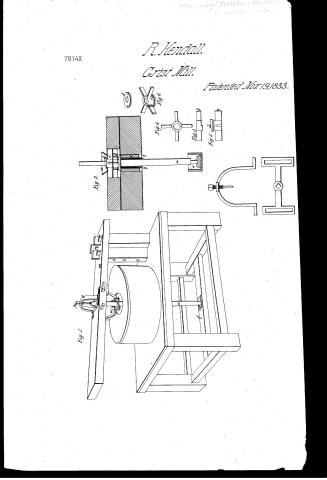 Page 1
-
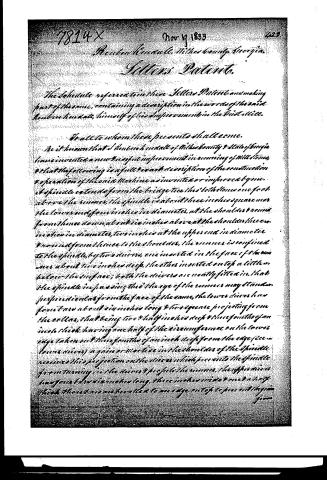 Page 2
-
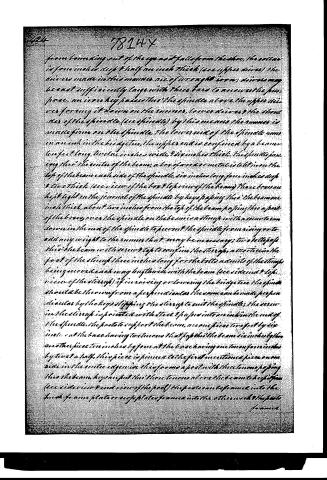 Page 3
-
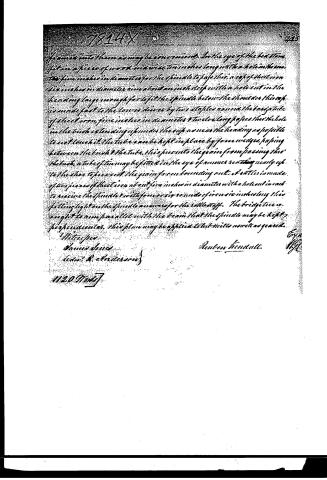 Page 4


U.S. Patent and Trademark Office · Google Patents
Show the transcription Hide (1,116 words)
Machine transcription (LightOnOCR) of the pages as scanned by the USPTO, most of them the handwritten copies made when the records were restored after the 1836 fire. Not checked; it can misread handwriting, so compare it with the scan.
Page 1.
7814X
R. Kendall.
Grist Mill.
Patented Nov. 19, 1833.
Fig. 1
Fig. 2
Fig. 3
Fig. 4
Fig. 5
Fig. 6
Page 2.
7814 X Nov 9 1833 429
Beauben Bendale, Wilkes county, Georgia.
Letters Patent.
The Schedules referred to in these Letters Patent and making part of the same, containing a description in the words of the said Beauben Bendale, himself of his improvement in the Vint Mill.
To all to whom these presents shall come.
Be it known that I Beauben Bendale of Wilkes county & State of Georgia have invented a new & useful improvement in running of Mill Stones, & that the following is a full & exact description of the construction & operation of the said Machine as invented or improved by me.
A Spindle extends from the bridge to the Mill Stones one foot above the summer, the Spindle is about three inches square near the lower end & four inches in diameter at the shoulders & round from there down about six inches above at the shoulders three inches in diameter, two inches at the upper end in diameter & round from there to the shoulders, the rimmer is confined to the Spindle by two diviers, one inserted in the face of the summer about two inches deep, the other inserted on top a little below the surface; both the diviers are neatly fitted in, that the Spindle in passing thru the eye of the rimmer may stand perpendicular from the face of the summer, the lower divier has four bars about six inches long & two square projecting from the collar, that being two & half inches deep & three fourths of an inch thick, having one half of the circumference on the lower edge taken out three fourths of an inch deep from the edge (see lower divier) a gain or Mortise in the shoulders of the Spindle receives this projection on the divier which prevents the Spindle from turning in the diviers & projects the rimmer, the upper divier has four bars six inches long, three inches wide & one & half thick, three & two inches wide to an edge on top to prevent the grain from
Page 3.
from bending out of the eye as it falls from the shoe, the collar is four inches deep & half an inch thick (see upper view) the rivets made in this manner one of wrought iron, rivets may be cast sufficiently large with three bars to answer the purpose, an iron key passes thru the spindle above the upper rivet forming it down on the runner, lower rivet & the shoulder of the spindle (see spindle) by this means the runner is made firm on the spindle, the lower end of the spindle runs in an ink in the bridge tee, the upper end is confined by a beam ten feet long, twelve inches wide, & six inches thick, the spindle passing thru the center of the beam, a box of iron or metal is bolted in on the top of the beam each side of the spindle, six inches long, four inches deep & two thick (see view of the box & top view of the beam) there is no kept light on the journal of the spindle by keys passing thru the beam one inch thick, about two inches from the top of the beam passing thru a part of the box over the spindle on the beam is a strap with a nut to run down in the end of the spindle to prevent the spindle from rising or to add any weight to the runner that may be necessary; two bolts pass thru the beam with a screw top to confine the strap, a mortise in the foot of the strap three inches long for the bolts admits of the strap being moved each way lengthwise with the beam (see side and top view of the strap) if in raising or lowering the bridge tee the spindle should be thrown from a perpendicular as the runner can be made perpendicular by the keys slipping the strap to suit the spindle; the screw in the strap is pointed with steel & passes into an ink in the end of the spindle, the posts to support the beam, are one piece ten feet by six inches at the base having two tenons that fasten the beam six inches from another piece ten inches by four at the base having one tenon four inches by two & a half, this piece is pinned to the first mentioned piece on one side in the center edge in this forms a post with three beams passing thru the beam, keys are put thru three tenons above the beam to keep firm (see side view & end view of the post) the posts can be framed into the head frame plates or one plate framed into the other work & the posts framed.
Page 4.
framed into them as may be convenient. In the eye of the bed stone fit in a piece of wood not wide ten inches long with a hole in the center five inches in diameter for the spindle to pass thru; a cap of sheet iron six inches in diameter nine or ten inches deep with a hole cut in the heading large enough for to fit the spindle below the stone as this cap is made fast to the lower stone by two staples across the base; a tube of sheet iron, five inches in diameter & twelve long passes thru the hole in the bed extending up under the cap as near the heading as possible to not touch it. The tube can be kept in place by some wedges, hinging between the bed & the tube. This prevents the grain from passing thru the bed; a tube of tin may be fitted in the eye of runner resting nearly up to the shoe to prevent the grain from breaking out. A cutter is made of two pieces of sheet iron about five inches in diameter with a hole cut in each to receive the spindle with four or six rounds of iron six inches long this fitting tight on the spindle as near as for the cutter staff. The bridge tree is sought to run parallel with the beam that the spindle may be kept perpendicular. This plan may be applied to flat mills as well as geared.
Witnesses
James Jones
John R. Anderson
Robert Kendall.
Published accounts: journal notice
Notice in the monthly list of patents
Journal of the Franklin Institute, new ser., vol. 13 (1834), p. 317 · View the page
38. For an improvement in the Running of Mill Stones; Reuben Kendall, Wilkes county, Georgia, November 19.
About this record
- Patentee
- DATAMP
- Date
- the Name and Date index of patents, DATAMP, USPTO records
- Invention
- DATAMP
- Listed in
- the Name and Date index of patents, DATAMP, USPTO records, Jim Shaw's X-patent list, the Journal of the Franklin Institute, Burke's List of Patents (1847)
- Burke's 1847 Patent Office list gives the same patent.