

Drawings and documents
USPTO scan
The patent as scanned by the USPTO
-
 Page 1
-
 Page 2
-
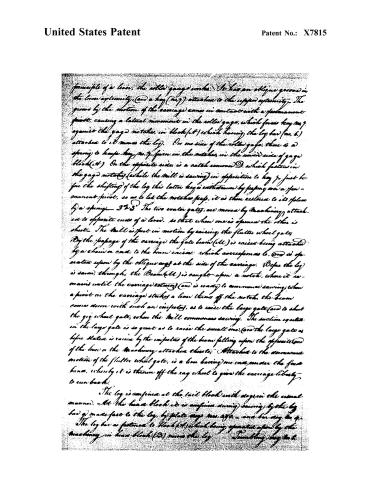 Page 3
-
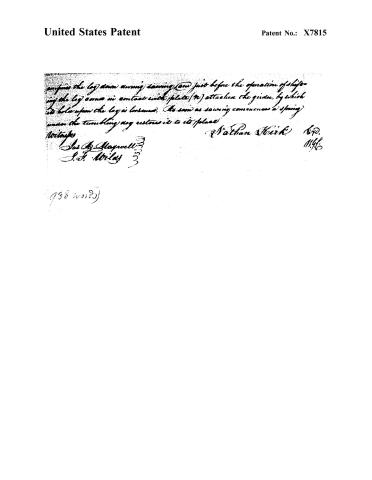 Page 4


U.S. Patent and Trademark Office · Google Patents
Show the transcription Hide (934 words)
Machine transcription (LightOnOCR) of the pages as scanned by the USPTO, most of them the handwritten copies made when the records were restored after the 1836 fire. Not checked; it can misread handwriting, so compare it with the scan.
Page 2.
United States Patent
Patent No.: X7815
Nathan Stirk
Letter Patent
The Schedule referred to in this Letter Patent (and making part of the same) containing a description in the words of the said Nathan Stirk, himself of his improvement in
To all to whom these Presents shall come—
Be it known that I Nathan Stirk of the county of Clinton and State of Indiana have invented a new and useful improvement in the construction and principle of common saw mills and that the following is an exact description of the construction and operation of said machine as invented and improved by me. The invention consists in the improvement of common saw-mills, so that by the mere operation of machinery, boards and scantlings may be sawed to any given gauge without the assistance of human power, after the log has been slatted and properly secured. The process is to secure a log upon the carriage, having been slatted, start the mill by raising the flutter wheel gate, the log is sawn through; the same movement raises the feed arm or hand shuts the flutter wheel gate, (and raises the gig wheel gate,—the carriage is run back until the saw leaves the log when by the operation of the machinery in the head block and tail block the log is moved the width of the plank intended, the log is again secured at the head block, the gig wheel gate is shut, the flutter wheel gate is raised and the saw commences cutting again, (and so on until the whole log is sawn up, when a foot on the carriage touches a lever which stops the whole mill. The object is shown in the process or operation.
There are three principle operations of the improvement to wit:
1. The shifting of the log by means of machinery attached to the head block and tail block.
2. The working of the flutter wheel gate, and the gig wheel gate.
3. The running the carriage backwards and forwards with two last are conformable, with each other.
4. The machinery in the head and tail blocks is substantially the same one therefore will only be attempted to be described. In the middle of the head block, (and on the
Page 3.
United States Patent
Patent No.: X7815
principle of a lever, the roller gage works. It has an oblique groove in the lower extremity, (and a key (a)) attached to the upper extremity. The groove by the motion of the carriage comes in contact with a permanent point, causing a lateral movement in the roller gage, which forces key (m) against the gage notches, in block (t) which having the log bar (on. b.) attached to it moves the log. On one side of the roller gage, there is a spring to keep key (m) firm in the notches, in the under side of gage block (t). On the opposite side is a catch removed D, which fastens in the gage notches (while the mill is sawing) in opposition to key (m) just before the shifting of the log this latter key is withdrawn by passing over a permanent pivot, so as to let the notches pass, it is then restored to its place by a spring—3 & 3. The two water gates, are moved by machinery attached to opposite ends of a lever, so that when one is opened the other is shut. The mill is put in motion by raising the flutter wheel gate. By the passage of the carriage the gate beam (ell) is raised being attached by a chain or cord, to the beam carrier which corresponds to. (and is operated upon by the oblique axis at the side of the carriage. Before the log is sawn, through, the Beam (ell) is caught upon a notch, where it remains until the carriage returns (and is ready to commence sawing) when a pivot on the carriage strikes a lever throws off the notch, the beam comes down with such an impact, as to raise the large gate (and to shut the gig wheel gate, when the mill commences sawing. The section opened in the large gate is so great as to raise the small one, (and the large gate as before stated is raised by the impact of the beam falling upon the opposite end of the lever or the machinery attached thereto; Attached to the announced motion of the flutter wheel gate, is a lever having one end under the force hand, whereby it is thrown off the rag wheel to give the carriage liberty to run back.
The log is confined at the tail block with dogs in the usual manner. At the head block it is confined during sawing by the log bar (g) made fast to the log, by plate (m) on. 2 fig. — and bar (a) on. 4. The log bar is fastened to block (t) which being operated upon by the machinery in head block (B) moves the log. — (see Fig. 1)
Page 4.
United States Patent
Patent No.: X7815
engines the log down during sawing, and just before the operation of shifting the log comes in contact with plate (R) attached to the guide, by which its hold upon the log is loosened. As soon as sawing commences a spring under the tumbling dog restores it to its place.
Nathan Stirk
640.
11.46.
Witnesses
Jos. G. Maynell
S. H. Miles
(998 words)
Published accounts: journal notice
Notice in the monthly list of patents, with remarks
Journal of the Franklin Institute, new ser., vol. 13 (1834), p. 318 · View the page
40. For an improvement in the saw mill; Nathan Kirk, Frankfort, Clinton County, Indiana, November 19.
Remarks. The improvements stated to have been made consist in so arranging the machinery of a saw mill, that after a log has been slabbed, and fixed upon the carriage, it shall be sawed completely up, to timber of any gauge, without manual assistance; the raising of the feed hand, the running back of the carriage, the shifting of the head and tail blocks, and all the other changes required, taking place in regular succession. The description is too brief, the drawings are too imperfect, and the references to them too few, to enable us to form a correct judgment respecting the machinery, nor is any part of it specifically claimed.
About this record
- Patentee
- DATAMP
- Date
- the Name and Date index of patents, DATAMP, USPTO records
- Invention
- DATAMP
- Listed in
- the Name and Date index of patents, DATAMP, USPTO records, Jim Shaw's X-patent list, the Journal of the Franklin Institute, Burke's List of Patents (1847)
- Burke's 1847 Patent Office list gives the same patent.