

Drawings and documents
USPTO scan
The patent as scanned by the USPTO
-
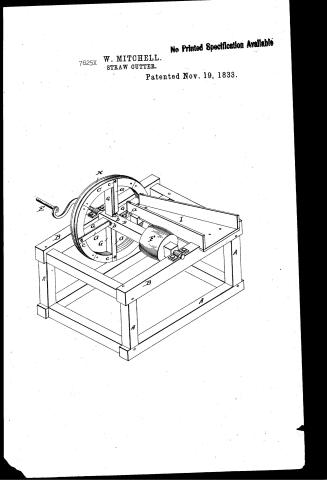 Page 1
-
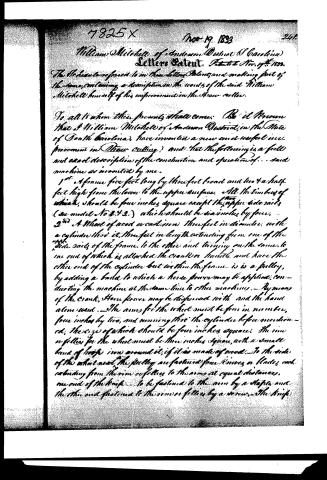 Page 2
-
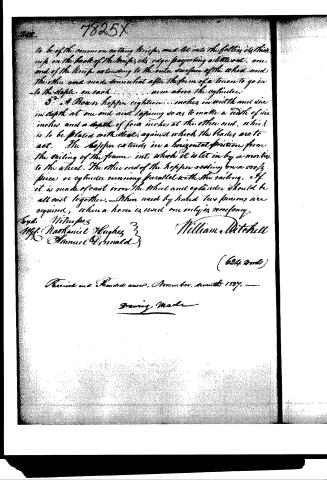 Page 3


U.S. Patent and Trademark Office · Google Patents
Show the transcription Hide (484 words)
Machine transcription (LightOnOCR) of the pages as scanned by the USPTO, most of them the handwritten copies made when the records were restored after the 1836 fire. Not checked; it can misread handwriting, so compare it with the scan.
Page 1.
7825X W. MITCHELL. No Printed Specification Available
STRAW CUTTER.
Patented Nov. 19, 1833.

Page 2.
1825 X Nov 19, 1833 241
William Mitchell, of Anderson District (S Carolina)
Letters Patent. Patented Nov. 19th 1833.
The 8th clause referred to in these Letters Patent, and making part of the same, containing a description in the words of the said William Mitchell himself of his improvement in the Straw cutter.
To all to whom these presents shall come: Be it known that I William Mitchell of Anderson District, in the State of South Carolina, have invented a new and useful improvement in Straw cutting; and that the following is a full and exact description of the construction and operation of... said machine as invented by me.
1st A frame five feet long by three feet broad and two and a half feet high from the lower to the upper surface. All the timbers of which, should be four inches square except the upper side rails (see model No 1 & 2.) which should be six inches by four.
2nd A Wheel of wood or cast iron three feet in diameter, with a cylinder thru it, three feet in length extending from one of the side rails of the frame to the other and turning on the same, to one end of which is attached the crank or handle and have the other end of the cylinder but within the frame is is a pulley, by adding a band to which a horse power may be applied, conducting the machine at the same time to other machines. By means of the crank, Horse power may be dispensed with and the hand alone used. The arms for the wheel must be four in number, four inches by two, and running thru the cylinder before mentioned, the size of which should be four inches square. The inner feller for the wheel must be three inches square, with a small band of hoop iron around it, if it is made of wood. To the side of the wheel next the pulley are fastened four knives or blades, each extending from the inner feller to the arms at equal distances, one end of the knife... to be fastened to the arm by a staple and the other end fastened to the inner feller by a screw. The knife
Page 3.
to be of the common cutting knife, and let into the folliis its thick rips on the back of the knife, its edge projecting a little out, one end of the knife extending to the outer surface of the wheel and the other end made somewhat after the form of a tenon to go in to the depth on each . . . . . . . . …
Published accounts: journal notice
Notice in the monthly list of patents, with remarks
Journal of the Franklin Institute, new ser., vol. 13 (1834), p. 315 · View the page
35. For a Machine for Cutting Straw; William Mitchell, Anderson District, South Carolina, November 19.
Remarks. A straw cutting machine operating in the same way with this, only better arranged, has been in use for half a century; should the patent now taken not be sustainable on the score of novelty, extensive and long tried utility may at all events be pleaded in its favour. A heavy wheel is to be made to revolve vertically, and is to carry knives, or cutters, extending from its centre to its periphery, and the straw to be cut is fed up to the knives in a horizontal trough. In all the cyclopedias, encyclopedias, and works on agriculture which have appeared during the last age, there are representations of M'Dougal's machines for cutting straw, operating on the foregoing principle; and if that before us is an improvement, this term must be employed under a very different acceptation to that which we have been in the habit of ascribing to it.
About this record
- Patentee
- DATAMP
- Date
- the Name and Date index of patents, DATAMP, USPTO records
- Invention
- DATAMP
- Listed in
- the Name and Date index of patents, DATAMP, USPTO records, Jim Shaw's X-patent list, the Journal of the Franklin Institute, Burke's List of Patents (1847)
- Burke's 1847 Patent Office list gives the same patent.