

Drawings and documents
USPTO scan
The patent as scanned by the USPTO
-
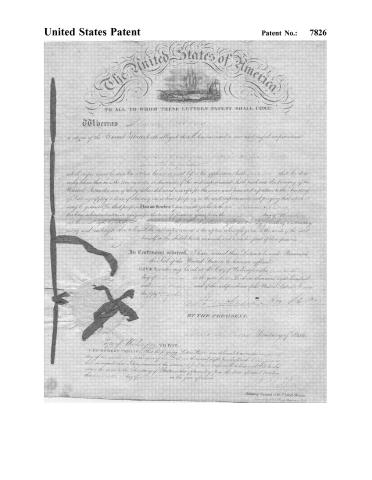 Page 1
-
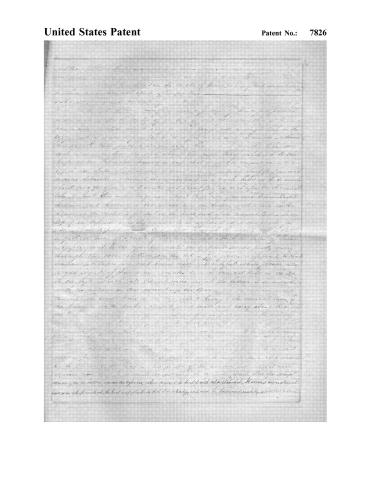 Page 2
-
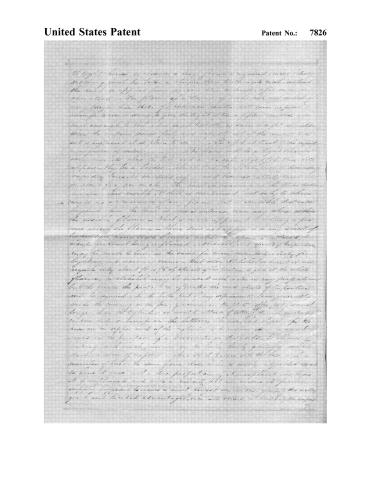 Page 3
-
 Page 4
-
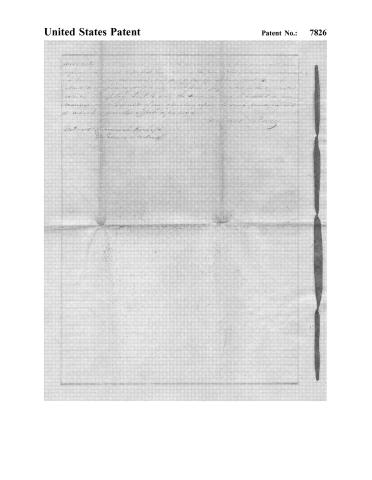 Page 5


U.S. Patent and Trademark Office · Google Patents
Show the transcription Hide (392 words)
Machine transcription (LightOnOCR) of the pages as scanned by the USPTO, most of them the handwritten copies made when the records were restored after the 1836 fire. Not checked; it can misread handwriting, so compare it with the scan.
Page 1.
United States Patent
Patent No.: 7826
The United States of America
TO ALL TO WHOM THESE LETTERS PATENT SHALL COME:
William S. H. H.
a citizen of the United States, who alleged that he has invented a new and useful improvement
which requires to be described in the body of this patent, but which is not fully described herein, but is to be taken as the true and correct description of the said improvement, had filed with the Secretary of the United States the form of the patent and a receipt for the same, and presented a petition to the Secretary of State, praying a decree of allowing him to have priority in the said improvement and praying that the same may be granted to him for the term of fourteen years from the day of the date of the patent, and praying that the same may be granted to him for the term of fourteen years from the day of the date of the patent, and praying that the same may be granted to him for the term of fourteen years from the day of the date of the patent.
In Witness whereof, I have caused these Letters Patent to be made and issued under the Seal of the United States, to be hereunto affixed.
GIVEN under my hand at the City of Washington, the day of , in the year of our Lord one thousand eight hundred and .
BY THE PRESIDENT.
TO WIT:
I DO HEREBY CERTIFY that the foregoing Letters Patent were delivered to me on the day of , in the year of our Lord one thousand eight hundred and , and that I have examined the same and found them to be in proper form and content, and have caused the same to be issued under the Seal of the United States, to be hereunto affixed.
Witness my hand at the City of Washington, the day of , in the year of our Lord one thousand eight hundred and .
Page 2.
United States Patent
Patent No.: 7826
Page 3.
United States Patent
Patent No.: 7826
Page 4.
United States Patent
Patent No.: 7826
Page 5.
United States Patent
Patent No.: 7826
Published accounts: specification
Specification printed in the Journal of the Franklin Institute
Journal of the Franklin Institute, new ser., vol. 13 (1834), p. 331 · View the page
Text of the specification as printed in the Journal, from OCR; not proofread.
Specification of a patent for a Lamp, or Apparatus for Producing Artificial Light. Granted to SAMUEL MOREY, Oxford, Grafton county, New Hampshire, November 19, 1833. This improvement consists of a metallic cylinder of such dimensions as may be desired, strong enough to bear a pressure of three or four pounds to the inch. In the centre of the top of this cylinder, there is to be a small tube inserted, about half an inch long, with a single hole in the upper end, of about from one-twentieth to one-sixtieth of an inch diameter. Round this small tube with a single hole, there is to be another tube an inch or more in diameter, and about an inch long, soldered to the top of the cylinder, having a cap that may be screwed on, or taken off; in the centre of which cap a screw may be fastened about one-eighth of an inch or more diameter. Around this screw, and in a circle, holes are to be made, about one-fiftieth or MOREY'S Improved Lamp. one-sixtieth of an inch diameter, and about one-third of an inch apart. A conical tube, about three inches long, and about three-fourths or more of an inch diameter, at the lower end, having a bar across near the bottom, with a hole and screw in the centre to fit that in the lower end of the conical tube. In the top of the cylinder a safety valve is to be affixed. It is then ready for use. To use it, put into the cylinder, through the safety valve, half a gill, or more of spirits of turpentine, and about the same of water. Apply heat to the cylinder until the vapour issues pretty freely through the conical tube on the top. If a flame is applied to that vapour, vapour, it takes fire, and burns with a beautiful white flame, like a gas light. If there is any smoke, turn the conical tube on the top to the left, which will admit more air at the bottom to be mixed with the vapour in its ascent up the tube. As the vapour issues through the small holes in the cap, into and through the conical tube, by the pressure in the boiler, it will mix with, and carry along through the tube, in passing along, more or less air, in proportion to its velocity, by which means it is easy to make these lamps burn with all degrees of intensity, from that of a white flame and smoke, to that of a very intense white, to blue and white, and to that of all blue, and from that to perpetual explosion. These cylinders, which may be made to hold half a pint, or many gallons, it will be well to enclose in such a manner as to preserve the heat; thin plates of tin answer well, and it will require that they be as much longer than the cylinder as will allow of a standing on the bottom under the cylinder, when desired to heat it with oil, or alcohol. It seems immaterial how, or in what method the heat is applied, so that it is steady, and can be readily lessened or increased. To lighthouses, or wherever a large flame is required, most likely nothing will be better, or cheaper, than anthracite coal, unless the heat is applied from the same stove, or lamp, after once in operation. The flame of a lamp of alcohol, not much, if any, larger than that of a common candle, will cause vapour enough to rise, or issue, to give the light of ten or fifteen candles, and heat enough to boil a two quart tea kettle in seven or eight minutes. When the vapour our issues freely and rapidly out of the conical tube, and is inflamed, it is plain to see the effect at least of the rapid recomposition of water. The flame will be a light blue for some inches above the tube, and on the outer edge of it, there will, apparently, be a border, which has the appearance of decreasing rapidly towards the outer edge, and becomes entirely invisible in about one-eighth of an inch. The heat increases as the flame becomes less and less visible, and this is continued not only to where there is no appearance of any flame, but to a sensible distance beyond; where the heat is more intense than any where within the visible flame; which is made apparent by holding a fine wire across the flame. There does not appear to be any smell of turpentine from these lamps, unless the vapour is allowed to escape without being inflamed. Alcohol and spirits of turpentine may be made to burn in the same for many uses, particularly for lighting and warming rooms; but when alcohol is burned, it will require only about one-fifth or one-sixth of spirits of turpentine to give it the white MOREY'S Improved Lamp. flame; or alcohol may be mixed with water in any proportion, but the greater the proportion of water, the more spirits of turpentine will be required. In the latter part of my experiments, I have generally made the covering in the form of a common tin plate coffee-pot, as much larger than the cylinder as would allow of setting in a lamp on the bottom, through an opening on one side. The use and object of the box on the upper end of the cylinder, is to answer, in a great measure, the purpose of a gasometer in gas works. It allows of working with much pressure in the boiler, thereby giving a much steadier issue of vapour. And as it passes into the box with a number of holes, the issue from those holes is easily adjusted, so as to have it mix with a due proportion of atmospheric air before it is inflamed, and with a velocity that will insure its further supply, sufficient to insure a most perfect combustion; giving to this mode great and decided advantages over all others in burning the vapours of the liquors before mentioned, as well as all others that can be conveniently evaporated, and that are combustible: and I can see no reason why carburetted hydrogen gas may not, in this way, be burnt with a large volume of flame, without any smoke, which will in many cases be very useful. The great and surprising volume and quantity of light and heat given out by these lamps and stoves, appears to me, evidently, to arise from the perpetual decomposition of the water in the combustion, and its recomposition from the air within the flame, as well as that surrounding it; which is owing in a great measure to the vapours of the liquors which contain much carbon as well as hydrogen, being so intimately mixed and blended with a great supply of atmospheric air, both before it is inflamed and after, and that constantly. These lamps have this great advantage, that the same lamp can be made to burn regularly with the light of one or two candles, or twenty, or thirty, or more. Nothing can be more convenient than these lamps are for cooking, to a certain extent; with a half gill of spirits of turpentine, as much water, and one-eighth of a gill of alcohol, two, or more, two quart tea-kettles can be made to boil in less than five minutes each, and bread toasted and meat enough for three or four men may be boiled. In boiling meat, it will be necessary to turn the tube off laterally, a few inches, and to have the flame blue or nearly so. So again, nothing, I should think, could be more convenient for soldering, than these lamps; for the moment you bring a piece of thin sheet copper in contact with the blue flame, having a piece of silver solder, or common silver and borax on it, the solder is instantly melt. ed, and the copper very soon. So also small brass wire brought over the flame, instantly drops to pieces; and small copper wire is as soon melted, and very fine iron wire, when the mixture of air and vapour is in the best proportion, is instantly inflamed. What I claim as my invention, and for which I ask a patent, is an improvement upon the mode of producing artificial light and heat for illumination, or other purposes, by mixing together, in suitable proportions, water, alcohol, or water and alcohol with spirits of turpentine, in a cylindrical, or other shaped, vessel, and inflaming the vapour extricated by heating the said mixture-which improvement MOREY'S Improved Lamp. consists principally in causing the vapour of the liquors to issue through holes from the evaporator into a small box, or reservoir, and from that box, or reservoir, through such a number of very small holes, into and through a conical, or other shaped tube, with such force and velocity as will insure its mixture with as much atmospheric air, as will, when inflamed, induce a perfect combustion,the principles of which improvement are hereinbefore described. And I do hereby declare, that I do not intend to confine myself to any exact form or proportions in the apparatus which I employ, but to vary the same as may be desired, in any manner which admits of my operating upon the same principle, and in which a similar effect is produced. SAMUEL MOREY. a Metallic cylinder. Section of Morey's Lamp. b Small tube one-sixtieth inch diameter. c Another tube one inch diameter.. d Screw. e Safety valve. a h f Small apertures through which vapour issues to the tubes e b g Tubes. a h Conical tube or receiver. i Place for the admission of atmospheric k air. T k Heat for generating vapour.
Editor's remarks. The statements of Mr. Morey may be relied on most implicitly, in whatever relates to those facts which have come under his own observation; and he has been an indefatigable experimenter and observer, more especially as regards the production of flame by the combined action of alcohol, essential oils, and water. In an article published in Silliman's Journal, vol. xxv. p. 150, he says, "I have no doubt that I have tried lamps, stoves, and machines, in more than four thousand different forms, for effecting these purposes; and yet not many months have elapsed since I have felt entirely satisfied." "The experiments which I have made, have proved practically, that an engine with a power equal to driving a boat four miles an hour, and a rail-road car twice that distance in the same time, with MOREY'S Improved Lamp. ten or twelve passengers, may be made for one hundred dollars; and that the engine with its preparing vessel (a substitute for the boiler in the steam engine) need not weigh one hundred pounds and the expense of working it will not exceed ten or twelve cents per hour. There are certainly no difficulties to be removed. These facts have been verified practically and repeatedly before hundreds of people. "Some recent improvements in the mode of constructing lamps for burning water to produce light and heat, have perfected the operation for these purposes. It now carries demonstration in every form." The foregoing observations are succeeded by some account of the effects produced by the flame, similar to those noticed in the specification of his patent; and Professor Silliman adds"We have seen some of Mr. Morey's experiments, and can testify to the correctness of his statements, as regards the great amount of heat and light evolved by combustion of the vapour of water mixed with that of spirits of turpentine or alcohol, and duly modified by common air. The results are very striking and beautiful, and we can see no reason why they should not prove of great practical utility." We have not witnessed the operation of Mr. Morey's lamp, but as we have already said, we are satisfied as regards the correctness of the statements, although we by no means agree with the gentleman in his theoretical views. In the article to which we have alluded, Mr. M. has given these at some length, but in doing so he has assumed as settled certain points with respect to the nature of electricity, which are by no means generally admitted by philosophers; and upon these he has founded his theory, or rather his hypothesis. We, however, should deem it out of place here, to enter into an argument upon this subject; so far as the lamp and the patent are concerned, the question is one of facts, and it will afford us much more gratification to find that this invention is publicly introduced, generally approved, and fully compensating the author of it for his indefatigable and meritorious exertions, than we should be to establish our own theory, if we have one, of its modus operandi. We will, however, make a remark or two, with respect to one point in the theory, that is, on the "burning of water." The idea of doing this is not peculiar to Mr. Morey, as others have taken patents for "water burners;" and certainly, the introduction of the vapour of water among burning fuel has, under many circumstances, the effect of quickening the combustion, and, more especially, of enlarging the flame; still we do not believe, in spite of this sensible evidence, that these effects are produced by the decomposition and recomposition of the water, but think that they arise from its mechanical action in diffusing the material of flame so as to expose it to a larger portion of atmospheric air. We have before made the remark, and will here repeat it, that so far as the production of light and heat are concerned, it would seem to us that the simultaneous decomposition and recomposition of
Published accounts: journal notice
Notice in the monthly list of patents, with remarks
Journal of the Franklin Institute, new ser., vol. 13 (1834), p. 322 · View the page
49. For an improvement in the Mode of Producing Artificial Light; Samuel Morey, Oxford, Grafton county, New Hampshire, November 19.
Remarks. (See the specification.)
Published accounts: journal notice
Notice in the monthly list of patents, with remarks
Journal of the Franklin Institute, new ser., vol. 13 (1834), p. 331 · View the page
There are several things relating to our patent laws which render it desirable that they should pass under revision by the Legislature, and among them is the propriety of granting patents to foreigners residing abroad. All special legislation upon the subject is a great, and must be an increasing, evil, for when a special act is passed in favour of one foreigner, it holds out a lure to others to seek the same favour; and however careful a committee of Congress may be, it will often be impossible for them to obtain a correct judgment of the particular value of an invention presented before them; we think, therefore, that such patents ought to be uniformly denied, or generally granted. We were, at one period, opposed to the policy of granting patents to foreigners, and as a matter of mere policy, we should still entertain the same opinion, as there are but very few instances in which the invention will not reach us from abroad, unshackled by any monopoly; but, assuredly, there is something due to comity as well as to policy, and while so many of our own citizens are allowed to tax the subjects of other countries for their own benefit, it would seem right that we should give something to the principle of reciprocity. It would appear proper in this case, however, not to admit foreigners to the privilege on the same terms with our own citizens, but to charge them as high a fee as that demanded from Americans in their respective countries. Specification of a patent for a Lamp, or Apparatus for Producing Artificial Light. Granted to SAMUEL MOREY, Oxford, Grafton county, New Hampshire, November 19, 1833.
Remarks. This improvement consists of a metallic cylinder of such dimensions as may be desired, strong enough to bear a pressure of three or four pounds to the inch. In the centre of the top of this cylinder, there is to be a small tube inserted, about half an inch long, with a single hole in the upper end, of about from one-twentieth to one-sixtieth of an inch diameter. Round this small tube with a single hole, there is to be another tube an inch or more in diameter, and about an inch long, soldered to the top of the cylinder, having a cap that may be screwed on, or taken off; in the centre of which cap a screw may be fastened about one-eighth of an inch or more diameter. Around this screw, and in a circle, holes are to be made, about one-fiftieth or MOREY'S Improved Lamp. one-sixtieth of an inch diameter, and about one-third of an inch apart. A conical tube, about three inches long, and about three-fourths or more of an inch diameter, at the lower end, having a bar across near the bottom, with a hole and screw in the centre to fit that in the lower end of the conical tube. In the top of the cylinder a safety valve is to be affixed. It is then ready for use. To use it, put into the cylinder, through the safety valve, half a gill, or more of spirits of turpentine, and about the same of water. Apply heat to the cylinder until the vapour issues pretty freely through the conical tube on the top. If a flame is applied to that vapour, vapour, it takes fire, and burns with a beautiful white flame, like a gas light. If there is any smoke, turn the conical tube on the top to the left, which will admit more air at the bottom to be mixed with the vapour in its ascent up the tube. As the vapour issues through the small holes in the cap, into and through the conical tube, by the pressure in the boiler, it will mix with, and carry along through the tube, in passing along, more or less air, in proportion to its velocity, by which means it is easy to make these lamps burn with all degrees of intensity, from that of a white flame and smoke, to that of a very intense white, to blue and white, and to that of all blue, and from that to perpetual explosion. These cylinders, which may be made to hold half a pint, or many gallons, it will be well to enclose in such a manner as to preserve the heat; thin plates of tin answer well, and it will require that they be as much longer than the cylinder as will allow of a standing on the bottom under the cylinder, when desired to heat it with oil, or alcohol. It seems immaterial how, or in what method the heat is applied, so that it is steady, and can be readily lessened or increased. To lighthouses, or wherever a large flame is required, most likely nothing will be better, or cheaper, than anthracite coal, unless the heat is applied from the same stove, or lamp, after once in operation. The flame of a lamp of alcohol, not much, if any, larger than that of a common candle, will cause vapour enough to rise, or issue, to give the light of ten or fifteen candles, and heat enough to boil a two quart tea kettle in seven or eight minutes. When the vapour our issues freely and rapidly out of the conical tube, and is inflamed, it is plain to see the effect at least of the rapid recomposition of water. The flame will be a light blue for some inches above the tube, and on the outer edge of it, there will, apparently, be a border, which has the appearance of decreasing rapidly towards the outer edge, and becomes entirely invisible in about one-eighth of an inch. The heat increases as the flame becomes less and less visible, and this is continued not only to where there is no appearance of any flame, but to a sensible distance beyond; where the heat is more intense than any where within the visible flame; which is made apparent by holding a fine wire across the flame. There does not appear to be any smell of turpentine from these lamps, unless the vapour is allowed to escape without being inflamed. Alcohol and spirits of turpentine may be made to burn in the same for many uses, particularly for lighting and warming rooms; but when alcohol is burned, it will require only about one-fifth or one-sixth of spirits of turpentine to give it the white MOREY'S Improved Lamp. flame; or alcohol may be mixed with water in any proportion, but the greater the proportion of water, the more spirits of turpentine will be required. In the latter part of my experiments, I have generally made the covering in the form of a common tin plate coffee-pot, as much larger than the cylinder as would allow of setting in a lamp on the bottom, through an opening on one side. The use and object of the box on the upper end of the cylinder, is to answer, in a great measure, the purpose of a gasometer in gas works. It allows of working with much pressure in the boiler, thereby giving a much steadier issue of vapour. And as it passes into the box with a number of holes, the issue from those holes is easily adjusted, so as to have it mix with a due proportion of atmospheric air before it is inflamed, and with a velocity that will insure its further supply, sufficient to insure a most perfect combustion; giving to this mode great and decided advantages over all others in burning the vapours of the liquors before mentioned, as well as all others that can be conveniently evaporated, and that are combustible: and I can see no reason why carburetted hydrogen gas may not, in this way, be burnt with a large volume of flame, without any smoke, which will in many cases be very useful. The great and surprising volume and quantity of light and heat given out by these lamps and stoves, appears to me, evidently, to arise from the perpetual decomposition of the water in the combustion, and its recomposition from the air within the flame, as well as that surrounding it; which is owing in a great measure to the vapours of the liquors which contain much carbon as well as hydrogen, being so intimately mixed and blended with a great supply of atmospheric air, both before it is inflamed and after, and that constantly. These lamps have this great advantage, that the same lamp can be made to burn regularly with the light of one or two candles, or twenty, or thirty, or more. Nothing can be more convenient than these lamps are for cooking, to a certain extent; with a half gill of spirits of turpentine, as much water, and one-eighth of a gill of alcohol, two, or more, two quart tea-kettles can be made to boil in less than five minutes each, and bread toasted and meat enough for three or four men may be boiled. In boiling meat, it will be necessary to turn the tube off laterally, a few inches, and to have the flame blue or nearly so. So again, nothing, I should think, could be more convenient for soldering, than these lamps; for the moment you bring a piece of thin sheet copper in contact with the blue flame, having a piece of silver solder, or common silver and borax on it, the solder is instantly melt. ed, and the copper very soon. So also small brass wire brought over the flame, instantly drops to pieces; and small copper wire is as soon melted, and very fine iron wire, when the mixture of air and vapour is in the best proportion, is instantly inflamed. What I claim as my invention, and for which I ask a patent, is an improvement upon the mode of producing artificial light and heat for illumination, or other purposes, by mixing together, in suitable proportions, water, alcohol, or water and alcohol with spirits of turpentine, in a cylindrical, or other shaped, vessel, and inflaming the vapour extricated by heating the said mixture-which improvement MOREY'S Improved Lamp. consists principally in causing the vapour of the liquors to issue through holes from the evaporator into a small box, or reservoir, and from that box, or reservoir, through such a number of very small holes, into and through a conical, or other shaped tube, with such force and velocity as will insure its mixture with as much atmospheric air, as will, when inflamed, induce a perfect combustion,the principles of which improvement are hereinbefore described. And I do hereby declare, that I do not intend to confine myself to any exact form or proportions in the apparatus which I employ, but to vary the same as may be desired, in any manner which admits of my operating upon the same principle, and in which a similar effect is produced. SAMUEL MOREY. a Metallic cylinder. Section of Morey's Lamp. b Small tube one-sixtieth inch diameter. c Another tube one inch diameter.. d Screw. e Safety valve. a h f Small apertures through which vapour issues to the tubes e b g Tubes. a h Conical tube or receiver. i Place for the admission of atmospheric k air. T k Heat for generating vapour. Remarks by the Editor. The statements of Mr. Morey may be relied on most implicitly, in whatever relates to those facts which have come under his own observation; and he has been an indefatigable experimenter and observer, more especially as regards the production of flame by the combined action of alcohol, essential oils, and water. In an article published in Silliman's Journal, vol. xxv. p. 150, he says, "I have no doubt that I have tried lamps, stoves, and machines, in more than four thousand different forms, for effecting these purposes; and yet not many months have elapsed since I have felt entirely satisfied." "The experiments which I have made, have proved practically, that an engine with a power equal to driving a boat four miles an hour, and a rail-road car twice that distance in the same time, with MOREY'S Improved Lamp. ten or twelve passengers, may be made for one hundred dollars; and that the engine with its preparing vessel (a substitute for the boiler in the steam engine) need not weigh one hundred pounds and the expense of working it will not exceed ten or twelve cents per hour. There are certainly no difficulties to be removed. These facts have been verified practically and repeatedly before hundreds of people. "Some recent improvements in the mode of constructing lamps for burning water to produce light and heat, have perfected the operation for these purposes. It now carries demonstration in every form." The foregoing observations are succeeded by some account of the effects produced by the flame, similar to those noticed in the specification of his patent; and Professor Silliman adds"We have seen some of Mr. Morey's experiments, and can testify to the correctness of his statements, as regards the great amount of heat and light evolved by combustion of the vapour of water mixed with that of spirits of turpentine or alcohol, and duly modified by common air. The results are very striking and beautiful, and we can see no reason why they should not prove of great practical utility." We have not witnessed the operation of Mr. Morey's lamp, but as we have already said, we are satisfied as regards the correctness of the statements, although we by no means agree with the gentleman in his theoretical views. In the article to which we have alluded, Mr. M. has given these at some length, but in doing so he has assumed as settled certain points with respect to the nature of electricity, which are by no means generally admitted by philosophers; and upon these he has founded his theory, or rather his hypothesis. We, however, should deem it out of place here, to enter into an argument upon this subject; so far as the lamp and the patent are concerned, the question is one of facts, and it will afford us much more gratification to find that this invention is publicly introduced, generally approved, and fully compensating the author of it for his indefatigable and meritorious exertions, than we should be to establish our own theory, if we have one, of its modus operandi.
Published accounts: journal notice
Notice in the monthly list of patents, with remarks
Journal of the Franklin Institute, new ser., vol. 13 (1834), p. 335 · View the page
We will, however, make a remark or two, with respect to one point in the theory, that is, on the "burning of water." The idea of doing this is not peculiar to Mr. Morey, as others have taken patents for "water burners;" and certainly, the introduction of the vapour of water among burning fuel has, under many circumstances, the effect of quickening the combustion, and, more especially, of enlarging the flame; still we do not believe, in spite of this sensible evidence, that these effects are produced by the decomposition and recomposition of the water, but think that they arise from its mechanical action in diffusing the material of flame so as to expose it to a larger portion of atmospheric air. We have before made the remark, and will here repeat it, that so far as the production of light and heat are concerned, it would seem to us that the simultaneous decomposition and recomposition of water must neutralize each other. VOL. XIII.-No. 5.-MAY, 1834. 43 Specification of a patent for an Odometer, or machine for indicating the distance traveled by a Wheeled Carriage. Granted to WILLIAM A. TURNER, Plymouth, Washington county, North Carolina, November 19th, 1833.
Remarks. (WITH A COPPERPLATE.) To all whom it may concern, be it known that I, William A. Turner, of Plymouth, in the county of Washington, and State of North Carolina, have invented an improvement ent in the Odometer, or machine for indicating the distance traveled by a wheeled carriage of any description, and I do hereby declare that the following is a full and exact description thereof. As the mode of applying this instrument to any other carriage will be obvious from the explanation of the way in which I have applied it to a stage, or other four wheeled carriage, I shall in my description confine myself to a vehicle of this kind. I drill a hole, longitudinally, through the centre of the axle of one of the hind wheels, to admit a rod which may revolve within the said axle, extending from the outer end thereof, to the middle of the axle. As such axles are usually bent, or curved, under the body of the carriage, the hole for the rod will, in such case, be free from the axle before it reaches the middle thereof; or, if straight, the axle may be constructed with an eye, or opening, in the middle, to allow the endless screw, or pinion, to act in the manner required. On the outer end of this rod, within the cap of the hub, I attach a piece at right angles thereto, having on it a jointed, or hinged, piece, so constructed that a pin projecting from the inside of the cap of the hub, will touch against it, and carry it round in one direction, but in consequence of the hinge, or joint, giving way before the pin, it will not turn it in the opposite direction; this is shown at a in the accompanying drawing, b being the rod within the axle; clicks, or stop joints, of this kind, are well understood by workmen. This click, when the carriage is backed, allows the rod, with the machinery attached to it, to remain at rest. Entirely to prevent all danger of the wheel work moving backwards from any stiffness in the click, I usually place a ratchet wheel upon some part of the revolving rod. That end of the rod which is inwards, and which reaches to the middle of the axle, has on it a bevel wheel, or an endless screw, e, which mashes, or takes, into a wheel f; placed upon an axle, or revolving rod, at right angles to the former, extending out above the perch, and inclining a little upwards towards the body and front end of the carriage. This rod is made to run in proper boxes, or bearings. Soon after it leaves the axles, and at any convenient distance therefrom, it is furnished with an universal joint, g, in order that it may suffer any necessary deflexion from a straight line, without experiencing a resistance which shall be injurious, or obstruct its motion; and when it reaches the bottom of the body of the carriage, or nearly so, I employ a second universal joint, h, as the rod at or near TURNER'S Odometer. that point is subject to some change in its direction. Between these two universal joints, the rod by which the motion is conveyed from the gearing near the axle, to a revolving rod or axle, i, lying within the body of the carriage, is made double as at j, in such a way that one part of it may slide within the other, and admit of its being lengthened or shortened by the pitching of the carriage, and by its motion from the elasticity of the springs and braces upon which it is hung; whilst at the same time the revolution of the rod itself is not impeded, and the universal joints allow a free lateral motion. One of the most simple modes of forming this slide, and which answers perfectly well in practice, is to make one part of the rod a socket with a square hole, and the other portion square, fitting into and sliding freely in this hole; this rod I denominate the accommodation rod. At the bottom of, and within, or under, the body of the carriage, the rod which conveys the motion is boxed up in any convenient way, by which means it is defended from injury; it runs in proper bearings, and where its direction is changed, as atk k, this may be done by universal joints, or by pinions. At its upper end l, it has an endless screw, a pinion, a fork and cross, or other contrivance by which it may give motion to the wheel work, and index plates which I usually place within the carriage near the upper end of the front, directly at the back of the driver. The same, however, may, if preferred, be fixed elsewhere. When used on rail-way carriages, the axles of which revolve with the wheels, an endless screw, or toothed wheel, is formed, or placed, upon the middle of the axle, and from this, the motion is conveyed to the wheel work, in the manner, or upon the principles, hereinbefore specified. The wheel work may be constructed in various ways; the number of the leaves upon the pinions, and of the teeth upon the wheels, being so calculated as to give the proper indication, as dependent upon the circumference of the wheel from which the motion is derived. This every competent workman is able to calculate, upon principles which do not require to be explained by me. I do not claim the application of wheels, pinions, or endless screws, to produce this effect, they having been already applied for a similar purpose; but having devised a combination of well known mechanical contrivances which is new in its application and arrangement, I consider myself as entitled to this special application and arrangement, which I shall therefore proceed to describe. The plate upon which the distance traveled is indicated, I make oblong, as seen in fig. 2, and usually with four openings, behind which the dials, or plates, having the figures on them, revolve. The right hand opening shows eighths, or the fractional parts of miles, the next units, the next tens, and the next hundreds; these plates are seen at m, m', m", m'''. As they are made to revolve by a direct motion from their axes, they turn in opposite directions, and the figures shown are, therefore, upon two of them on the upper, and upon the other two on the lower, side of the wheel, as will be seen by inspecting the drawing. As it is requisite, or most convenient, to give to the wheels TURNER'S Odometer. an intermitting motion, I employ a kind of escapement wheel and pallet, well known in clock and watch work: n and o, figs. 1 and 3, show the construction of these wheels, o being the pallet, and n the wheel which it turns; the projecting part of the pallet taking into one of the notches, or teeth, in the wheel at each revolution: n in fig. 3 acts as a crown wheel, and in fig. 4 as a common flat wheel. The action throughout the index box is of this character; p,p, p, are spring checks. the use of which is apparent. I will now give an example of the numbers on the wheels which will answer for a coach wheel of five feet in diameter, the usual size of the hind wheels of coaches as used in this country. I make the wheel or pinion f, of seven leaves; at, or near, the point where the rod enters the bottom of the carriage, I place a wheel and pallet n o, the wheel having six notches or teeth; the wheel of the first index plate m, has eight notches or teeth, and those of each of the others ten. The pinion f has seven leaves, and the thread of the endless screw a being single, the coach wheel will turn seven times whilst the pinion turns once. The wheel n has six teeth, and it will turn once, therefore, whilst the coach wheel turns 7×6, or 42 times. Now upon taking the circumference of a five foot wheel, with its tire, it will be found that 42 revolutions of such a wheel will carry it to a distance which is equal, as near as may be, to one-eighth of a mile, which is indicated by one revolution of the pallet l. The calculation for each of the other wheels being decimal, they are all made with the same number of teeth upon the wheels into which the pallets take, and with the exception of that on the arbor of the first plate, they are all flat wheels. Fig. 4, shows the carriage and its body, with the accommodation rod, and nearly all the parts of the apparatus which appear externally, without the body of the carriage. As it is necessary to secure the part of the apparatus within the cap from injury by dust, or otherwise, and at the same time to be able to open the cap with facility for the purpose of greasing the axle, I have devised a new mode of fastening the cap on to the end of the hoop, or barrel, of the hub, or nave; this I do by what is called a bayonet joint, having two or more pins projecting from the rim of the cap, which pass into notches on the hoop, and then turn at right angles, and lock; or otherwise I make a flanch, or rim, to project inwards from the edge of the hoop, and in this make two or more notches, which allow clips upon the cap to pass through, turn, and lock upon the flanch. In addition to their thus locking by pins, or clips, I place a spring bolt, or catch, which falls into a cavity within the box, and prevents its removal until the bolt, latch, or spring, is raised; which may be done by a nail or pin, passing through a small opening in the cap. Boxes of this description may be applied to all the wheels. The manner of making these may be seen in fig. 5, and will not require further explanation.
Originals held in libraries and archives: letters patent
Letters patent for a mode of decomposing and recomposing water in combustion with spirit of turpentine, signed by President Andrew Jackson, 1833
Held by Rauner Special Collections Library, Dartmouth College, Samuel Morey papers (MS-150). Not reproduced here. · Catalog record
About this record
- Patentee
- DATAMP
- Date
- the Name and Date index of patents, DATAMP, USPTO records
- Invention
- DATAMP
- Listed in
- the Name and Date index of patents, DATAMP, USPTO records, Jim Shaw's X-patent list, the Journal of the Franklin Institute, Burke's List of Patents (1847)
- The original letters patent is held by the Rauner Special Collections Library, Dartmouth College.
- Burke's 1847 Patent Office list gives the same patent.