

Drawings and documents
USPTO scan
The patent as scanned by the USPTO
-
 Page 1
-
 Page 2
-
 Page 3
-
 Page 4


U.S. Patent and Trademark Office · Google Patents
Show the transcription Hide (1,050 words)
Machine transcription (LightOnOCR) of the pages as scanned by the USPTO, most of them the handwritten copies made when the records were restored after the 1836 fire. Not checked; it can misread handwriting, so compare it with the scan.
Page 1.
H. J. Shumway.
Cistern. Patented Nov. 19, 1833.
7838X
Page 2.
7838X Nov 19, 1833 447.
Horace J. Shumway of Van Buren N. York
Letters Patent
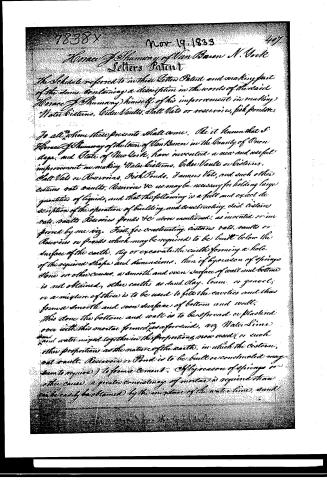
The Schedule referred to in these Letters Patent and making part of the same containing a description in the words of the said Horace J. Shumway himself of his improvement in making Water Cisterns, Cider Vaults, Salt Vats or reservoirs, fish ponds, etc.
To all to whom these presents shall come, Be it known that I Horace J. Shumway of the town of Van Buren in the County of Oneida, and State of New York, have invented a new and useful improvement in making Water Cisterns, Cider Vaults or Cisterns, Salt Vats or Reservoirs, Fish Ponds, Jammer Vats, and such other cisterns vats vaults, Reservoirs etc as may be necessary for holding large quantities of liquids, and that the following is a full and exact description of the operation of building and constructing said cisterns vats vaults Reservoirs ponds etc above mentioned, as invented or improved by me viz.
First for constructing cisterns vats vaults or Reservoirs or ponds which may be required to be built below the surface of the earth, dig or excavate the earth forming a hole of the required shape and dimensions. Then if by reason of springs etc or other causes, a smooth and even surface of wall and bottom is not obtained, other earths as sand clay, loam, or gravel, or a mixture of these is to be used to fill the cavities and thus form a smooth and even surface of bottom and wall.
This done the bottom and wall is to be spread or plastered over with this mortar formed as aforesaid, viz Water Lime and water mixed together in the proportion now used (or such other proportion as the nature of the earth, in which the cistern, vat vault, Reservoir or Pond is to be built or constructed may seem to require) to form a Cement. If by reason of springs or other causes, a greater consistency of mortar is required than can be easily be obtained by the mixture of the water lime, sand
Page 3.
and water, gravel may be used, and either mixed in while making the mortar, or sprinkled on to the same after having been plastered or spread on and partially or wholly imbedded while the mortar is yet green or soft. This done, and the first coat having obtained a sufficient hardness or consistency to receive a second, it should be immediately applied and the gravelly re-peats, and so on until the wall shall have attained the required thickness. Cisterns, Vats, Vaults or Reservoirs, thus formed either with or without the gravel, and which require to be covered with either wood or stone are to be so done by first preparing a foundation for the covering to rest upon on the outside of the wall of cement, so that the covering may not rest upon the wall of cement, then put on the covering, which is to be so neatly fitted to the top of the wall that by plastering upon the underside of the covering there may be a continuation of the walls all over the whole exterior of the Cistern, Vat, vault, or reservoir.
If the above covering is made of wood a coat of mortar ought to be spread over the whole outside to prevent decay. In the cover there may be left a hole or a tube inserted through which the liquid is to pass into the Cistern, vault, vat, &c as above, and also another hole of any convenient size out of which to draw the liquid and if large this ought and is to be protected by a curb and this curb covered with a lid. A drain may also be necessary, and for this purpose a small aperture or opening should be left or a tube inserted in such a manner as to prevent any waste of the cement. To construct or build any of the above named articles, which shall or may be required to be built upon or above the surface of the earth, a frame or mould will be necessary, and when made of wood the outside should be protected from frost and decay by a coat of plaster, or otherwise, and the inside may be plastered without (and with the use of gravel) with a mortar made as aforesaid. The particulars
Page 4.
advantage which this method of constructing or building cisterns, vaults, reservoirs and ponds which are to be sunk below the surface of the earth, by plastering upon the bare walls of earth instead of first lining the hole or excavation with stone, brick or wood, as is now practiced in constructing water cisterns, are numerous, but the principle of which are cheapness and durability. Wood thus exposed will soon decay and leave the wall unsupported. Brick by contraction and expansion cracks the walls, and at the same time, like stone are expensive. The principal grounds and items for and upon which your Petitioner prays and requests letters Patent are the following viz: 1st for plastering upon the earthy walls instead of plastering upon stone, brick, and wood, as heretofore and now practiced in building and constructing of cisterns for holding rain water which may pass through a rectifying before passing into the cistern by which the water is fit for all uses. 2nd for applying the use of said cement to the constructing and building of cider cisterns or vaults, famous cists, salt cists or reservoirs, fish ponds and other vaults and reservoirs for holding large quantities of liquids, for which the said cement has not been used or known. 3rd for the use of gravel to stiffen or harden the mortar which has not been heretofore used in the manner specified above or in any other, to form a cement, or stiffen the mortar.
In Witness whereof I have hereunto subscribed my name 2nd day of November A.D. 1838.
Witnesses
Sam. L. Allen
John R. Hatcher
(1055 words)
Horace J. Shumway.
(Patented Nov. 19, 1839)
Published accounts: journal notice
Notice in the monthly list of patents, with remarks
Journal of the Franklin Institute, new ser., vol. 13 (1834), p. 322 · View the page
50. For Cisterns and Reservoirs; Horace J. Shumway, Van Buren, Onondaga county, New York, November 19.
Remarks. Cisterns, or reservoirs, to hold water, or other liquids, are to be dug in the ground, and the walls of earth are to be plastered overby a cement made of hydraulic lime and sand, mixed in the usual proportions. The novelty in this proceeding consists in applying the cement directly upon the surface of the ground, without first building a wall of brick or stone. The advantages said to result from this are several; besides the economy of the process, it is stated to be more durable; as the change in the brick or stone wall, from settling, expansion and contraction, &c. is said to crack the plaster, while such accidents will not take place with earth walls. It is proposed, in addition to the sand, sometimes to use gravel, which may either be mixed up with the cement, or applied to the surface of it whilst in a moist state. The claims made are "for plastering upon earth walls instead of plastering stone, brick, or wood, as heretofore; for applying said cement to the constructing and building of cider cisterns or vaults, tanner's vats, salt vats, and reservoirs for holding large quantities of liquids. For the use of gravel to stiffen or harden the mortar, which has not been heretofore used in the manner specified, to form a cement, or to stiffen the mortar." In a firm clay soil, we have no doubt that cisterns made in the way specified would answer the intended purpose; but in the greater number of situations, we think they would not, as it cannot be intended to give to the water cement lining such a thickness as shall sustain the pressure of the earth, which, in most places, requires a wall of considerable strength. In cisterns which are to be kept constantly full, the pressure of the contained liquid would do much towards sustaining that of the earth, but in those which are sometimes to be empty the danger would be greatly increased. The last item of the claim, that of using gravel to stiffen the cement, is one which certainly cannot stand, as this article has frequently been used both with ordinary and with hydraulic lime in forming a cement. :
About this record
- Patentee
- DATAMP
- Date
- the Name and Date index of patents, DATAMP, USPTO records
- Invention
- DATAMP
- Listed in
- the Name and Date index of patents, DATAMP, USPTO records, Jim Shaw's X-patent list, the Journal of the Franklin Institute, Burke's List of Patents (1847)
- Burke's 1847 Patent Office list gives the same patent.