

Drawings and documents
USPTO scan
The patent as scanned by the USPTO
-
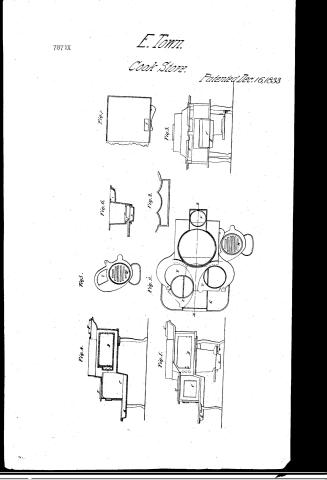 Page 1
-
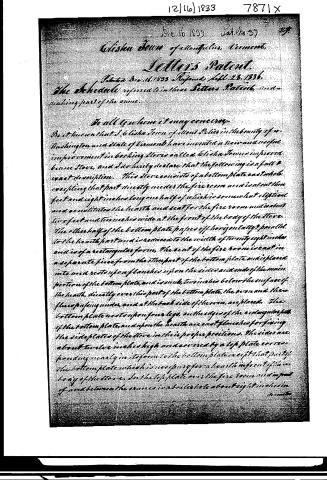 Page 2
-
 Page 3
-
 Page 4
-
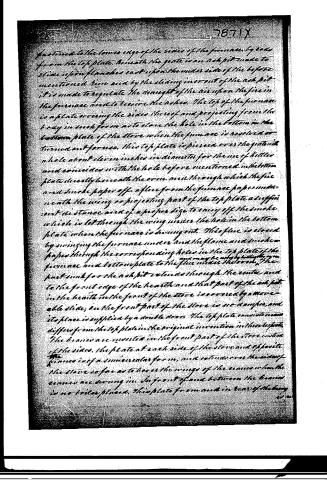 Page 5
-
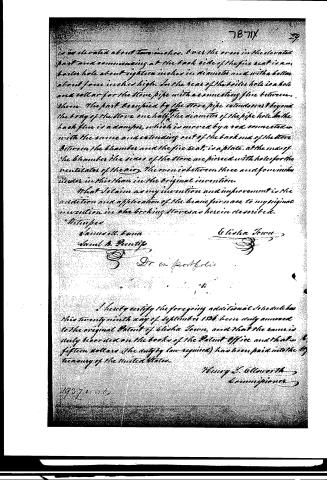 Page 6


U.S. Patent and Trademark Office · Google Patents
Show the transcription Hide (1,876 words)
Machine transcription (LightOnOCR) of the pages as scanned by the USPTO, most of them the handwritten copies made when the records were restored after the 1836 fire. Not checked; it can misread handwriting, so compare it with the scan.
Page 1.
7871X
E. Town.
Cook Stove.
Patented Dec. 16, 1833
Fig. 1.
Fig. 2.
Fig. 3.
Fig. 4.
Fig. 5.
Fig. 6.
Fig. 7.
Fig. 8.
Page 2.
12/16/1833 7871X
Dec. 16, 1833 Pat. No. 37 29
Elisha Town of Montpelier, Vermont.
Letters Patent.
Patented Dec. 16, 1833 Referred Sept. 23, 1836.
The Schedule referred to in these Letters Patent, and making part of the same.
To all to whom it may concern:
Be it known that I, Elisha Town of Montpelier in the county of Washington and state of Vermont have invented a new and useful improvement in cooking stoves called Elisha Town improved bame stove, and I do hereby declare that the following is a full & exact description. This stove consists of a bottom plate each whole excepting that part directly under the fire room and is about three feet and eight inches long one half of which is somewhat elevated and constitutes the hearth and seat for the fire room and about two feet and ten inches wide at the front of the body of the stove. The other half of the bottom plate projects off horizontally & parallel to the hearth part and is reduced to the width of twenty eight inches and is of a rectangular form. The seat of the fire room is cast in a separate piece from the other part of the bottom plate and is placed into and rests upon flanches upon the sides and ends of the main portion of the bottom plate, and is sunk two inches below the surface of the hearth, directly over this part of the bottom plate, the oven and three flues passing under, and at the back side of the oven, are placed. The bottom plate rests upon four legs, on the edges of the rectangular part of the bottom plate, and upon the hearth are cast flanches for fixing the side plates of the stove in their proper positions. The sides are about twelve inches high and covered by a top plate corresponding nearly in its form to the bottom plate except that part of the bottom plate which is occupied for a hearth in front of the body of the stove. In the top plate over the fire room and in part of and between the cranes in a circle hole about eight inches in diameter.
Page 3.
diameter and the back part of the top plate is a hole and enter for the stove pipe. The oven is constructed by passing plates from side to side of the stove leaving spaces of about one and one half inches between it and the bottom, top and back plates. These spaces are the places for conveying the flame and heat or smoke around the oven and to the pipe. In front of the oven and behind it and the fire room, is a chamber formed on the back side by an oven plate, and in front and on the top by a thick plate (the bottom of this chamber being formed by an extension of the bottom plate of the oven and by means of this chamber the temperature of the oven is equalized. Between the chamber and fire room is a thick plate distant about two inches from the chamber and reaching within about five or six inches of the top plate. The fire room occupies the front part and about one third of the body of the stove. The heat is regulated by a damper in the front part of the fire room which slides up and down in grooves directly over the fire room and two boiler places which I call ovens. These ovens are made by axes being placed in the rear corners of the fire room on the sides of the stove, with their pits inserted in the bottom and top plates. They are from three to four inches deep and parallel when swung in, with the sides of the stove without bottoms and with collars for resting places for kettles. These ovens are cast in parts, separate from the top plate, when swung forward, the projecting top plates or wings cover the places of the boiler holes and prevent the passage of the fire and smoke into the room by swinging the boilers off they are deprived of the greatest portion of the heat of the fire and the quantity of the heat necessary for boiling is regulated thereby as a current of cold air is then permitted to pass underneath the holes so as to derive the heat from the same. What I claim as my invention and desire to secure by Letters Patent is the application of the ovens or hinges to the boiler places in boiling stoves as herein described.
Witnesses: Samuel A. Pritchard
Elisha Iron
Page 4.
12/16/1883
This schedule contains a description of improvements over and above said The Letter Patent granted to Elisha Townshend on the 16th day of December 1882, and making part of the same.
To all to whom it may concern,
Be it known that I Elisha Town of Montpelier in the county of Washington and state of Vermont have invented a new and useful improvement on Elisha Townshend's invention, called Elisha Townshend improved stove, and I do hereby declare that the following is a full and exact description of said improvement. The improvement consists in and differs from the original invention in these respects. The bottom plate is cast with a hole that under one end of the oven, is a circular hole, about eleven inches in diameter, coinciding with a similar hole in the top of a furnace herein after mentioned. The rear part of the bottom plate commencing at the back side of the fire seat rises three inches in height and is reduced in width to twenty two inches. It extends out from under one end of the oven, two and one half inches so the leg maybe bolted to it. To this leg is attached to this leg in a manner as follows: a furnace from the leg and about eight below the bottom plate, is a projection of sufficient size to admit of a 3/8 inch hole with a female screw cut in the same, and of such strength as will be required to support the weight of the furnace and its contents or whatever may be necessary to use about it. Through this hole in the projection is passed a male screw in a vertical position with a nutty in the upper end, which forms the stay for the lower end of the axis of motion of the furnace. This axis is cast solid in a corner of a furnace which is in the form of the letter D, and the upper pivot of the axis is inserted into a circular hole in the bottom plate near the leg and directly over the stay. The furnace is about three inches deep near the bottom of which is a gate to lower the fire. This gate is in a manner in its place by resting upon the inner edge of an rim about three inches wide in the letter D form.
Patented.
Page 5.
fastened to the lower edge of the sides of the furnace, by rods from the top plate. Beneath the gate is an ash pit made to slide upon flanches cast upon the under side of the before mentioned iron and by the sliding in or out of the ash pit it is made to regulate the draught of the air upon the fire in the furnace and to receive the ashes. The top of the furnace is a plate covering the sides thereof and projecting from the body in such form as to close the hole in the bottom in the bottom plate of the stove when the furnace is removed or turned out for use. This top plate is pierced over the gate with a hole about eleven inches in diameter for the use of kiln air and coincides with the hole before mentioned in the bottom plate directly beneath the oven, and through which the fire and smoke pass off. A flue from the furnace passes underneath the wing or projecting part of the top plate a sufficient distance and of a proper size to carry off the smoke which is let through the wing under the hole in the bottom plate when the furnace is swung out. This flue is closed by swinging the furnace under and the flame and smoke passes through the corresponding holes in the top plate of the furnace and bottom plate to the flue under the door. The first sink for the ash pit extends through the center and to the front edge of the hearth and that part of the ash pit in the hearth in the front of the stove is covered by a movable slide; on the front part of the stove is no lamp, and its place is supplied by a double door. The top plate considerably differs from the top plate in the original invention in this respect. The braces are inserted in the front part of the stove instead of the sides. The plate at each side of the stove and opposite the braces is of a semicircular form, and extends over the sides of the stove so far as to cover the wings of the braces when the braces are swung in. The front of and between the braces is no boiler placed. This plate from and in front of the wing
Page 6.
is so elevated about two inches, but the oven in the elevated part and commencing at the back side of the fire seat is an boiler hole about eighteen inches in diameter and with a bottom about four inches high. In the rear of the boiler hole is a hole and collar for the stove pipe with a connecting flue between them. The part occupied by the stove pipe extends well beyond the body of the stove one half the diameter of the pipe hole but the back flue is a damper, which is moved by a rod connected with the oven and extending out of the back end of the stove. Between the chamber and the fire seat, is a plate, at the end of the chamber the sides of the stove are pierced with holes for the ventilation of the air. The oven is between three and four inches wider in this than in the original invention.
What I claim as my invention and improvement is the addition and application of the branc furnace to my original invention in the broking stove as herein described.
Witnesses:
Samuel L. Dana
Samuel B. Dentijo
Elisha Town
Dr in Portland
I hereby certify the foregoing additional schedule has this twenty ninth day of September 1856 been duly annexed to the original Patent of Elisha Town, and that the same is duly recorded on the books of the Patent Office and that the fifteen dollars (the duty by law required) has been paid into the treasury of the United States.
Henry L. Ellsworth
Commissioner
1937 x 00
Published accounts: journal notice
Notice in the monthly list of patents, with remarks
Journal of the Franklin Institute, new ser., vol. 13 (1834), p. 390 · View the page
13. For a Cooking Stove; Elisha Town, Montpelier, Washington county, Vermont, December 16.
Remarks. The specification of this patent is not a description, as it merely tells what is claimed by the inventor; the drawing, however, which accompanies it, represents the stove clearly in one of its forms. The things claimed are, "First, the use of cranes, so constructed in the top as to be made the seats, or resting places, for pots, kettles, or other furniture in use about the stove, and by which they may be easily swung on or off the fire, thereby regulating the quantity of heat applied to them." These, so called, cranes, consist of a part of the upper American Patents for December, with Remarks. plate of the stone, with the requisite appurtenances, which swivel on a pin, allowing them, with the cooking utensil, to be drawn on one side. Second, the use of these plates between the oven and the fuel, to render the heat in the oven uniform. Third, the casting of a portion of the hearth, under the fuel, in a separate piece, to admit of its expansion and contraction. Fourth, a damper, or door, which is to slide up and down in front of the fire to regulate the draft, and to admit of toasting, &c. before it. Fifth, the general construction of the stove, admitting of the introduction of grates for the burning of coal, peat, or other fuel. Sliding doors, to rise and fall in grooves, in the front of fires, are a very old contrivance, and this, at least, therefore, had better not have found a place among the things claimed as new.
Published accounts: journal notice
Notice in the monthly list of patents, with remarks
Journal of the Franklin Institute, new ser., vol. 13 (1834), p. 391 · View the page
15. For a Seeding Cultivator; John Richard, Guilford Township, Franklin county, Pennsylvania, December 16.
Remarks. This is a modification of that species of harrow usually denominated a cultivator, and which, we are informed, operates well in practice. The frame of it is made triangular, each side being about seven feet long, and in drawing it along, one of the sides of the triangle becomes the forward part; two handles, like those of a plough, projecting from the hind angle. In this angle there is fixed a double, or wedge-formed mouldboard, provided with a share and coulter. This share and mouldboard project forward towards the front of the cultivator, and serve to divide the lands. In each of the side pieces of the frame there are ten teeth, each about four inches wide, and made in the usual form; they are placed so as to stand at right angles with the sides, and therefore, obliquely to the line of their motion. "In using this instrument the ground is first prepared by ploughing and harrowing in the usual way. When this has been done, and the seed sown, the land is staked off at distances of a little upwards of seven feet; the stakes serving as guides for the centre, or plough, part of the cultivator, and the teeth on the sides then form the ground into furrows of the most convenient and suitable width for the advantageous growth of the grain." The claim is not to any of the individual parts, but to that general arrangement and combination of them which gives to this machine its individual character. "A principal feature by which it is thus distinguished, being the reversed direction in which the triangle is drawn forward; and the fixture of the double mouldboard and its appendages, by which the lands are divided."
About this record
- Patentee
- DATAMP
- Date
- the Name and Date index of patents, DATAMP, USPTO records
- Invention
- DATAMP
- Listed in
- the Name and Date index of patents, DATAMP, USPTO records, Jim Shaw's X-patent list, the Journal of the Franklin Institute, Burke's List of Patents (1847)
- Burke's 1847 Patent Office list gives the same patent.