

Drawings and documents
USPTO scan
The patent as scanned by the USPTO
-
 Page 1
-
 Page 2
-
 Page 3
-
 Page 4
-
 Page 5


U.S. Patent and Trademark Office · Google Patents
Show the transcription Hide (1,493 words)
Machine transcription (LightOnOCR) of the pages as scanned by the USPTO, most of them the handwritten copies made when the records were restored after the 1836 fire. Not checked; it can misread handwriting, so compare it with the scan.
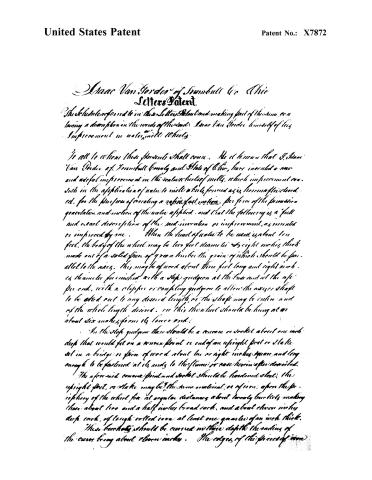
Page 2.
United States Patent
Patent No.: X7872
Isaac Van Gorder of Yonkers Co. Ohio
Letters Patent.
The subject referred to in this Letters Patent and making part of the same, or containing a description in the words of the said Isaac Van Gorder himself of his Improvement in water mill wheels.
To all to whom these presents shall come, Be it known that I, Isaac Van Gorder of Yonkers County and State of Ohio, have invented a new and useful improvement in the water wheels of mills, which improvement consists in the application of water to mill wheels formed as is hereinafter described, for the purpose of creating a rapid and uniform motion, by force of the frictional gravitation and motion of the water applied, and that the following is a full and exact description of the said invention or improvement, as invented or improved by me.
When the head of water to be used is about ten feet, the body of the wheel may be ten feet diameter & eight inches thick made out of a solid piece of green timber the grain of which should be parallel to the axis. This may be of wood about three feet long and eight inches in diameter furnished with a step gudgeon at the base and at the upper end, with a clipper or coupling gudgeon to allow the axis or shaft to be slid out to any desired length, or the shaft may be entire and of the whole length desired. On this the wheel should be hung at an about six inches from its lower end.
In the step gudgeon there should be a concave or socket about one inch deep that would fit on a convex point or end of an upright post or stake set in a bridge or piece of wood about ten or eight inches square and long enough to be fastened at its ends to the flume or race herein after described.
The aforesaid concave point and socket should be hardened steel, the upright post, or stake may be the same material, or of iron, upon the periphery of the wheel fix at regular distances about twenty feet, making them about two and a half inches broad each, and about eleven inches deep each, of tough rolled iron at least one quarter of an inch thick. These berths should be curved in their depths the radius of the curve being about eleven inches. The edges of the pieces of iron
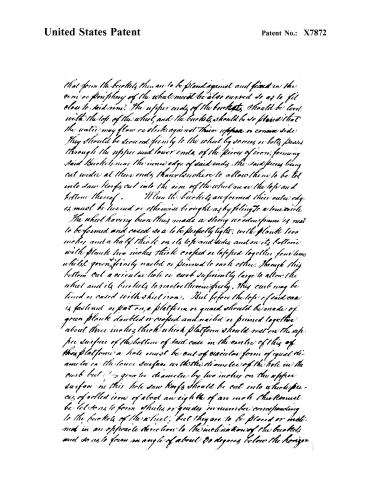
Page 3.
United States Patent
Patent No.: X7872
that form the buckets, then are to be placed against and fixed in the rim or periphery of the wheel must be also curved so as to fit close to said rim. The upper ends of the buckets should be level with the top of the wheel, and the buckets should be so placed that the water may flow or strike against their upper or concave side. They should be secured firmly to the wheel by screws or bolts passed through the upper and lower ends of the pieces of iron, forming said buckets, near the inner edge of said ends, the said pieces being cut wider at their ends than elsewhere to allow them to be let into saw kerfs cut into the rim of the wheel near the top and bottom thereof. When the buckets are formed their outer edges must be turned or otherwise brought as by filing to a true circle. The wheel having been thus made a strong wooden frame is next to be formed and cased so as to be perfectly light, with plank two inches and a half thick on its top and sides, and on its bottom with plank two inches thick crimped or lapped together four rows, which are firmly nailed or pinned to each other. Through this bottom cut a circular hole or cleft sufficiently large to allow the wheel and its buckets to rotate therein freely. This cleft may be lined or cased with sheet iron. But before the top of said case is fastened or put on, a platform or guard should be made of green plank doubled or crimped and nailed or pinned together about three inches thick which platform should rest on the upper surface of the bottom of said case in the center of this, of this platform a hole must be cut of circular form of equal diameter in the lower surface with the diameter of the hole in the cleft but of greater diameter by two inches on the upper surface; in this hole saw kerfs should be cut into which pieces, of rolled iron of about an eighth of an inch thick must be let so as to form shules or guides in number corresponding to the buckets of the wheel; but they are to be placed or inclined in an opposite direction to the inclination of the buckets and so as to form an angle of about 90 degrees below the horizon
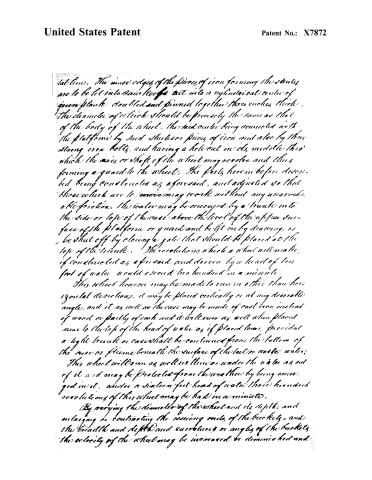
Page 4.
United States Patent
Patent No.: X7872
The inner edges of the pieces of iron forming the stiles are to be let into said hoops cut into a cylindrical cavity of green plank doubled and pinned together three inches thick, the diameter of which should be precisely the same as that of the body of the wheel. The said cavity being connected with the platform by said stiles or pieces of iron and also by three strong iron bolts, and having a hole cut in its middle through which the axis or shaft of the wheel may revolve and thus forming a guard to the wheel. The parts hereinbefore described being constructed as aforesaid, and adjusted so that those which are to move may work without any unnecessary friction, the water may be conveyed by a trunk into the side or top of the case above the level of the upper surface of the platform or guard and be let on by drawing, or be shut off by closing a gate that should be placed at the top of the trunk. The revolutions which a wheel will make, if constructed as aforesaid and driven by a head of ten feet of water would exceed two hundred in a minute.
This wheel however may be made to run in other than horizontal directions, it may be placed vertically or at any desirable angle, and it as well as the case may be made of cast iron instead of wood or partly of each and it will run as well when placed near to the top of the head of water as if placed lower. Provided a light trunk or case shall be continued from the bottom of the case or flume beneath the surface of the tail or waste water.
This wheel will run as well in thin or under the water as out of it and may be protected from the weather by being emerged in it. Under a sixteen feet head of water three hundred revolutions of this wheel may be had in a minute.
By varying the diameter of the wheel and its depth, and enlarging or contracting the issuing ends of the buckets, and the breadth and depth and curvature or angles of the buckets the velocity of the wheel may be increased or diminished and
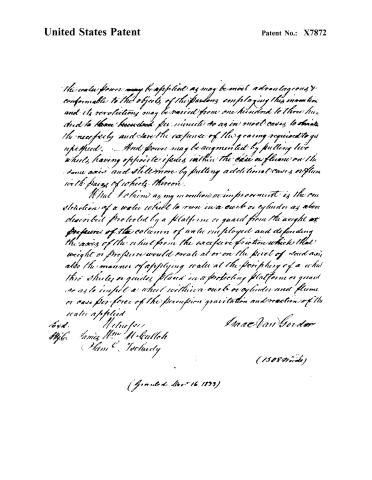
Page 5.
United States Patent
Patent No.: X7872
The water power may be applied as may be most advantageous & conformable to the objects of the patentee employing this invention and its revolutions may be varied from one hundred to three hundred to three hundred per minute so as in most cases to drive the necessary and save the expense of the gearing required to get up speed. And power may be augmented by putting two wheels having opposite faces within the case or flume on the same axis and still more by putting additional cases or flumes with pairs of wheels thereon.
What I claim as my invention or improvement is the construction of a water wheel to run in a curb or cylinder as above described protected by a platform or guard from the weight or pressure of the column of water employed and defending the axis of the wheel from the excessive friction which that weight or pressure would create or on the pivot of said axis also the manner of applying water at the periphery of a wheel this shoulers or guides placed in a protecting platform or guard so as to impel a wheel within a curb or cylinder and flume or case per force of the percussion gravitation and reaction of the water applied
Inventor: Isaac Van Gordon
Attest:
James Wm. McCallah
Sam L. Tschudy
(1508 words)
(Granted Dec 16, 1833)
Published accounts: journal notice
Notice in the monthly list of patents, with remarks
Journal of the Franklin Institute, new ser., vol. 13 (1834), p. 393 · View the page
19. For a Water Wheel; Isaac Van Gorder, Warren, Trumbull county, Ohio, December 16.
Remarks. This is a wheel said to be acted upon by the percussion, gravitation, and reaction of the water applied to it. The wheel is to be contained in a chest or flume, in the manner of those called reaction wheels, but the water, instead of escaping from its periphery, as in most of them, escapes at the under side of it, supposing its axis to stand vertically. The wheel is to be solid in the centre, and may consist of a circular piece of timber, two feet in diameter, and eight inches thick; around the edge of this are to be placed the buckets, of which there may be about twenty, so curved that they shall deliver the water below as nearly as may be in a horizontal direction; they may be two inches and a half broad. This wheel is to run within a circular case, or curb, and the water is to be admitted on to the buckets through openings above them, inclined in a contrary direction to the curvature of the buckets, and corresponding with them in number. The claims made are to the construction of such a wheel, to run in a curb, or cylinder, protected by a platform, or guard, from the weight, or pressure of the column of water employed, the manner of applying the water at the periphery, through shutes, or guides, placed in a projecting platform, within a flume; together with some other incidental appurtenances. We do not perceive in what sense it can be said that the water in this wheel acts by gravitation, percussion, and reaction; we consider these as merely different names applied to particular modes of action, all derived from the same power, gravitation, and that there is no mode in which the effect of this power may be twice told. In the wheel itself, there is little or no novelty.
About this record
- Patentee
- the Journal of the Franklin Institute, Journal
- Date
- the Name and Date index of patents, USPTO records, Jim Shaw's X-patent list
- Invention
- the Name and Date index of patents
- Listed in
- the Name and Date index of patents, USPTO records, Jim Shaw's X-patent list, the Journal of the Franklin Institute, Burke's List of Patents (1847)
- The patentee's full name comes from the Franklin Institute's journal.
- The residence comes from the Franklin Institute's journal.
- Burke's 1847 Patent Office list gives the same patent.