

Drawings and documents
National Archives restored drawings: drawing
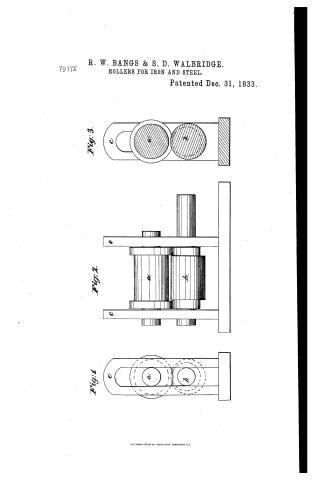
R.W. Bangs and A.D. Walbridge's Patent Drawing fro Rollers for Iron and Steel

National Archives, Restored Patent Drawings (Record Group 241) · Full-size scan at the National Archives · Catalog record
Show the text on the drawing Hide (109 words)
Words on the drawing as machine-read by the National Archives; not checked. Useful mainly for searching.
80, METAL-ROLLING, / TRING, / Milis. Advancing rolls. and receding / CLASSIFICATION / R.W.Bangs Q A.D. Walbridge / 7917- X / DIVISION. / Rollers for iron & steel de. / Patented Tee. 1833.X / Val if M. 465. / The tapes is reg ulates by having the bearings / or journals eccentrie to the rolling surface / Puferences / a. the upper waller / b. the doner waller / C.C. standards. / by i. Lidewiew / Jj.2. Trantview. / Aig.3. Section / Hig. / Aig.2. / this / Intent offic January 3 1843 / Inad under the directive of the Commissioner / of Patents in conformit with act of 3rd March 1837 / H L'Ellorth / Commitions of Patent
USPTO scan
The patent as scanned by the USPTO
-
 Page 1
-
 Page 2


U.S. Patent and Trademark Office · Google Patents
Show the transcription Hide (408 words)
Machine transcription (LightOnOCR) of the pages as scanned by the USPTO, most of them the handwritten copies made when the records were restored after the 1836 fire. Not checked; it can misread handwriting, so compare it with the scan.
Page 1.
7917X
R. W. BANGS & S. D. WALBRIDGE.
ROLLERS FOR IRON AND STEEL.
Patented Dec. 31, 1833.
Fig. 3.
Fig. 2.
Fig. 1.
THE NORRIS PETERS CO., PHOTO-LITHO., WASHINGTON, D. C.
Page 2.
7917X
UNITED STATES PATENT OFFICE.
RUFUS W. BANGS AND STEBBINS D. WALBRIDGE, OF BENNINGTON, VERMONT.
IMPROVEMENT IN THE CONSTRUCTION OF ROLLERS FOR THE ROLLING OF IRON, STEEL, AND OTHER METALS.
Specification forming part of Letters Patent dated December 31, 1833.
To all whom it may concern:
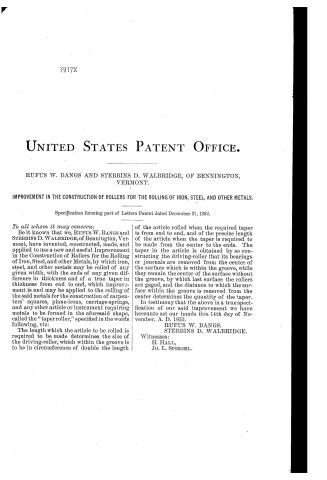
Be it known that we, RUFUS W. BANGS and STEBBINS D. WALBRIDGE, of Bennington, Vermont, have invented, constructed, made, and applied to use a new and useful Improvement in the Construction of Rollers for the Rolling of Iron, Steel, and other Metals, by which iron, steel, and other metals may be rolled of any given width, with the ends of any given difference in thickness and of a true taper in thickness from end to end, which improvement is and may be applied to the rolling of the said metals for the construction of carpenters’ squares, plane-irons, carriage-springs, and any other article or instrument requiring metals to be formed in the aforesaid shape, called the “taper roller,” specified in the words following, viz:
The length which the article to be rolled is required to be made determines the size of the driving-roller, which within the groove is to be in circumference of double the length of the article rolled when the required taper is from end to end, and of the precise length of the article when the taper is required to be made from the center to the ends. The taper in the article is obtained by so constructing the driving-roller that its bearings or journals are removed from the center of the surface which is within the groove, while they remain the center of the surface without the groove, by which last surface the rollers are gaged, and the distance to which the surface within the groove is removed from the center determines the quantity of the taper.
In testimony that the above is a true specification of our said improvement we have hereunto set our hands this 14th day of November, A. D. 1833.
RUFUS W. BANGS.
STEBBINS D. WALBRIDGE.
Witnesses:
H. HALL,
JO. L. SPIRGEL.
Published accounts: journal notice
Notice in the monthly list of patents, with remarks
Journal of the Franklin Institute, new ser., vol. 14 (1834), p. 36 · View the page
87. For Rollers for Rolling Iron and other metal; Rufus W. Bangs and Stebbins D. Walbridge, Bennington, Bennington county, Vermont, December 31.
Remarks. The patentees inform us that their improvement consists in the construction of rollers by which metal may be rolled of a given width, and of a regular taper from end to end, adapting it to many purposes, such as carriage springs, plane irons, &c. To regulate the width the driving roller is to be grooved, and to regulate the thickness, the groove must be sunk, or the roller made eccentric, so as to produce the intended effect. There is no claim made, and as there is nothing novel in the plan, there was no room for one. We have had occasion to speak of such rollers repeatedly, and their operation is so obvious that any one proposing to offer them to the public as a new invention, might well pause before doing so, although he had not been so situated as to be actually informed of their previous employment. The world is large; there are many ingenious heads and skilful hands at work, under the strong stimulus of interest, leading them to devise the best means of facilitating the operations in which they are engaged; and it is of no avail to a patentee to say that he did not know of the previous existence of the thing which he has patented, as the law does not intend to give him an exclusive right in consequence of his ignorance.
DATAMP: illustration
Illustrations from DATAMP


DATAMP (Directory of American Tool and Machinery Patents), via the Internet Archive · Archived DATAMP page
About this record
- Patentee
- the Journal of the Franklin Institute, Journal
- Date
- the Name and Date index of patents, DATAMP, USPTO records
- Invention
- DATAMP
- Listed in
- the Name and Date index of patents, DATAMP, USPTO records, Jim Shaw's X-patent list, the Journal of the Franklin Institute, Burke's List of Patents (1847)
- The patentee's full name comes from the Franklin Institute's journal.
- The residence comes from the Franklin Institute's journal.
- Burke's 1847 Patent Office list gives the same patent.