

Drawings and documents
USPTO scan
The patent as scanned by the USPTO
-
 Page 1
-
 Page 2
-
 Page 3
-
 Page 4


U.S. Patent and Trademark Office · Google Patents
Show the transcription Hide (624 words)
Machine transcription (LightOnOCR) of the pages as scanned by the USPTO, most of them the handwritten copies made when the records were restored after the 1836 fire. Not checked; it can misread handwriting, so compare it with the scan.
Page 2.
United States Patent
Patent No.: X7916
Alpheus Babcock
Letters Patent
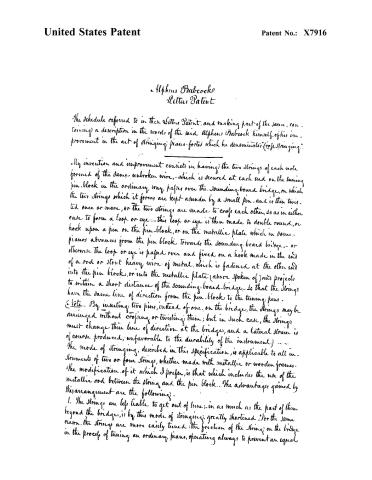
The schedule referred to in these Letters Patent, and making part of the same, containing a description in the words of the said Alpheus Babcock himself, of his improvement in the art of stringing piano-fortes which he denominates “(ref. Stringing).”
My invention and improvement consists in having the two strings of each note formed of the same unbroken wire, which is secured at each end on the tuning pin block in the ordinary way, passes over the sounding-board bridge, on which the two strings which it forms are kept asunder by a small pin, and is then twisted once or more, or the two strings are made to cross each other, so as in either case to form a loop or eye; this loop or eye is then made to double round, or hook upon a pin on the pin block, or on the metallic plate which in some pianos advances from the pin block towards the sounding-board bridge, or otherwise the loop or eye is passed over and fixed on a hook made in the end of a rod or stout heavy wire of metal, which is fastened at the other end into the pin block, or into the metallic plate (above spoken of) and projects to within a short distance of the sounding-board bridge, so that the strings have the same line of direction from the pin block to the tuning pins.
(Note. By inserting two pins, instead of one, on the bridge, the strings may be arranged without crossing or twisting them; but in such case, the strings must change their line of direction at the bridge, and a lateral strain is of course produced, unfavorable to the durability of the instrument.)
The mode of stringing, described in this specification, is applicable to all instruments of two or four strings, whether made with metallic or wooden frames. The modification of it which I prefer, is that which includes the use of the metallic rod between the string and the pin block. The advantages gained by this arrangement are the following:
1. The strings are less liable to get out of tune; in as much as the part of them beyond the bridge, is by this mode of stringing, greatly shortened. For the same reason, the strings are more easily tuned: the friction of the string on the bridge in the process of tuning an ordinary piano, operating always to prevent an equal
Page 3.
United States Patent
Patent No.: X7916
degree of tension on the two sides of the bridge; and in fact, often causing the bridge of the sounding board to support much of the strain, which should properly be borne by the pin block only. 2. The sounding board bridge is relieved from the lateral strain, which the common piano is occasioned by the strings changing their line of direction, after crossing it; as well as from the strain alluded to in the foregoing paragraph: thus increasing the durability of the instrument.
3. The false tones, to which all ordinary pianos are more or less subject, produced by the vibration of the strings between the bridge of the sounding board and the pin block, are obviously prevented by this improvement, and the tone of the vibrating part of the string is left clear and brilliant.
Witnesses
John P. Wilson
Geo. R. Rae
Alpheus Babcock
Toyd.
J.H.C.
Page 4.
United States Patent
Patent No.: X7916
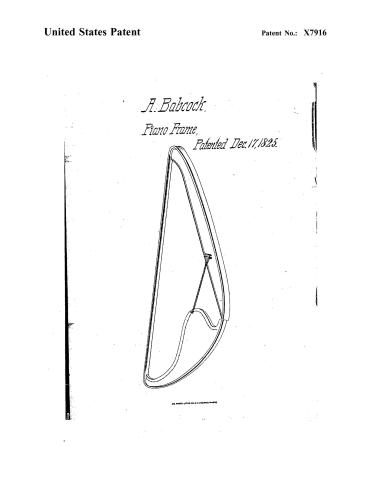
A. Babcock,
Piano Frame,
Patented Dec. 17, 1825.

Published accounts: journal notice
Notice in the monthly list of patents, with remarks
Journal of the Franklin Institute, new ser., vol. 14 (1834), p. 36 · View the page
86. For an improvement in the Structure and Action of the Piano Forte; Alpheus Babcock, city of Philadelphia, December 31.
Remarks. This improvement is said to consist in three particulars; first, in the arrangement by which the motion of the key is communicated to the hammer; secondly, in the preparation of the hammer: and thirdly, in the arrangement of the damper. In the first part, the invention claimed consists in the novelty of the particular arrangement of the respective parts, and not to any of them individually. We might, probably, without the drawing, describe this part of the action so that it would be understood by a competent workman, but it would not be easy so to do, and the description would not interest any other person; it is perfectly well represented in the drawing, and clearly described. In preparing the hammer, the piece of wood which is to be covered with the leather to strike the string, is made concave, to receive a small roll, or pad, of woollen cloth, or other suitable material, over which the covering of leather is to be placed in the usual way. The claim is to "the substitution of cloth for the layers of leather heretofore used." The advantage of this is said to be that the uniform and regulated hardness given to the roll, particularly when of cloth, renders it more perfectly elastic, and prevents its indentation and hardening by use. The wire which raises the damper rests upon the inner end of the key, by which it is raised; but its gravity alone is not depended upon to cause it to descend, its tendency to do so being aided by a slight lively spring, placed under the key, in such a way as to act on the lower end of the damper.
About this record
- Patentee
- Jim Shaw's X-patent list
- Date
- the Name and Date index of patents, USPTO records, Jim Shaw's X-patent list
- Invention
- the Name and Date index of patents
- Listed in
- the Name and Date index of patents, USPTO records, Jim Shaw's X-patent list, the Journal of the Franklin Institute, Burke's List of Patents (1847)
- Burke's 1847 Patent Office list gives the same patent.