

Drawings and documents
USPTO scan
The patent as scanned by the USPTO
-
 Page 1
-
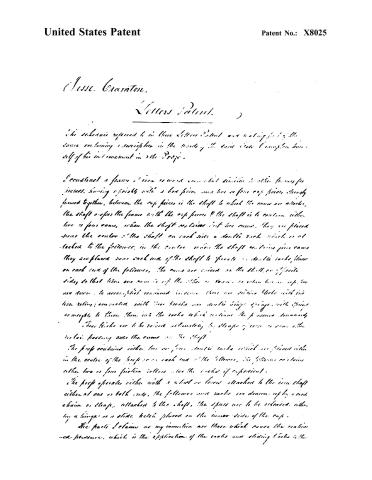 Page 2
-
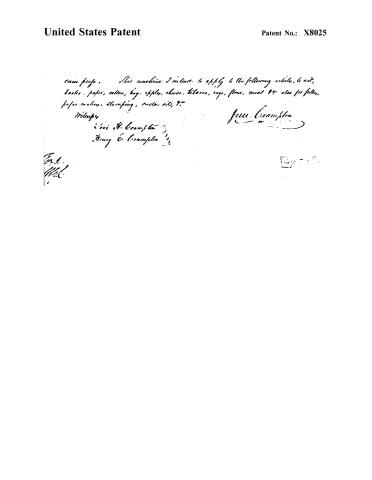 Page 3


U.S. Patent and Trademark Office · Google Patents
Show the transcription Hide (463 words)
Machine transcription (LightOnOCR) of the pages as scanned by the USPTO, most of them the handwritten copies made when the records were restored after the 1836 fire. Not checked; it can misread handwriting, so compare it with the scan.
Page 2.
United States Patent
Patent No.: X8025
Jesse Granston.
Letters Patent.
The scheme referred to in these Letters Patent and not a part of the same containing a description in the words of the said Jesse Granston himself of his improvement in the Prop.
I construct a frame of iron or wood somewhat similar to other frames for presses, having rigidly with a bed piece and two or four top pieces, strongly joined together, between the top pieces is the shaft to which the cams are attached, the shaft passes the frame with the top pieces & the shaft is to contain either two or four cams, when the shaft contains but two cams, they are placed near the center of the shaft on each side a double rack which is attached to the followers, in the center when the shaft contains four cams they are placed near each end of the shaft to furnish a double rack, there on each end of the followers, the cams are raised on the shaft on opposite sides so that when one cam is up the other is down, so when two are up, two are down, to accomplish continued motion there are sliding blocks with friction rollers; connected with two blocks are double hinge springs, with springs arranged to throw them into the racks which continue the pressure downward.
These blocks are to be raised alternately by straps of iron or wood, the metal passing over the cams on the shaft.
The prop contains either two or four double racks which are placed either in the center of the prop or on each end of the followers, the followers contain either two or four friction rollers under the racks if required.
The prop operates either with a wheel or lever attached to the iron shaft either at one or both ends, the followers and racks are driven by a rod chain or straps, attached to the shaft, the gears are to be released either by a hinge or a slide, hinged placed on the inner side of the cap.
The parts I claim as my invention are those which cause the continued pressure, which is the application of the racks and sliding blocks to the
Page 3.
United States Patent
Patent No.: X8025
exam. profo. This machine I intend to apply to the following articles, to wit, books, paper, cotton, hay, apples, cheese, tobacco, rags, flours, meal &c. also for fulley, paper making, stamping, and so on.
Witness
Leo H. Crampson
Henry E. Crampson
Jesse Crampson
End.
11/11
Published accounts: journal notice
Notice in the monthly list of patents, with remarks
Journal of the Franklin Institute, new ser., vol. 14 (1834), p. 186 · View the page
33. For a Press; Jesse Cramton, city of New York, February 18.
Remarks. The description of this press is meagre and defective in the extreme, and although it is accompanied by a good drawing, this is without written references to its respective parts. The power is to be communicated by the turning of a shaft, which is situated at the upper end, close to the cap piece. This shaft has on it either two or four eccentrics, to operate upon a double rack, or racks, which rise from the follower. When there is but one double rack, it rises vertically from the centre of the follower, the cams, in this case, being on the centre of the shaft. Two sliding boxes, one on each side of the rack, are alternately raised and depressed by the cams, and these sliding boxes have teeth on them which, as they descend, catch upon the teeth of the racks. When there are four cams, there are two such double racks, one placed near each cheek of the press. The parts claimed "are those which cause the continued pressure, which is the application of the racks and sliding blocks to the cam press. We do not perceive any advantages offered in this press above those in others now in use, and although the double rack may not have been applied in precisely the same way, the principle has been known and used for more than a century; and, according to the form of the claim, it would appear that the patentee does not confine himself to his peculiar arrangement.
About this record
- Patentee
- DATAMP, Burke's List of Patents (1847)
- Date
- DATAMP, USPTO records, Burke's List of Patents (1847)
- Invention
- DATAMP
- Listed in
- the Name and Date index of patents, DATAMP, USPTO records, Jim Shaw's X-patent list, the Journal of the Franklin Institute, Burke's List of Patents (1847)
- The name conflict was settled by Burke's 1847 list.
- The sources give different dates; the date shown is the one most of them agree on.
- The Franklin Institute's journal confirms the date shown.
- Burke's 1847 Patent Office list gives the same patent.