

Drawings and documents
USPTO scan
The patent as scanned by the USPTO
-
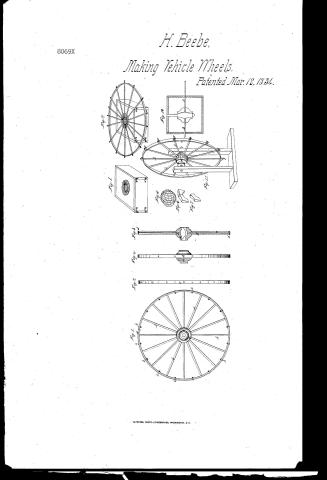 Page 1
-
 Page 2
-
 Page 3
-
 Page 4
-
 Page 5


U.S. Patent and Trademark Office · Google Patents
Show the transcription Hide (1,563 words)
Machine transcription (LightOnOCR) of the pages as scanned by the USPTO, most of them the handwritten copies made when the records were restored after the 1836 fire. Not checked; it can misread handwriting, so compare it with the scan.
Page 1.
H. Beebe.
Making Vehicle Wheels.
Patented Mar. 12, 1834.
Page 2.
3/12/1834 8069X
Mar 12 1834
Henry Beebe
Letters Patent
The Schedules referred to in these Letters Patents and making part of the same containing a description in the words of the said Henry Beebe himself of his improvement in the construction of wheels for the use of all kinds of carriages.
To all to whom these presents shall come. Be it known that I Henry Beebe of the Town of Haverstraw in the County of Rockland and State of New York have invented a new and useful improvement in the construction of wheels for the use of all kinds of carriages such as stages, wagons, carts, gigs, coaches, and road cars and other kinds of transportation vehicles which invention he calls "The metallic vehicle circular wheel" and that the following is a full and exact description of the construction and operation of the said machine as invented or improved by me. The wheel to consist of the flint, spokes, rim and tire with such other appendages thereto as are herein after mentioned. The spokes and the rim to consist of wrought or malleable iron or steel the hub of cast iron, brass composition of metal or of any metallic substance. The tire of wrought or malleable iron lacquered with or without steel. The rim of the wheel to be circular of such diameter as the constructor may choose and as may be appropriate to the use for which it is intended. If the wheel is to be of the diameter of four feet and an half the thickness of the rim should be about five sixteenths of an inch and the width about one inch and three eighths. The rim to be made by bending the bar of the material of which it is to be made into a circular form fastening the two ends by welding or other wise at the option of the constructor, or the rim may consist of segments or felloes either before or after the rim is formed it is to be pierced with as many holes as there are intended to be spokes to the wheel twelve or fourteen more or less at the option of the constructor. These holes to be equidistant from each other and to have the surface of the rim and of such depth as may be deemed effective in regard being but to the use in order to be made of the wheel. In the case of the same and the same-
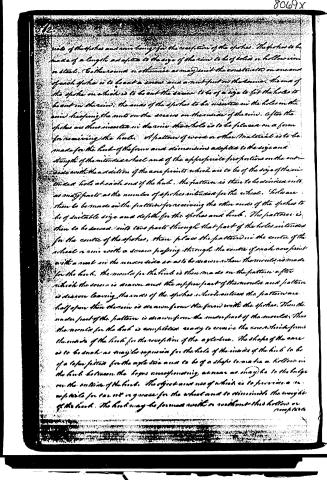
Page 3.
8069X
312.
ends of the spokes and are being for the reception of the spokes. The spokes to be made of a length adapted to the size of the rims to be of solid or hollow iron or steel. Either round or otherwise as may be most the construction on account of each spoke is to be cut a screw and a nut put in the same. The end of the spoke on which is to be cut the screw to be of a size to fit the hole to be cut in the rim. The ends of the spokes to be inserted in the holes in the rim leaving the nuts on the screws on the inside of the rim. After the spokes are thus inserted in the rim the hole is to be placed on a form for receiving the hub. A pattern of wood or other material is to be made for the hub of the form and dimensions adapted to the size and strength of the intended wheel and of the appropriate proportions on the outside with the addition of the core points which are to be of the size of the intended hole at each end of the hub. The pattern is then to be divided into as many parts as the number of spokes intended for the wheel. Holes are then to be made in the pattern for receiving the other ends of the spokes to be of suitable size and depth for the spokes and hub. The pattern is then to be sawed into two parts through that part of the holes intended for the centre of the spokes, then place the pattern in the centre of the wheel or rim with a screw passing through the centre of each core point with a nut on the inner side so as to be drawn when the mould is made for the hub. The mould for the hub is then made on the pattern after which the screw is drawn and the upper part of the mould and pattern is drawn leaving the ends of the spokes which are on the pattern one half open then the rim is drawn from the form with the spokes. Then the under part of the pattern is drawn from the under part of the mould. Then the mould for the hub is completed ready to receive the core which forms the centre of the hub for the reception of the axle-tree. The shape of the core is to be such as may be required for the hole of the inside of the hub to be of a shape for the axle-tree and to be of a shape to make a hollow in the hub between the boys corresponding as near as may be to the holes on the outside of the hub. The object and use of which is to provide a suitable for one or more for the wheel and to receive the weight of the hub. The hub may be formed with or without the hollow or receptacle.
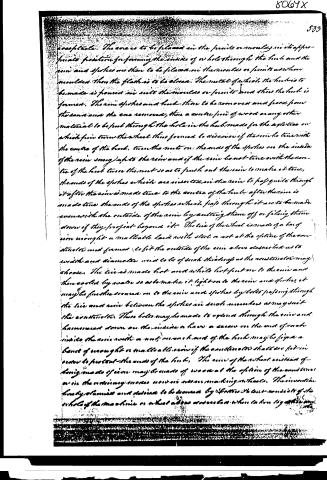
Page 4.
acceptate. The cones to be placed in the pins or moulds in its appropriate position for forming the inside of a hole through the hub and the rim and spokes are then to be placed in the moulds or pins as when moulded then the flash is to be closed. The metal of which the hub is to be made is poured in into the moulds or pins and thus the hub is formed. The rim spokes and hub then to be removed and fixed from the sand and the cone removed, then a centre pin of wood or any other material to be put through the hole in the hub made for the axle tree on which pin turn the wheel thus formed to discover if the axle tree is with the centre of the hub, turn the nut on the ends of the spokes on the inside of the rim snugly up to the rim and if the rim is not true with the centre of the hub turn the nut so as to push out the rim to make it true, the ends of the spokes which are inserted in the rim to pass quite through it after the rim is made true to the centre of the hub after the rim is made true the ends of the spokes which pass through it are to be made even with the outside of the rim by cutting them off or filing them down if they project beyond it. The tie of the wheel is made of a bar of iron wrought or malleable laid with steel or not at the option of the constructor and formed to fit the outside of the rim above described as to width and diameter and to be of such thickness as the constructor may choose. The tie is made hot and while hot fastened to the rim and then cooled by water so as to make it light on to the rim and spokes, it may be further secured on to the rim and spokes by bolts passing through the tie and rim between the spokes in such numbers as may suit the constructor. These bolts may be made to open through the rim and hammer down on the inside or have a screw on the end of each inside the rim with a nut on each end of the hub may be fixed a band of wrought or malleable iron if the constructor shall see fit in order to protect the ends of the hub. The axle of the wheel instead of being made of iron may be made of wood at the option of the constructor or in the ordinary manner now in use in making wheels. The invention hereby claimed and desire to be deemed by Letters Patent consists of the whole of the machinery or wheel above described when taken together.
Page 5.
the mode and manner of constructing the same particularly the principle of constructing the hub upon the iron or steel spokes. But no claim is made for the mode of making the hub, the spokes, the iron or the tire or any of the parts of the wheel or machine taken separately.
In a further illustration of my invention I refer to the model and drawing of the same deposited in the Patent Office. In testimony whereof I have hereunto subscribed my name this twenty-first day of February one thousand eight-hundred and thirty-four.
Witness
Wm. J. Steiger
Chas. M. Huddart
Henry Buche
Drawing 15-00
80691x
Published accounts: journal notice
Notice in the monthly list of patents, with remarks
Journal of the Franklin Institute, new ser., vol. 14 (1834), p. 241 · View the page
33. For an improvement in the construction of Wheels for Carriages of all kinds; Henry Beebe, Haverstraw, Rockland county, New York, March 12.
Remarks. This wheel is to be made with a rim and spokes of wrought iron, and a hub of cast iron. The rim for a four feet six wheel, it is proposed to make of iron five-sixteenths thick, and one and three-eighths wide. After this is formed into a hoop, holes are to be bored in it to correspond with the number and size of the spokes; these latter are tapped, and have nuts on their outer ends, the screw slides freely within the holes in the rim, which are smooth. When the hub is to be cast, it is moulded in such a way that the bore to receive the axle, may have an enlarged opening in the centre, for the sake of lightness, and to contain oil, &c. The spokes, surrounded by the rim, are laid in the flask, so that the cast metal shall embrace VOL. XIV.-No. 4.-OCTOBER, 1834. 31 their inner ends. When cast, the wheel is placed upon an axle, and turned round to try if the rim is true; to make it so, the nuts are tightened up against it, and when true, the projecting ends of the spokes are removed, and heated tire put on. The claim is to "the whole of the machine, or wheel, above described, when taken together, and the mode and manner of constructing the same, particularly the principle of constructing the hub upon the iron or steel spokes. But no claim is made for the mode of making the hub, the spoke, the rim, or the tire, or any of the parts of the machine, or wheel, taken separately." The hubs of wheels have often been cast upon wrought iron spokes; it would seem, therefore, that the particular principle claimed, is not new. We doubt the goodness of the whole wheel, and particularly the durability of the connexion between the cast iron hub and wrought iron spokes.
DATAMP: illustration
Illustrations from DATAMP
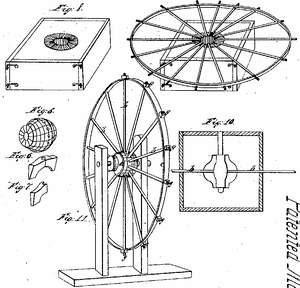
DATAMP (Directory of American Tool and Machinery Patents), via the Internet Archive · Archived DATAMP page
About this record
- Patentee
- DATAMP
- Date
- the Name and Date index of patents, DATAMP, USPTO records
- Invention
- DATAMP
- Listed in
- the Name and Date index of patents, DATAMP, USPTO records, Jim Shaw's X-patent list, the Journal of the Franklin Institute, Burke's List of Patents (1847)
- Burke's 1847 Patent Office list gives the same patent.