

Drawings and documents
USPTO scan
The patent as scanned by the USPTO
-
 Page 1
-
 Page 2
-
 Page 3
-
 Page 4
-
 Page 5
-
 Page 6
-
 Page 7
-
 Page 8
-
 Page 9


U.S. Patent and Trademark Office · Google Patents
Show the transcription Hide (2,838 words)
Machine transcription (LightOnOCR) of the pages as scanned by the USPTO, most of them the handwritten copies made when the records were restored after the 1836 fire. Not checked; it can misread handwriting, so compare it with the scan.
Page 2.
United States Patent
Patent No.: X8099
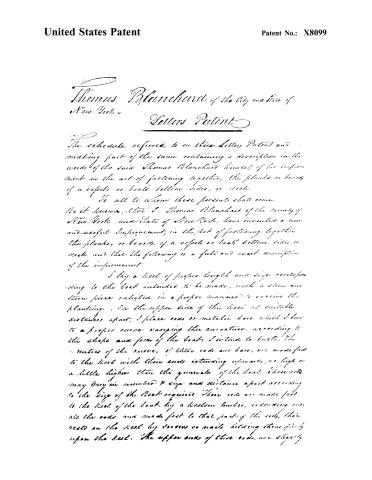
Thomas Blanchard of the City and State of New York
Letters Patent
The schedule referred to in these Letters Patent and making part of the same containing a description in the words of the said Thomas Blanchard himself of his improvement in the art of fastening together, the planks or boards of a vessel or boat’s bottom, sides, or deck.
To all to whom these presents shall come
Be it known, that I Thomas Blanchard of the county of New York and State of New York, have invented a new and useful Improvement, in the Art of fastening together the planks, or boards, of a vessel or boat’s bottom, sides, or deck and that the following is a full and exact description of the improvement.
I lay a keel of proper length and size corresponding to the boat intended to be made, with a stem and stern piece rivetted in a proper manner to receive the planking. On the upper side of this keel at suitable distances apart, I place rods or metallic bars which I bend to a proper curve varying their curvature, according to the shape and form of the boat, I intend to build. The centres of the curve, of these rods and bars, are made fast to the keel with their ends extending upwards, as high or a little higher than the gunwales of the boat. These rods may vary in number & size and distance apart according to the size of the boat required. These rods are made fast to the keel of the boat, by a wooden timber, extending over all the rods and made fast to that part of the rods, that rests on the keel by screws or nails holding them firmly upon the keel. The upper ends of these rods are slightly
Page 3.
United States Patent
Patent No.: X8099
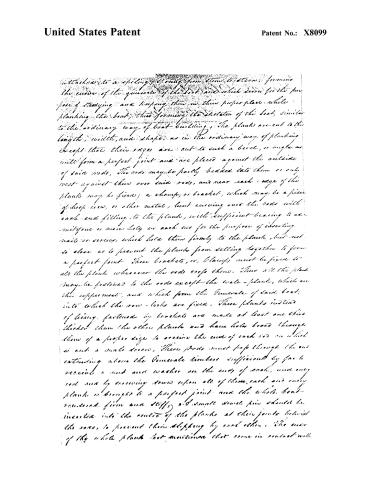
attached to a splicing, spring from stem to stern, forming the curve of the gunwale of the boat and which serves for the purpose of steadying and keeping them in their proper place while planking the boat, thus forming the skeleton of the boat, similar to the ordinary way of boat-building. The planks are cut to the length, width, and shape, as in the ordinary way of planking except that their edges are cut to such a bevel, or angle as will form a perfect joint and are placed against the outside of said rods. The rods may be partly beaded into them or only rest against them over said rods, and near each edge of the planks may be fixed, a clamp, or bracket, which may be a piece of hoop iron, or other metal, bent curving over the rods with each end fitting to the planks, with sufficient bearing to admit one or more holes in each end for the purpose of inserting nails or screws, which hold them firmly to the planks, but not so close as to prevent the planks from setting together to form a perfect joint. These brackets, or, clamps, must be fixed to all the planks wherever the rods cross them. Thus all the planks may be fastened to the rods except the wall-planks, which are the uppermost, and which form the gunwale of said boat, into which the row-locks are fixed. These planks instead of being fastened by brackets are made at least one third thicker than the other planks and have holes bored through them of a proper size to receive the ends of each rod on which is cut a male screw. These rods must pass through the end extending above the gunwale timber sufficient by far to receive a nut and washer on the ends of each, and every rod nut by screwing down upon all of them, each and every plank is brought to a perfect joint and the whole boat rendered firm and stiff, and small screw pins should be inserted into the centre of the planks at their joints behind the rods, to prevent them slipping by each other. The ends of the whole planks that maintain that come in contact with
Page 4.
United States Patent
Patent No.: X8099
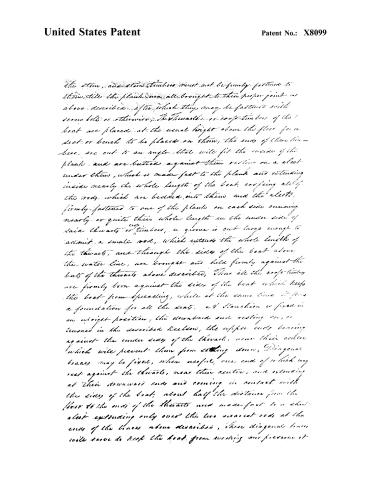
the stem, and stern timbers must not be firmly fastened to them, till the planks are all brought to their proper joint as above described, after which they may be fastened with screw bolts or otherwise. The thwart or cross timbers of the boat are placed at the usual height above the floor for a seat or bench to be placed on them, the ends of these timbers are cut to an angle that will fit the inside of the planks and are butted against them resting on a cleat under them, which is made fast to the planks and extending inside nearly the whole length of the boat, crossing all of the body which are bedded into them and the cleats firmly fastened to one of the planks on each side running nearly or quite their whole length in the under side of said thwart or timbers, a groove is cut large enough to admit a small rod, which extends the whole length of the thwart, and through the sides of the boat above the water line, are brought and held firmly against the butts of the thwarts above described. Thus all the cross timbers are firmly born against the sides of the boat which keeps the boat from spreading, while at the same time it forms a foundation for all the seats. A stanchion is fixed in an upright position, the downward end resting on, or secured in the described keelson, the upper end bearing against the under ends of the thwarts, near their center which will prevent them from settling down. Diagonal braces may be fixed, when useful, one end of which may rest against the thwarts, near their center, and extending at their downward ends and coming in contact with the sides of the boat about half the distance from the floor to the ends of the thwarts and made fast to a short cleat extending only over the two nearest rods at the ends of the braces above described, these diagonal braces will serve to keep the boat from swaying and prevent it
Page 5.
United States Patent
Patent No.: X8099
Different from that which is described, the method of applying the mode of fastening together ordinary lifeboats, whale boats, and pleasure boats, etc., I will now describe the manner of forming the deck, by the mode of fastening and attaching it to a boat as above described.
Rods of sufficient length to reach from one gunwale to another are passed through them a sufficient distance to admit of a screw, nut, and washer outside of the gunwale, these rods are bent to curves or crowning corresponding to the curve or crown of the deck, and put at convenient distances apart the whole length of the boat. The deck boards or plank are cut to the width, length and shape required for ordinary boat placed on the upper side of said deck rods, and fastened to them by brackets in the same manner as the side of the boat are fastened as above described and by the same method brought to a perfect joint that is by the screws on each end of the rods, outside being drawn up till every plank of the deck is brought so close as will render it invisible, to water, while at the same time the screws that pass through the gunwale before described, hold the deck down and bring the underside of the gunwale timber to a joint with the side of the boat. To render the deck capable of sustaining the necessary weight I fix stanchions to the keelson, as above described with their upper ends rising to a timber which runs horizontally under the whole length of the deck, on which the deck rods rest, which secures the deck from sitting down.
To prevent the sides of the boat from spreading by the pressure upon the deck, rods are fixed under the deck at suitable distances apart passing through each gunwale in a straight line from one gunwale to another, these rods being in a straight line and not crowning like
Page 6.
United States Patent
Patent No.: X8099
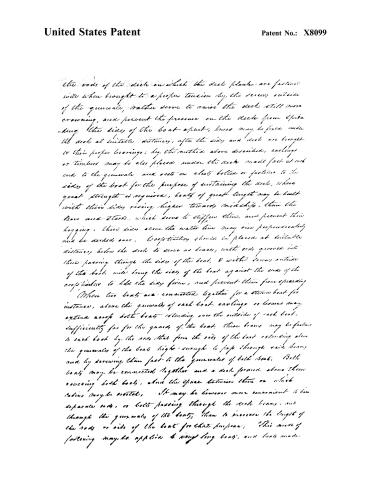
the rods of the deck on which the deck planks are fastened will when brought to a proper tension by the screws outside of the gunwale, rather serve to raise the deck still more crowning, and prevent the pressure on the deck from spreading the sides of the boat apart, braces may be fixed under the deck at suitable distances, after the sides and deck are brought to their proper bearings; by the method above described, earlings or timbers may be also placed under the deck made fast at each end to the gunwale and rests on cleats bolted or fastened to the sides of the boat for the purpose of sustaining the deck, where great strength is required, boats of great length may be built with their sides rising higher towards midships, than the bow and stern, which serves to stiffen them, and prevent their hogging, their sides above the water line may rise perpendicularly and be decked over, Cross-timbers should be placed at suitable distances, below the deck to serve as braces, with rods grooved into them passing through the sides of the boat, & with screws outside of the boat will bring the sides of the boat against the ends of the cross-timbers to hold the sides firm, and prevent them from spreading.
When two boats are connected together for a steam boat for instance, above the gunwales of each boat, earlings or beams may extend across both boats extending over the outside of each boat, sufficiently far for the guard of the boat. These beams may be fastened to each boat by the rods that form the sides of the boat extending above the gunwales of the boats high enough to pass through said beams, and by screwing them fast to the gunwales of both boats. Both boats may be connected together and a deck formed above them covering both boats, and the space between them on which cabins may be erected. It may be however more convenient to have separate rods, or bolts passing through the deck beams, and through the gunwales of the boats, than to increase the length of the rods or sides of the boat for that purpose. This mode of fastening may be applied to many long boats, and boats made
Page 7.
United States Patent
Patent No.: X8099
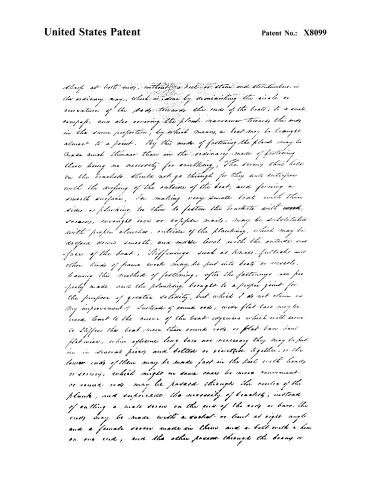
sharp at both ends, without a keel or stem, and sterntimbers, in the ordinary way, which is done by diminishing the curve or curvature of the body towards the ends of the boat, to a small compass, and also covering the planks narrower towards the ends in the same proportion, by which means, a boat may be brought almost to a point. By this mode of fastening the planks may be made much thinner than in the ordinary mode of fastening there being no necessity for caulking. The screws that hold on the brackets should not go through for they will interfere with the arcing of the outside of the boat, and forming a smooth surface, for making very small boats with their sides or planking too thin to fasten the brackets with wood, screws, wrought iron or copper nails, may be substituted with proper clinches, outside of the planking, which may be driven down smooth, and made level with the outside surface of the boat. Stiffenings such as knees, furlongs and other kinds of frame work may be put into boats or vessels, having this method of fastening, after the fastenings are properly made, and the planking brought to a proper joint for the purpose of greater solidity, but which I do not claim as my improvement. Instead of sound rods, wide flat bars may be used bent to the curve of the boat carcase which will serve to stiffen the boat more than sound rods or flat bars bent flatwise, when extreme long bars are necessary they may be put in in several pieces and bolted or riveted together, or the lower ends of them may be made fast in the keel with heads or screws, which might in some cases be more convenient, or sound rods may be passed through the curve of the planks, and supersede the necessity of brackets; instead of cutting a male screw on the end of the rod or bar, the ends may be made with a socket or head at right angle and a female screw made in them and a bolt with a head on one end, and the other passes through the bracing or
Page 8.
United States Patent
Patent No.: X8099
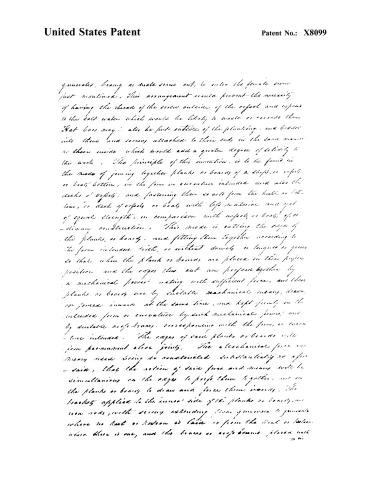
gumwales, having as male screw cut, to enter the female screw just mentioned. This arrangement would prevent the necessity of having the thread of the screw outside of the vessel and exposed to the salt water which would be likely to waste or corrode them. That bars may also be put outside of the planking, and bedded into them and screw attached to their ends in the same manner as those inside which would add a greater degree of solidity to the work. The principle of this invention, is to be found in the mode of joining together planks or boards of a ship, or vessel or boat bottom, in the form or curvature intended and also the decks of vessels, and fastening them so as to form the hull or bottom, or deck of vessel or boat, with less material and yet of equal strength, in comparison with vessels or boats of ordinary construction. This mode is cutting the edges of the planks or boards, and fitting them together according to the form intended with, or without dowels, or tongues or grooves so that when the planks or boards are placed in their proper position and the edges thus cut are pressed together by a mechanical power acting with sufficient force, and these planks or boards are by suitable mechanical means, drawn, or forced inwardly at the same time, and kept firmly in the intended form or curvature by such mechanical power, and by suitable cross braces, corresponding with the form or curvature intended. The edges of such planks or boards will form permanent close joints. The aforesaid mechanical force and means need not be so constructed substantially as aforesaid, that the action of said force and means will be simultaneous on the edges to press them together, and on the planks or boards to draw and force them inwardly. The brackets applied to the inner side of the planks or boards, are iron rods, with screws extending from gumwales to gumwales where no keel or keelson is laid so from the keel or keelson where there is one, and the boards or cross beams placed with
= 21
Page 9.
United States Patent
Patent No.: X8099
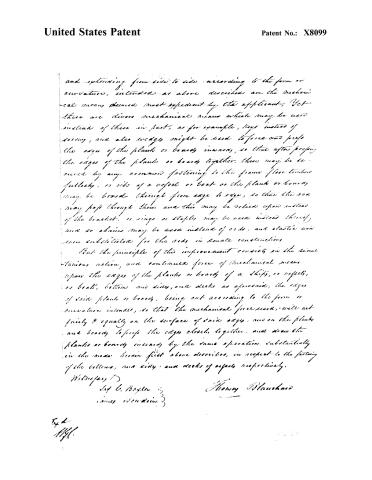
and extending from side to side according to the form or curvature, intended as above described are the mechanical means deemed most expedient by the applicant. Yet there are divers mechanical means which may be used instead of these in part, as for example, keys instead of screws, and also wedges might be used to force and keep the edges of the planks or boards inwardly, so that after joining the edges of the planks or boards together, these may be secured by any common fastening to the frame floor timber, felloes, or ribs of a vessel or boat or the planks or boards may be bored through from edge to edge, so that the rods may pass through them and this may be relied upon instead of the bracket, or rings or staples may be used instead thereof, and so chains may be used instead of rods, and elastic wire even substituted for the rods in small constructions.
But the principle of this improvement consists in the simultaneous action, and continued force of mechanical means upon the edges of the planks or boards of a ship, or vessel, or boat, bottom and sides, and decks as aforesaid, the edges of said planks or boards, being cut according to the form or curvature intended, so that the mechanical force used, will act fairly & equally on the surface of said edges, and on the planks and boards to keep the edges closely together, and draw the planks or boards inwardly by the same operation, substantially in the mode herein first above described, in respect to the fastening of the bottoms, and sides, and decks of vessels respectively.
Witnesses,
Jas. C. Boyler
James Woodin
Henry Blanchard
Published accounts: journal notice
Notice in the monthly list of patents, with remarks
Journal of the Franklin Institute, new ser., vol. 14 (1834), p. 249 · View the page
62. For an improvement in the Mode of Fastening together the Planks of a Boat or other Vessel; Thomas Blanchard, city of New York, March 20.
Remarks. (See description, with specifications.) VOL. XIV. No. 4.-OCTOBER, 1834.
Published accounts: journal notice
Notice in the monthly list of patents, with remarks
Journal of the Franklin Institute, new ser., vol. 14 (1834), p. 269 · View the page
Description of an improvement in the art of fastening together the Planks or Boards of a Vessel's or Boat's Bottom, Sides, or Deck; for which a patent was granted to THOMAS BLANCHARD, city of New York, March 20, 1834.
Remarks. After laying the keel, and fixing the stem and stern posts, rods or bars of metal are placed upon the top of the keel, and fastened to it BLANCHARD'S Improvements in Vessels or Boats. by their middles, their ends being bent up in the form of ribs to the boat intended to be built, their ends reaching up a little higher than the place of the gunwale. The rods are perfectly secured in their places by the keelson, which crosses the whole of them. The rods are to be slightly attached to a spiling at their upper ends, to confine them so as to give the proper form of the boat. The planks are to be cut and fitted in the usual way, but so as to form perfect joints, and are placed against the outside of said rods, which may be imbedded in, or merely rest against, them. Near each edge of each plank is firmly attached a clamp, passing over the rods; these clamps may be made of hoop iron, or otherwise. All the planks are thus fixed excepting those for the wales, which, being thicker than the others, are to be bored through to receive the rounded and tapped ends of the metallic ribs, which have screw nuts, the tightening of which upon the gunwale, will draw all the planks together, in the most perfect manner. Dowel pins may be employed in the edges of the plank to prevent slipping. Thwarts are placed at the usual height, and properly fitted and supported by cleets. Under each thwart a metallic rod crosses the boat, passing through its sides, and serving to draw them close to the thwarts, and thus to prevent all danger of spreading. The mode of securing the deck by similar means, and of fixing diagonal or other braces, are fully explained, but these not affecting the general principle, we do not deem it necessary to particularize. It is manifest that futtocks, knees, and other known modes of giving stability, may be added to the particular device of the patentee.
About this record
- Patentee
- DATAMP
- Date
- the Name and Date index of patents, DATAMP, USPTO records
- Invention
- DATAMP
- Listed in
- the Name and Date index of patents, DATAMP, USPTO records, Jim Shaw's X-patent list, the Journal of the Franklin Institute, Burke's List of Patents (1847)
- Burke's 1847 Patent Office list gives the same patent.