

Drawings and documents
National Archives restored drawings: drawing
T. Spaulding's Patent Drawing for a Steam Generator

National Archives, Restored Patent Drawings (Record Group 241) · Full-size scan at the National Archives · Catalog record
Show the text on the drawing Hide (111 words)
Words on the drawing as machine-read by the National Archives; not checked. Useful mainly for searching.
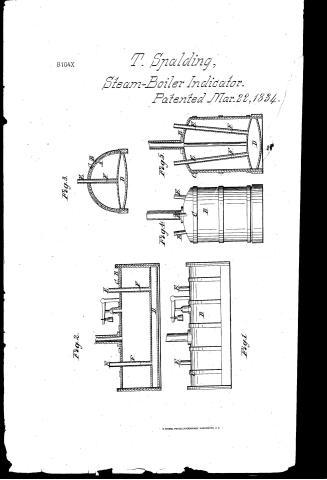
STEAM. / 2. BOILERS. / [148] / Indicators. / CLASSIVISATION / 8104-X / Refferenc / DIVISION. / In / T. SPALDIN G, , / Fig.1, Elevation of a long Boiler / Fig.2, Sectional Elevation / Cteam Generator. / Fió.3, Transverse Section / Fio. Fig.4, Elevation of an Upright Boiler / Fig.5, Sectional Elevation / The same letters refer to the different Fig's / Patented 22 Mar. 1834 / A. The iron ca. ny / Vol 19-4.393 / B. Cloth Covering / C. Iron hoops / FIg. 2 / D. Chamber for the tallow or Oil Sc. / E. Alarm tubes / F Dotted lines show hom high the tallon or oil / rises in the alarm tubes / GB / F1g. 4 / F1Ó. 5 / F16. Ó. 1 / Fio.3 3 / very good shading
USPTO scan
The patent as scanned by the USPTO
-
 Page 1
-
 Page 2
-
 Page 3


U.S. Patent and Trademark Office · Google Patents
Show the transcription Hide (802 words)
Machine transcription (LightOnOCR) of the pages as scanned by the USPTO, most of them the handwritten copies made when the records were restored after the 1836 fire. Not checked; it can misread handwriting, so compare it with the scan.
Page 1.
8104X
T. Spalding,
Steam-Boiler Indicator.
Patented Mar. 22, 1834.
Fig. 3.
Fig. 5.
Fig. 4.
Fig. 2.
Fig. 1.
N. PETERS, PHOTO-LITHOGRAPHER, WASHINGTON. D. C.
Page 2.
March 22, 1834
Thomas Spalding, McIntosh, Co Georgia 8104X
Silly Patent.
The schedule referred to in the Letters Patent and making part of the same containing a description in the words of the said Thomas Spalding himself of his improvement in Generating Steam
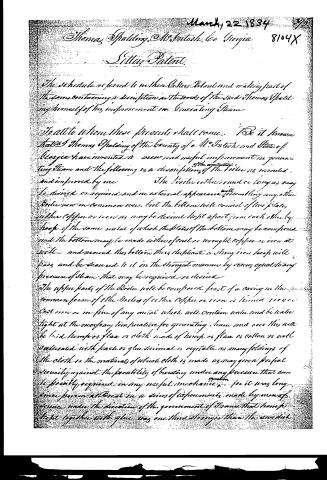
To all to whom these presents shall come: Be it known that I Thomas Spalding of the County of McIntosh and State of Georgia have invented a new and useful improvement in generating Steam and the following is a description of the Boiler as invented and improved by me.
The Boiler either round or long as may be desired or required and in external appearance resembling any other Boiler now in common use, but the bottom will consist of two plates, either copper or iron, may be desired, kept apart from each other by hoops of the same metal of which the plates of the bottom may be composed and the bottom may be made either of cast or wrought copper or iron at will — and around this bottom there duplicate a strong iron hoop will pass and be secured to it in the strongest manner by equal to any pressure of steam that may be required or desired.
The upper parts of the Boiler will be composed first of a casing in the common form of the Boilers of either copper or iron or lined iron or cast iron or in fine of any metal which will contain water and be water tight at the necessary temperature for generating steam and over this will be laid hemp or flax or cloth made of hemp or flax or cotton or will saturated with pitch or glue animal or vegetable as many foldings of the cloth or the materials of which cloth is made as may give a perfect security against the possibility of bursting under any pressure that can be possibly required in any useful machinery. For it was long since proven and proved in a series of experiments made by men of science under the direction of the government of France that hemp kept together with glue was one third stronger than the woodish.
Page 3.
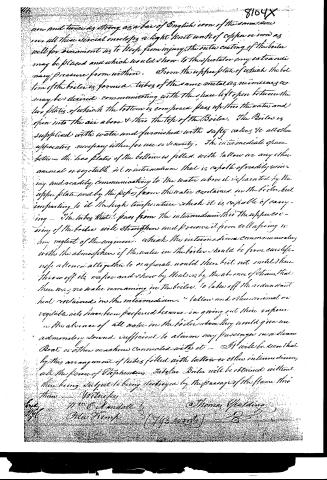
now and twice as strong as a bar of English iron of the same size, and all these several encloses a light knit work of copper or iron as well for ornament as to keep from injury, the outer coating of the boiler may be placed and which would show to the spectator any extraordinary pressure from within. From the upper plate of which the bottom of the boiler is formed, tubes of the same metal as surrounding may be desired communicating with the space left open between the two plates of which the bottom is composed, pass up into the water and open into the air above & into the top of the Boiler. The Boiler is supplied with water and furnished with safety valves &c. all other apparatus necessary either for use or security. The intermediate space between the two plates of the bottom is filled with tallow or any other animal or vegetable oil or intermedium that is capable of readily warming and readily communicating to the water above it separated by the upper plate and by the pipes from the water contained in the boiler, but imparting to it the high temperature which it is capable of raising. The tubes that pass from the intermedium into the upper covering of the boiler will strengthen and preserve it from collapsing in any neglect of the engineer, which the intermedium communicating with the atmosphere of the valve in the boiler should be from carefulness allowed altogether to evaporate would then but not until then throw off its vapor and show by that very the absence of steam that there was no water remaining in the boiler to take off the redundant heat contained in the intermedium. Tallow and other animal or vegetable oils have been preferred because in giving out their vapors in the absence of all water in the boiler where they would give an admonitory sound sufficient to alarm any passenger in a steam boat or other machine connected with it. It will be seen that by this arrangement of tubes filled with tallow or other intermedium, all the power of Stephenson's Jetlike Boiler will be obtained without there being subject to being destroyed by the passage of the flame there than.
Witness
N. E. Amdale
Jno. Kemp
Thomas Spalding
(1793 words)
Published accounts: journal notice
Notice in the monthly list of patents, with remarks
Journal of the Franklin Institute, new ser., vol. 14 (1834), p. 251 · View the page
67. For Generating Steam; Thomas Spalding, Mackintosh county, Georgia, March 22.
Remarks. Boilers are to be made in any of the usual forms, and either of copper or of iron, as may be preferred. The bottom of the boiler is to be double, allowing a space of some inches between the two plates, and to the upper one, tubes are to be attached which are to rise up through the water, and top of the boiler, into the atmosphere, thus opening a free communication between the above named space and the air. This space is to be filled with tallow, or other animal or vegetable oil, which becomes an intermedium through which the heat must pass from the fire in arriving at the water. The upper part or the boiler, is to be "of either copper, or iron, tinned iron, or cast iron," and over this is to be laid hemp, or hemp cloth, saturated with paste or glue, in such thickness "as may give a perfect security against the possibility of bursting under any pressure that can possibly be required." Reference is here made to some experiments performed in France, tending to prove that hemp, kept together by glue, is twice as strong as English bar iron of the same section. -Over all these a light net work of copper or iron is to be placed. Strong hoops of iron are also to be employed, to give additional support to the boilers. Safety valves, &c. as usual, are to be employed. Should the water become entirely exhausted from the boiler, we are told that the tallow will then evaporate, with a peculiar noise and a characteristic appearance, "and give an admonitory sound sufficient to alarm any passenger." We think, however, that there would in case of such alarm, be more fear than danger, as empty boilers are not apt to burst. What benefit the hemp and glue can produce, unless they are continued all round the boiler, excepting as bad conductors, we cannot perceive; in contact with the fire, they would not certainly be very available. The intermedium of tallow appears to present several disadvantages without any corresponding benefit; and, in fact, the whole plan seems to manifest a want of practical knowledge of the subject to which the patent refers.
About this record
- Patentee
- DATAMP
- Date
- the Name and Date index of patents, DATAMP, USPTO records
- Invention
- DATAMP
- Listed in
- the Name and Date index of patents, DATAMP, USPTO records, Jim Shaw's X-patent list, the Journal of the Franklin Institute, Burke's List of Patents (1847)
- Burke's 1847 Patent Office list gives the same patent.