

Drawings and documents
National Archives restored drawings: drawing
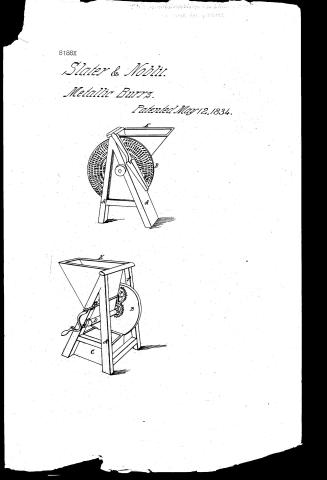
Samuel Slater and Stephen Noblit's Patent Drawing for a Machine for Shelling and Grinding

National Archives, Restored Patent Drawings (Record Group 241) · Full-size scan at the National Archives · Catalog record
Show the text on the drawing Hide (75 words)
Words on the drawing as machine-read by the National Archives; not checked. Useful mainly for searching.
83. MILLS. / Poneave / Grinding Mills. / Cylinder and Concave. / Samuel Mater & Stephens Noblit / Thelling & Grinding Corno / ICATION / 8188-X / DIVISION. / Patented 12May/1834 / ... / Frame / B Sheller / C. Box to receive shelled corn 07 Grist / D. Grinder / E' / II Hopper / Del / Patent office 14th 1839 / Made under the direction of the lom "of patents / in conformity with achy "March 1837 / Commissioner of hate
USPTO scan
The patent as scanned by the USPTO
-
 Page 1
-
 Page 2
-
 Page 3


U.S. Patent and Trademark Office · Google Patents
Show the transcription Hide (642 words)
Machine transcription (LightOnOCR) of the pages as scanned by the USPTO, most of them the handwritten copies made when the records were restored after the 1836 fire. Not checked; it can misread handwriting, so compare it with the scan.
Page 1.
8188X
Slater & Nobili.
Metallic Burrs.
Patented May 12, 1834.
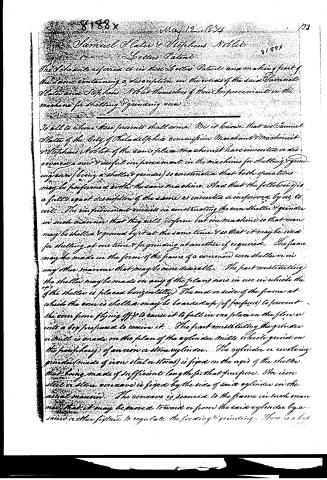
Page 2.
8188x May 12, 1834 132
Samuel Slater & Stephens Noble
Letters Patent
The Schedule annexed to these Letters Patent and making part of the same containing a description in the words of the said Samuel Slater and Stephens Noble themselves of their Improvement in the machine for shelling & grinding corn.
To all to whom these presents shall come: Be it known that we Samuel Slater of the City of Philadelphia commission Merchant & Machinist & Stephens Noble of the same place Machinist have invented or discovered a new & useful improvement in the machines for shelling & grinding corn (being a sheller & grinder) so constructed that both operations may be performed with the same machine. And that the following is a full & exact description of the same as invented or improved by us, to wit: The improvement consists in constructing the corn sheller & grinder in such manner that they will perform but one machine so that corn may be shelled & ground by it at the same time & so that it may be used for shelling at one time & for grinding at another if required. The frame may be made in the form of the frame of a common corn sheller or in any other manner that may be more desirable. The part constituting the sheller may be made on any of the plans now in use in which the corn is placed horizontally. The end or side of the frame at which the corn is shelled may be boarded up (if preferred) to prevent the corn from flying off & to cause it to fall in one place on the floor or into a box prepared to receive it. The part constituting the grinder or mill is made on the plan of the cylinder mills which grind on the periphery of an iron or stone cylinder. The cylinder or revolving grinder (made of iron steel or stone) is fixed on the axis of the sheller that being made of sufficient length for that purpose. An iron steel or stone concave is fixed by the side of said cylinder in the usual manner. The concave is joined to the frame in such manner that it may be moved toward or from the said cylinder by a screw or other fixture to regulate the feeding & grinding. There is a hop
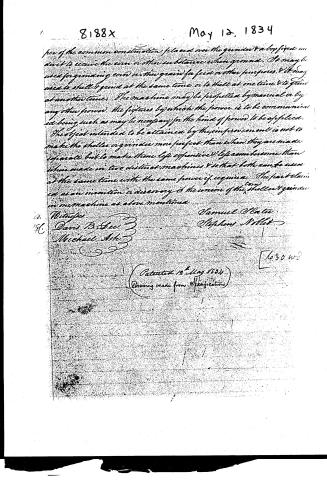
Page 3.
8188x May 12, 1834
per of the common construction placed over the grinder & a by fixed in
suit to receive the corn or other substance when ground. It may be
used for grinding corn or the grain for feed or other purposes. It may
used to shell & grind at the same time or to shell at one time & to grind
at another time. The machine may be propelled by manual or by
any other power. The fixtures by which the power is to be communicated
ed being such as may be necessary for the kind of power to be applied.
The object intended to be attained by the improvement is not to
make the sheller or grinder more perfect than when they are made
separate but to make them less expensive & less cumbersome than
when made in two distinct machines & so that both can be used
at the same time with the same power if required. The part claim
ed as an invention or discovery is the union of the sheller & grinder
in one machine as above mentioned.
Witnesses
Davis B. Lee
Michael Ashe
Samuel Slater
Stephen Noble
Patented 12th May 1834
Drawing made from Specification
1630 w2
Published accounts: journal notice
Notice in the monthly list of patents, with remarks
Journal of the Franklin Institute, new ser., vol. 14 (1834), p. 392 · View the page
This we believe is as much as could be fairly claimed, and it amounts to little or nothing, as the same kind of movement may be equally well obtained by combinations very different from those described in the patent, and not in the slightest degree interfering with them. 10. For a Corn Sheller and Grinder; Samuel Slater, and Stephens Noblet, city of Philadelphia, May 12.
Remarks. The two parts of which this machine consists are, confessedly, both old, the claim being made to the using the axis of the vertical cast iron plate, which forms the sheller, as a machine for breaking or grinding the corn; giving to it, for this purpose, the shape of a grooved, or other cylinder, with an adjustable concave. The machine can thus be used, alternately, for either purpose. It is expressly said, that "the part claimed as an invention, or discovery, is the union of the sheller and grinder in one machine." The amount of invention in this case is certainly very small, and we are apprehensive, too, that it is not of that kind which the law will recognise, If I take a horse power invented by one man, and a thrashing machine invented by another, and merely gear them together, it is much to be doubted whether, in the eye of the law, I should be viewed as an inventor.
About this record
- Patentee
- DATAMP
- Date
- the Name and Date index of patents, DATAMP, USPTO records
- Invention
- DATAMP
- Listed in
- the Name and Date index of patents, DATAMP, USPTO records, Jim Shaw's X-patent list, the Journal of the Franklin Institute, Burke's List of Patents (1847)
- Burke's 1847 Patent Office list gives the same patent.