

Drawings and documents
National Archives restored drawings: drawing
Robert Miller's Patent Drawing for a Hemp Brake

National Archives, Restored Patent Drawings (Record Group 241) · Full-size scan at the National Archives · Catalog record
Show the text on the drawing Hide (101 words)
Words on the drawing as machine-read by the National Archives; not checked. Useful mainly for searching.
13. BRAKES & GINS. / $250 / Reciprocating Brakes. / Жетр brake / Robert Miller. / Patented: May 23d, 1834. / TRATION / 8214-X / DIVISION / a References. Sills / b. Uprights. / c. Spraces. / d Crofs beams. / Shaft / Gir. / Wheel. arms / g. Rim. / h Triangular cogs / sill of the brake / k. Head block of the same / 1. Tail block of ditte / m Lower swordes. / n Breakers / p Driving Lever / any / 9 Triangular lever / r. bast. vron friction wheel. / large / no / the / Scott / Sonne, / Patent Officery / Made under the direction of the / mipioreer fatents in compounty with h / 3Mar, 1837 / Hum / Commities
USPTO scan
The patent as scanned by the USPTO
-
 Page 1
-
 Page 2
-
 Page 3
-
 Page 4
-
 Page 5


U.S. Patent and Trademark Office · Google Patents
Show the transcription Hide (1,338 words)
Machine transcription (LightOnOCR) of the pages as scanned by the USPTO, most of them the handwritten copies made when the records were restored after the 1836 fire. Not checked; it can misread handwriting, so compare it with the scan.
Page 1.
8214X
R. MILLER.
HEMP BRAKE.
Patented May 23, 1834.
THE NORRIS PETERS CO., PHOTO-LITHO., WASHINGTON, D. C.
Page 2.
5/23/1834 8214 X
May 23, 1834 363
Robert A. Miller of Glasgow, Kentucky
Letters Patent.
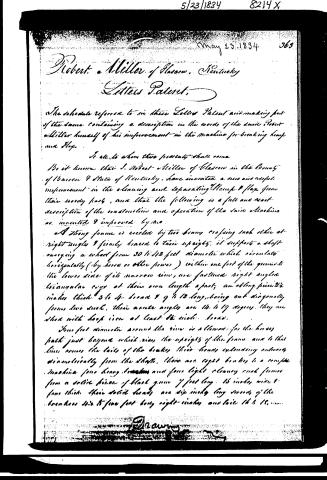
The schedule referred to in these Letters Patent and making part of the same containing a description in the words of the said Robert A. Miller himself of his improvement in the machine for breaking hemp and flax.
To all to whom these presents shall come
Be it known that I, Robert A. Miller of Glasgow in the County of Warren & State of Kentucky, have invented a new and useful improvement in the cleaning and separating Hemp & flax from their woody parts, and that the following is a full and exact description of the construction and operation of the said Machine as invented & improved by me.
A Strong frame is erected by two heavy crossing each other at right angles & firmly braced to their uprights, it supports a shaft carrying a wheel from 30 to 312 feet diameter which circulates horizontally (by horse or other power) within one foot of the ground to the lower side of its narrow rim, are fastened right angled triangular cogs at their own length a part; an oblong piece 2½ inches thick 3 to 4 broad & 9 to 12 long, being cut diagonally from one end, their acute angles are 16 to 19 degrees, they are shot with hoop iron at least ½ inch broad.
Four feet diameter around the rim is allowed for the horses path just beyond which rises the uprights of the frame and to that line comes the tails of the brakes their heads extending outward diagonally from the shaft, there are eight brakes to a complete machine four heavy and four light cleaning each formed from a solid piece of black gum 7 feet long 16 inches wide & four thick their solid heads are six inches long seven of the breakers 12 to 15 feet long eight inches and tails 16 to 18...
Drawing
Page 3.
5/23/1834 8214x
364
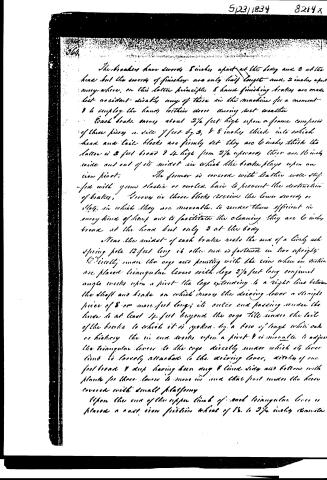
The breakers have swords 8 inches apart at the body and 2 at the head but the swords of finishing are only half length and 2 inches apart anywhere, on this latter principle 8 hand finishing breakers are made but accident-likely any of these in the machine for a moment & to employ the hands within doors during wet weather.
Each brake moves about 2½ feet high upon a frame composed of three pieces a side 7 feet by 2, & 8 inches thick into which head and tail blocks are firmly set they are 6 inches thick the latter is 2 feet broad & 14 high from 2½ upwards there are 16 inch wide and out of its midst in which the brake plays upon an iron pivot. The former is covered with leather well stop-fed with gum stachic or curled hair to prevent the destruction of brakes. Grooves in these blocks receive the lower swords or slugs, in which they are moveable to render them efficient in every kind of hemp and to facilitate the cleaning they are 6 inch broad at the head but only 3 at the body.
Near the midst of each brake rests the arm of a lively ash spring pole 12 feet long its other end is fastened in two uprights. Directly under the cogs and pointing with the rim when an action are placed triangular levers with legs 2½ feet long conjugated angle works upon a pivot the legs extending to a right line between the shaft and brake on which moves the driving lever a straight piece of 8 or more feet long; its outer end passing under the horse is at least 14 feet beyond the cogs till under the tail of the brake to which it is yoked by a bow of length which oak or hickory the in and works upon a pivot & is movable to adjust the triangular levers to the cogs directly under which its lever limb is loosely attached to the driving lever, directly of one foot broad & deep having been dug & lined side and bottom with plants for these levers to move in and that part under the horse covered with small plating.
Upon the end of the upper limb of such triangular levers is placed a cast iron friction wheel of 1½ to 2½ inch diameter
Page 4.
which remove four fifths of the friction as they roll over the iron face or the inclined plane of the cogs, these pins are out of the tail of each brake called-regulators because removing the yoke from one to another elevates or depresses the head of the brake to any desired height. Our each spring hole is a guard coming out of the tail block, which causes the brake to return from a given elevation. Each hand is furnished with a rake the pins of which are one foot long with it he occasionally removes the accumulating shavings & by a certain motion brings into one place all that have been attached to them, these levers are totally lost and lifted in burden & claimed in the same manner without the wheel put into motion, each cog in passing the friction wheel depresses the movable limbs of the triangle and with them the outer ends of the drawing levers and tails of the brakes elevating their head to any regulated height, whence the spring poles and their guards throw them freely down again, thus perpetuating by the simple action & reaction of levers for the triangle serve only to remove the drawing levers out of the hands way, they loose power and are wholly unnecessary with steam or water.
Eight hands are the full complement of a machine and move in the following order,
It stands upon (say the right side of a brake) and puts on his ample of raw hemp moving it shellfully at every arc of the brake, while the woody parts are chiefly driven out, when he turns to the finisher at the moment C, leaves it and is succeeded by B on the left side with his rough hemp who also turns to his finisher as D, puts it, thus alternately & continually occupying the eight brakes without interrupting each other and not performing the work of their superiors by more activity, by the labour being small.
The additional cog is necessary to the successive fall of the brakes each pair of which stand diametrically opposite to each other and move simultaneously, running as one...
The four brakes occupy the cardinal points forming a square.
Page 5.
366.
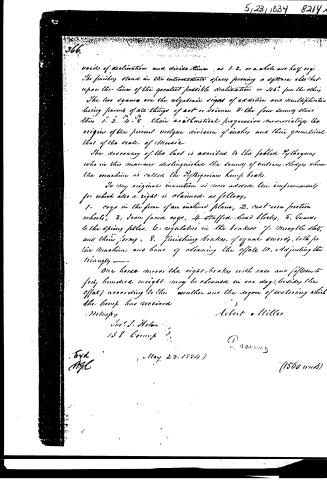
voids of declination and divide them as 1, 2, or a whole and half cog. The finishing stands in the intermediate space forming a system also but upon the line of the greatest possible declination or 45° from the other. The two squares are the algebraic signs of addition and multiplication being parents of all things of art or science & the four corners stand thus 1, 2, 4, 8 their arithmetical progression memorializes the origin of this present vulgar division of inches and their geometrical that of the scale of Music.
The discovery of the last is ascribed to the fabled Pythagoras who in this manner distinguished the sounds of outlaws, slugs, when the machine is called the Pythagorean hemp brake.
To my original invention is now added ten improvements for which also a right is claimed as follows,
1. cogs in the form of an inclined plane, 2. cast-iron friction wheels, 3. iron faced cogs, 4. stuffed lead blocks, 5. bands to the spring plates, 6. regulators in the brakes, 7. movable slats, and their forms, 8. finishing brakes, of equal density, both for the machine and hand, 9. cleaning the offals, 10. adjusting the triangle —
One horse moves the eight brakes with ease and filaments forty hundred weight may be cleaned in one day (besides the offals) according to the weather and the degree of watering which the hemp has received.
Murray
Albert a Miller
Mr. J. Helon
13 P. Lomps
(1)
May 20, 1806
(1560 words)
5/23/1834 8214 x
Published accounts: journal notice
Notice in the monthly list of patents, with remarks
Journal of the Franklin Institute, new ser., vol. 14 (1834), p. 403 · View the page
Those who are curious on the subject, and have the means of reference, may examine the 2d vol. p. 25, of the above named work, where, under date of 1702, they will find the description of a "Machine pour remonter les Bateaux, inventée par M. Martinot." It will then appear that this wheel has a fair claim to be placed among the "Modern Antiques." 35. For a machine for Breaking and Cleansing Hemp and Fax; Robert Miller, Glasgow, Barren county, Kentucky, May 23.
Remarks. We have not examined the list of patents, but presume from the wording of the claim that this is taken for improvements upon a machine previously patented by the same person, as he says, "To my original invention is now added ten improvements, (for which, only, a right is claimed.) 1. Cogs in the form of an inclined plane; 2. Cast iron friction wheels; 3. Iron faced blocks; 4. stuffed head blocks; 5. Guards for the spring poles; 6. Regulators on the brakes; 7. Movable slats and their forms; 8. Finishing brakes of equal swords, both for the machine and hand; 9 Cleaning the offal; 10. Adjusting the triangles." Whether all these, including friction wheels, movable slats, &c., are new, and patentable, we shall not now stop to inquire; there are others, we presume, who can reply to a question upon the subject.
About this record
- Patentee
- DATAMP
- Date
- the Name and Date index of patents, DATAMP, USPTO records
- Invention
- DATAMP
- Listed in
- the Name and Date index of patents, DATAMP, USPTO records, Jim Shaw's X-patent list, the Journal of the Franklin Institute, Burke's List of Patents (1847)
- Burke's 1847 Patent Office list gives the same patent.