

Drawings and documents
USPTO scan
The patent as scanned by the USPTO
-
 Page 1
-
 Page 2
-
 Page 3
-
 Page 4
-
 Page 5
-
 Page 6


U.S. Patent and Trademark Office · Google Patents
Show the transcription Hide (1,319 words)
Machine transcription (LightOnOCR) of the pages as scanned by the USPTO, most of them the handwritten copies made when the records were restored after the 1836 fire. Not checked; it can misread handwriting, so compare it with the scan.
Page 2.
United States Patent
Patent No.: X8215
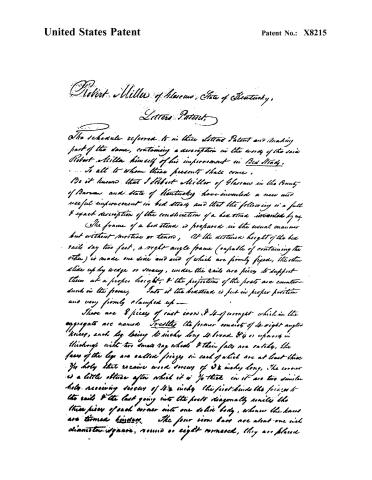
Robert Miller of Glasgow, State of Kentucky,
Letters Patent,
The schedule referred to in these Letters Patent and making part of the same, containing a description in the words of the said Robert Miller himself of his improvement in Bed Stead.
To all to whom these presents shall come,
Be it known that I Robert Miller of Glasgow in the County of Barren and State of Kentucky have invented a new and useful improvement in bed stead and that the following is a full & exact description of the construction of a bed stead invented by me.
The frame of a bed stead is prepared in the usual manner but without mortise or tenon, At the distance height of the bed rails say two feet, a right angle frame (capable of containing the other) is made one side and end of which are firmly fixed, the other slide up by wedge or screw, under the rails are pieces to support them at a proper height, & the projections of the posts are counter-sunk in the frame, Into it the bedstead is put in proper position and very firmly clamped up—
There are 8 pieces of cast iron & 4 of wrought which in the aggregate are named Fretles the former consists of 4 right angle knees, each leg being 10 inches long 4 broad & ½ or upwards in thickness with two small rag wheels & their fasts are catches, the faces of the legs are called fretles in each of which are at least three ½ hole that receive wood screws of 3½ inches long, The corner is a little obtuse after which it is ½ thick in it are two similar holes receiving screws of 3½ inches the first binds the fretles to the rails & the last going into the posts diagonally unites the three pieces of each corner into one solid body, whereas the knees are termed knees. The four iron bars are about one inch diameter square, round or eight cornered, they are placed
Page 3.
United States Patent
Patent No.: X8215
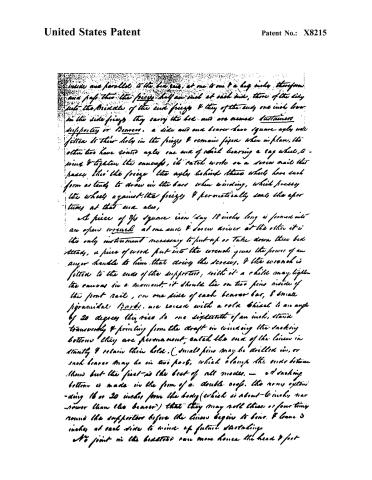
inside and parallel to the bar ends, at one to one & a half inch, therefrom and pass thru the fringes half an inch at each end, those of the city into the middle of the end fringes & they of the end one inch lower in the side fringes. They carry the bed and are named butterners supporting or Bearers. A side and end bearer have square axles and fitted to their hole in the fringes & remain fixed when in place; the other two have round axles one end of which bearing a tag wheel, to wind & tighten the canvas, it catch works on a screw nail that passes thru the fringes the axles behind these wheels have such form as tends to draw in the bars when winding, which presses the wheels against the fringes & permanently seals the after turns at that end also,
A piece of 3/4 square iron (say 18 inches long) is formed into an open wrench at one end & screw driver at the other; it is the only instrument necessary to put up or take down these bed stands, a piece of wood put into the wrench gives the power of an auger handle to him that drives the screws, & the wrench is fitted to the ends of the supporters, with it a child may tighten the canvas in a moment; it should lie on two pins inside of the front rail, on one side of each bearer bar, & small pyramidal Darks. are raised with a cold chisel to an angle of 20 degrees this rises to one sixteenth of an inch, stands transversely & pointing from the draft in winding the stocking bottom they are permanent, catch the end of the linen in stably & retain their hold. (Small pins may be drilled in, or such bearer may be in two parts, which clamp the ends between them but the first is the best of all modes. — a stocking bottom is made in the form of a double crop, the arms extending 16 or 20 inches from the body (which is about 6 inches narrower than the bearer) that they may roll three or four times round the supporter before the linen begins to bend, & leave 3 inches at each side to mine of future stretching.
A joint in the bedstead can move hence the head & foot
Page 4.
United States Patent
Patent No.: X8215
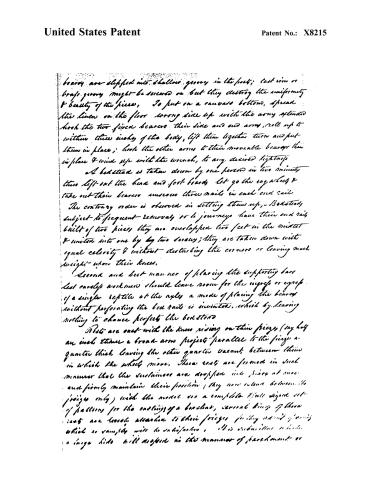
braces are slipped into shallow grooves in the posts; cast iron or brass grooves might be screwed on but they destroy the uniformity & beauty of the piece. To put on a canvas bottom, spread the linen on the floor, screw side up with the army extended, hook the two fixed braces, their side and end arms, roll up to within three inches of the body, lift them together, turn and put them in place; hook the other arms to their movable braces then in place & wind up with the wrench, to any desired height.
A bedstead is taken down by one person in two minutes, two lift out the head and foot boards, let go the sag wheels & take out their braces, unscrew three nails in each end rail.
The contrary order is observed in setting them up. Bedsteads, subject to frequent removal or to journeys, have their end rails built of two pieces, they are overlapped two feet in the midst & united into one by two screws; they are taken down with equal celerity & without disturbing the corners or leaving much weight upon their knees.
Second and best manner of placing the supporting bars lest careless workmen should leave room for the ingress or egress of a single reptile at the apex, a mode of placing the braces without perforating the bed rails is invented, which by leaving nothing to chance perfects the bedstead.
Rests are cast with the knees rising on thin pieces (say half an inch thick) a broad arm projects parallel to the pieces a quarter thick leaving the other quarter vacant between them in which the wheels move. These rests are formed in such manner that the sustainers are dropped into places at once and firmly maintain their position (they now return between the joists only) with the model as a complete & all sized set of patterns for the castings of a bedstead, several kinds of these rests are loosely attached to their joists for the varied forms which so simply will be satisfactory. It is evident that a large kind will respond in the manner of fastenment or
Page 5.
United States Patent
Patent No.: X8215
William T. Colwell, as a matter of course, will not make the most elastic, clean, and durable bottom.
All the rows must be painted, which renders them vulnerable to water and they will fall down. There is from five to one piece of each set should record the year of their birth that every house in future ages may possess what is now undetermined a true chronological era, this frame is joined to its trusses and filled without mortises, tenons, pins, nuts, cords, laces, lines, or eyelet hole, it is firm to solidity, durable as wood & iron. Nor is there a single invisible lodgment for one of those pestiferous vermin that have so long annoyed the human family. It never needs re-building whence it is called the Clean, firm and everlasting Bedstead.
Witnesses
Shon S. Hellen
B. V. Grosse
Robert Miller
1417 N.D.
Page 6.
United States Patent
Patent No.: X8215
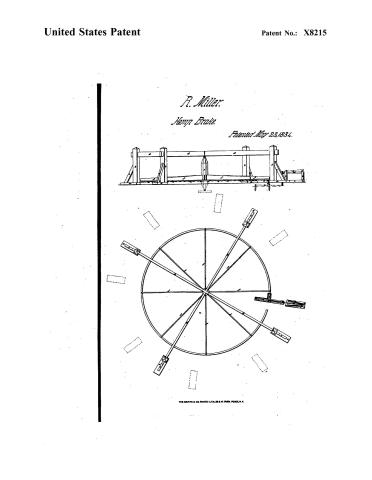
R. Miller
Harp Brake.
Patented May 23, 1834.

THE GRAPHIC CO., PHOTO-LITH., 30 & 41 PARK PLACE, N.Y.
Published accounts: journal notice
Notice in the monthly list of patents, with remarks
Journal of the Franklin Institute, new ser., vol. 14 (1834), p. 404 · View the page
26. For an improvement in Bedsteads; Robert Miller, Glasgow, Barren county, Kentucky, May 23.
Remarks. Some pains have been taken with this and the preceding specification, and the drawing accompanying them are pretty well executed; yet they fail in giving a clear idea of the particular things intended to be patented. So far as we are able to judge respecting the bedstead, the rails are to be united to the posts by means of irons dropping into each other, in a manner not very unlike many other bedstead fastenings. The sacking bottom is to be tightened by revolving iron bars, or rods, placed within the rails, and extending their whole length, they having journals turning in proper holes, and ratchet wheels and palls to hold them in their places. The patentee, who ought to know its value, praises the affair very highly; he says that "it is firm to solidity, durable as wood and iron; nor is there a single invisible lodgment for one of those pestiferous vermin that have so long annoyed the human family; it never needs scalding, whence it is called the Clean, Firm, and Everlasting Bedstead. As the sailor said by the everlasting to make into trowsers, "in that case, let me have enough for two pair."
About this record
- Patentee
- DATAMP
- Date
- the Name and Date index of patents, DATAMP, USPTO records
- Invention
- DATAMP
- Listed in
- the Name and Date index of patents, DATAMP, USPTO records, Jim Shaw's X-patent list, the Journal of the Franklin Institute, Burke's List of Patents (1847)
- Burke's 1847 Patent Office list gives the same patent.