

Drawings and documents
National Archives restored drawings: drawing
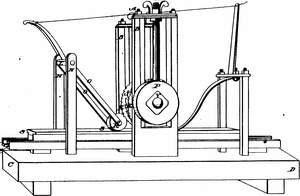
Benjamin Redheffer and William Redheffer's Patent Drawing for a Comb Machine


National Archives, Restored Patent Drawings (Record Group 241) · Full-size scan at the National Archives · Catalog record
Show the text on the drawing Hide (169 words)
Words on the drawing as machine-read by the National Archives; not checked. Useful mainly for searching.
Sheet 1. 144. WOOD WORKING MACHINES. / Molding, Straight Feed. / 8220 LOION. ICATION I R E D H E C & M WIL B HEDHEFFER'S / 13 / the atter / MACHINE. / Patented 26th May. 1834. / PLATE 1st / be / P. / one / D. / H. / H. / 11 / 11. / 11 / 12. / t. / S. / 3. / 6. / 8. / 7. / 2. / 4. / 5. / 1. / 1. / P L A T E 2 nd
Sheet 2. 144. WOOD WORKING MACHINES. / Plate 1. / Molding, Straight Feed. / $430 / BENJAMIN REDHEFFER & WILLIAM REDHIEFFER / bassivication / Machine for maKing combs / Patented 26 May 1834 / 8220-X 20- X / DIVISION. / Patent Office April 8th 1839 / made under the direction of the Comm prioner of Patents / in conformity with act of 3rd march 1837 / ML Sumorth / Commitsioner of Patents
Sheet 3. 144. WOOD WORKING MACHINES. / Molding, Straight Feed. / Ilat / CLASSIVICATION / Sig_10. / 8.220X 82 20. X / Tig.1 / Sig. 4. / Ig35 / Tig.11 / 11 / Jig.1 / Tig.9 / Jis.8 / Jig.7. / Jig. B / AA / rods / nuts / Refirinces R to Plate 2 / B.B The uprights / Jig.12 / Fig 1.1. / C.D / The saws / The arte / EE sliding boses / HH / The uprights / seraper / KK / L 0.0 arms R the coller P the pully the pulley
USPTO scan
The patent as scanned by the USPTO
-
 Page 1
-
 Page 2
-
 Page 3
-
 Page 4


U.S. Patent and Trademark Office · Google Patents
Show the transcription Hide (727 words)
Machine transcription (LightOnOCR) of the pages as scanned by the USPTO, most of them the handwritten copies made when the records were restored after the 1836 fire. Not checked; it can misread handwriting, so compare it with the scan.
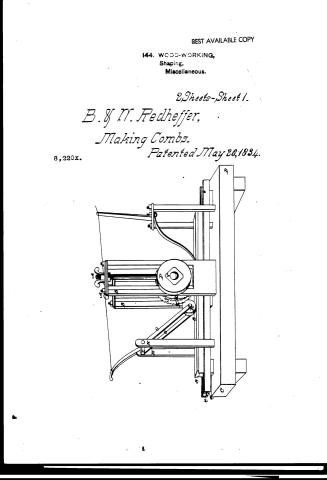
Page 1.
BEST AVAILABLE COPY
144. WOOD-WORKING,
Shaping,
Miscellaneous.
2 Sheets-Sheet 1.
B. & M. Redheffer,
Making Combs.
Patented May 26, 1884.
8,320x.

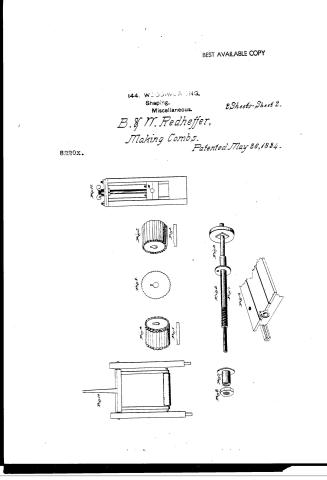
Page 2.
BEST AVAILABLE COPY
144. WOODWORKING.
Shaping,
Miscellaneous.
B. & M. Redheffer,
Making Combs.
Patented May 26, 1884.
8220x.

Page 3.
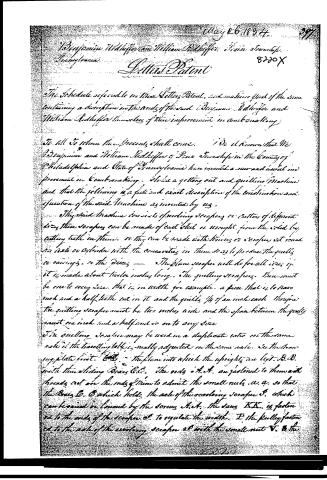
May 26, 1894. 397
Benjamin Riddiffer and William Riddiffer, Penna. Township, Pennsylvania
8220X
Letters Patent
The Schedule referred to in these Letters Patent, and made a part of the same containing a description in the words of the said Benjamin Riddiffer and William Riddiffer themselves of their improvement in comb-making.
To all to whom these presents shall come: We do it known that We Benjamin and William Riddiffer of Penna. Township in the County of Philadelphia and State of Pennsylvania have invented a new and useful improvement in Comb-making. Called a getting out and quilling Machine and that the following is a full and exact description of the construction and operation of the said Machine as invented by us.
The said Machine consists of feeding scrapers or cutters of different sizes, these scrapers can be made of cast steel or wrought from the solid by cutting teeth in them, or they can be made with knives or scrapers cut round in axle or cylinder with the concavities in them so as to produce the quills or ravings, so the sizes — The plane scraper will do for all sizes if it is made about twelve inches long. The quilling scrapers, there must be one to every size, that is, in width for example, a piece that is to have inch and a half teeth cut in it and the quills 1/4 of an inch each. Therefore the quilling scraper must be two inches wide and the space between the quills must one inch and a half and so on to any size.
The quilling scrapers may be used in a duplicate ratio on the same axle if the travelling table is neatly adjusted on the same axle. See the travelling plate first. C.C. — The plane into which the uprights are left. B.B. with their sliding Boxes C.C. The rods A.A. are fastened to them with threads cut on the ends of them to admit the small nuts a.a. so that the Boxes C.C. which holds the axle of the revolving scraper F. which can be raised or lowered by the screws A.A. the saws K.K. is fastened to the ends of the scraper C. to regulate the width. P. the pulley fastened to the axle of the revolving scraper C with the small nut V. & the
Page 4.
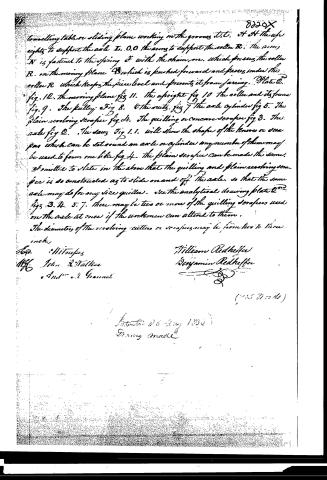
travelling table or sliding plane working in the grooves T.T. H H the uprights to support the axle I. O.O the arms to support the roller R. The arms N is fastened to the spring J with the chain m. which presses the roller R. on the moving plane B which is pushed forward and passes under the roller R which keeps the piece level and prevents it from farring. Plate 2. fig. 12. the moving plane fig 11. the upright fig 10 the roller and its frame fig. 9. The pulley fig 8. O the nuts. fig 7 The axle cylinder fig 5. The plain revolving scraper fig 4. The quilling or concave scraper fig 3. The axle fig 2. The saws fig 1.1. will show the shape of the knives or saws which can be set round an axle or cylinder any number of them may be used to form one like fig 4. The plain scraper can be made the same. I omit to state in the above that the quilling and plain revolving scraper is so constructed as to slide on and off the axle. so that the same axle may do for any size quills. see the analytical drawing plate 2 figs 3. 4. 5. 7. there may be two or more of the quilling scrapers used on the axle at once if the workmen can attend to them. The diameter of the revolving quills or scrapers may be from two to three inches.
Cop. : Mitroffes
Wm. John R. Walker
e And" A. Gannal
William Redheffer
Benjamin Redheffer
(15 30 46)
Patented 26 May 1854
Drawing made
Published accounts: journal notice
Notice in the monthly list of patents, with remarks
Journal of the Franklin Institute, new ser., vol. 14 (1834), p. 407 · View the page
43. For Machinery for Making Combs; Benjamin and William Redheffer, Germantown, Philadelphia county, Pennsylvania, May 26.
Remarks. This patent is taken for tools to be employed in the getting out and quilling of horn or tortoiseshell, for combs, preparatory to cutting the teeth. These tools consist of revolving steel cutters, or scrapers, and bearing pieces so constructed as to hold and advance the material properly against the cutters. In those for flat, or plane work, the teeth run straight across from end to end; in those for quilling, there must be grooves on the cutters corresponding to the size of the quill to be formed. The different scrapers are to be made to slide on and off the same axle, so that the quilling tools may be readily changed for those of other sizes. It is much to be doubted whether a patent for revolving cutters of this description can be sustained, as they have been used in the lathe for a variety of purposes for many years; and the application of such tools to the scraping, or cutting, of horn, &c., for combs, does not render them new. It is necessary, in order to justify the obtaining of a patent, to tell what is new in the thing patented, which has not been attempted in the present instance.
DATAMP: illustration
Illustrations from DATAMP

DATAMP (Directory of American Tool and Machinery Patents), via the Internet Archive · Archived DATAMP page
About this record
- Patentee
- DATAMP
- Date
- the Name and Date index of patents, DATAMP, USPTO records
- Invention
- DATAMP
- Listed in
- the Name and Date index of patents, DATAMP, USPTO records, Jim Shaw's X-patent list, the Journal of the Franklin Institute