

Drawings and documents
National Archives restored drawings: drawing
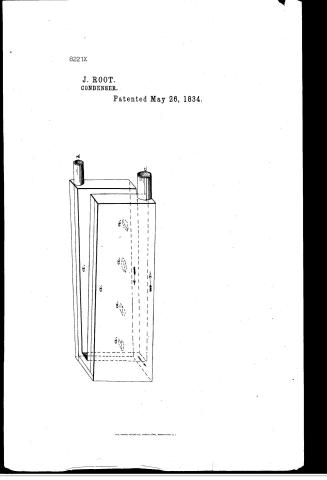
James Root's Patent Drawing for a Condenser

National Archives, Restored Patent Drawings (Record Group 241) · Full-size scan at the National Archives · Catalog record
Show the text on the drawing Hide (39 words)
Words on the drawing as machine-read by the National Archives; not checked. Useful mainly for searching.
XL / 195. ALCOHOL. / Distilled spirits- / Apparatus- / Stills- / Doublers and worms. / JAMES ROOT'S / Condenser / ICATION / 8221-X / Patente do 26th May 1834. / a. / Horizontal Line / us
USPTO scan
The patent as scanned by the USPTO
-
 Page 1
-
 Page 2
-
 Page 3
-
 Page 4
-
 Page 5


U.S. Patent and Trademark Office · Google Patents
Show the transcription Hide (1,786 words)
Machine transcription (LightOnOCR) of the pages as scanned by the USPTO, most of them the handwritten copies made when the records were restored after the 1836 fire. Not checked; it can misread handwriting, so compare it with the scan.
Page 1.
8221X
J. ROOT.
CONDENSER.
Patented May 26, 1834.

THE NORRIS PETERS CO., PHOTO-LITHO., WASHINGTON, D.C.
Page 2.
8221x
May 26, 1834
May 26, 1834
James Root Painesville Ohio
Letters Patent
The Schedule referred to in this Letters Patent and making part of the same containing a description in the words of the said James Root himself of his improvement called "Root's Condenser"
To all to whom these presents shall come, I James Root late of Albany in the State of New York now of the Town of Painesville, County of Geauga and State of Ohio send Greeting. Be it known that I the said James Root have invented, constructed and applied to use, a new and useful improvement in the form and construction of a worm or condenser for the purpose of condenser for the purpose of condensing vapours or steam arising from the boiling of any fermented or other liquids for distillation and separating the water from the Spirit by which Spirit is obtained much purer and at less expense than by any other means, called "Root's improved condenser" specified in the words following viz. This improvement consists in the form of the worm which is flat instead of being round, and in its dimensions and manner of construction, which is as follows.
From two plates from sheet copper, each fifty two feet in length, and fifteen and a half inches in width, upon one of these sheets intended for the inner side of the condenser, turn down each edge three fourths of an inch the whole length of the sheet at right angles with it, from twenty six studs or braces of sheet copper two inches square, and one inch in length and solder them firmly by one end along the centre of the sheet at the distance of six inches from each other, the sheet is then bent at right angles four inches each way from the longitudinal centre, and the two ends brought as near within eight inches of each other. The bend is slightly curved so that when the sheet is placed on one edge there may be an ascent of one half an inch to the foot from a horizontal line, which when the ends are brought around will raise or elevate one edge above the other twenty six inches. Then take the other sheet and turn the edges and bend it in the centre so that it will fit the first sheet and leave the space of one inch the length of each brace between them and firmly solder the two sheets.
Page 3.
together when the edges thereof have been turned over at right angles, laps forming a flat tube or worm, fifty-two feet in length, fourteen inches in depth, and one inch in width, turned at right angles, four inches each way from the centre, and the ends brought around even and eight inches apart, with the edge of one end elevated above that of the other twenty-six inches, having a clear uniform space from the ends up to the angle of eight inches into the lower edge of the lowest insert a cylindrical pipe or tube formed of sheet copper, four inches in diameter, and of any length necessary to connect the condenser with the boiler. One end of this pipe is elongated or flattened, so that it will properly fit into the condenser, and there firmly soldered in, and the residue of the end of the condenser fastened perfectly tight by a strip of copper soldered firmly on. Insert to the upper edge of the other end of the condenser, insert and securely fasten by solder a pipe or tube of sheet copper, two inches in diameter, elongated or flattened at the end, placing into the condenser, and of any length required to connect the other end with a common still worm, the remainder of the end of the condenser is then to be securely closed, in the same manner as the other, making the condenser perfectly tight, excluding both air and water except through the two tubes or pipes in the ends as aforesaid: a more perfect idea may be obtained from an examination of the accompanying drawing of said condenser to which reference is had for that purpose.
a a The body of the condenser, completed and placed on one edge, at an elevation of one-half inch to the foot, from a horizontal line. C pipe, four inches in diameter, through which the steam arising from the boiling beer, fermented liquor, or other liquid or substance to be distilled, passes from the boiler into the condenser. D pipe, two inches in diameter, through which the spirit, vapour or steam when separated from the aqueous, and heavy parts in the flat condenser passes and is received into a common still worm, to be condensed.
it, it, it, it, Bones or studs placed six inches apart in the centre of the condenser to prevent its collapsing from the pressure of the water surrounding it. The arrow shows the course of the condensed water returning along the bottom of the condenser, and into the boiler through the pipe C, which is made large for that purpose, so that the returning water and entering steam may not interfere. This condenser is calculated for a boiler that will contain three hundred gallons.
Page 4.
8221x
May 26, 1834
3.
and should be increased in length and depth in proportion as the boiler shall be either larger or smaller, and the diameter of the pipe or tube C, should also be increased in proportion to the enlarged size of the boiler.
Application and use. The condenser when applied to use is placed in a vat or trough twenty seven feet long, three and a half feet deep and eighteen inches wide in its edge, having the pipe C, at the bottom and elevated one half inch to the foot from a horizontal line at the angle or turn in the condenser and the pipe C, firmly and tightly connected with the boiler forming a conductor from the boiler to the condenser, and the pipe B attached to and forming conductor from the condenser to the common still room. The vat is then filled with cold water and the boiler charged with beer or other liquid or substance, to be distilled and the heat applied as in common distilleries. The steam passing from the boiler into the condenser will condense and return back into the boiler, until the water in the vat is raised to about one hundred and seventy six degrees of Fahrenheit thermometer, when the watery and heavy parts of the steam in the condenser will condense and separate from the spirituous or lighter parts and fall to the bottom of the condenser and return into the boiler through the pipe C, while the spirituous parts of the steam will rise and ascend along the upper edge of the condenser and pass out through the pipe B into a common still room to be condensed when the water in the vat arises to the proper degree of heat and the spirit arises and passes through the pipe B. It should be kept at that temperature by running a stream of cold water into it sufficient to counteract the effect of the continual heat thrown out by the steam passing through the condenser. By increasing the temperature of the water in the vat above 176 degrees you diminish the strength of the spirit, it being the purest at the lowest temperature of the water in the vat at which the spirit and water will separate in the condenser. The condenser is designed more especially for the manufacture of alcohol or high spirits, which can be obtained by passing it once through the still from eighty six to ninety four per cent above hydrometric proof of whiskey, and by going through the process termed doubling that is running it through the still again, it will come out as high as ninety four per cent above proof. Advantages. The advantages of my improved condenser condenser over any other known or used prior to my
Page 5.
said invention, are principally these. It is extremely difficult by any other form, or condenser, to manufacture alcohol even as high as eighty degrees above hydrometric proof, and almost impossible to run it as high as ninety per cent above proof or high enough for the making of what is called alcohol gas, whereas by means of my improved condenser alcohol can be obtained as high as ninety six per cent above hydrometric proof, and the expenses but a trifle more than the expense of running common proof whiskey and for the purpose of manufacturing gas from alcohol and spirits of turpentine, the improvement in making and obtaining the alcohol is invaluable on account of its purity and the low price per gallon at which it can be made.
My improvement and for which I claim a patent consists in the constructing of the worm or condenser flat so that the sheet of steam passing through it shall not be more than one inch thick, and of sufficient depth to allow the ascending steam of spirit and the descending condensed water to pass along the condenser without interfering and in putting in the studs to prevent the collapsing of the condenser. The condenser may be made of any length, and it is believed that if made long enough, it will separate the water and spirit entirely, but for any known use it may be obtained pure enough by one of the lengths heretofore mentioned. It may also be made straight, circular, zig zag, octagon or quadrat, as may best suit the convenience of the works, and the fancy of the maker. The principle is the same and care should be taken that the width or thickness in no case exceeds one inch. The principles of the separation of water from spirit by means of surrounding the condenser with hot water, I do not claim as any part of my improvement or invention. My intention being more properly an improvement on the patent of James Y. Penekes, for an improvement in the process of distilling. In testimony that the above is a true specification of my said invention and improvement as above described I have set my hand the twenty fourth day of April A. D. eighteen hundred and thirty four.
Witnesses
W. H. Asborn
H. Rosa
Drawing (1792 words)
(Granted May 26, 1834)
Published accounts: journal notice
Notice in the monthly list of patents, with remarks
Journal of the Franklin Institute, new ser., vol. 14 (1834), p. 406 · View the page
41. Foran improved Condenser for Stills; James Root, Painesville, Geauga county, Ohio, May 24.
Remarks. This condenser is to be made by taking two sheets of copper, each fifty-two feet in length, and placing them parallel to each other, and not more than an inch apart; studs are to be soldered between these, to keep them at that distance, and their edges are to be bent over and united by soldering, thus forming them into a flat tube, fourteen inches wide. This tube is to be bent in the middle, so as to reduce it to about half the length, the space between the two parts being four inches at the bend, and eight inches at the ends. One of these ends is to be connected with the still, by a tube, at its lower edge; and from a tube at the upper edge of the other end, the vapour is to escape into the ordinary worm. The condenser is to be placed within a vat supplied with cold water, and is to have an inclination towards the still of half an inch to a foot, throughout its whole length, that the fluid formed in it may return by its own gravity. By this arrangement, alcohol of a very high proof can, it is said, be obtained in the first running, and that with great economy. The claim is to "the constructing of the worm, or condenser, flat, so that the sheet of steam passing through it shall not be more than one inch thick, and of sufficient depth to allow the ascending steam of spirit, and the descending condensed water, to pass along the condenser without interfering; and in putting in the studs to prevent the collapsing of the condenser." "It may be made straight, circular, zigzag, &c.; the principle is the same." This claim cannot, certainly, be sustained, condensers formed of flat tubes having been made, and more than one of them patented.
About this record
- Patentee
- DATAMP
- Date
- the Name and Date index of patents, DATAMP, USPTO records
- Invention
- DATAMP
- Listed in
- the Name and Date index of patents, DATAMP, USPTO records, Jim Shaw's X-patent list, the Journal of the Franklin Institute, Burke's List of Patents (1847)
- The Franklin Institute's journal gives a different date.
- Burke's 1847 Patent Office list gives the same patent.