

Drawings and documents
National Archives restored drawings: drawing
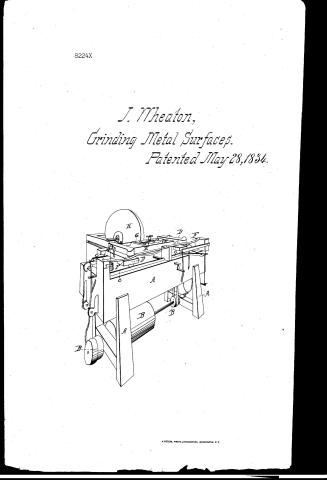
J. Wheaton's Patent Drawing for an Elliptical Spindle Grinder

National Archives, Restored Patent Drawings (Record Group 241) · Full-size scan at the National Archives · Catalog record
Show the text on the drawing Hide (121 words)
Words on the drawing as machine-read by the National Archives; not checked. Useful mainly for searching.
(70 ed is Angular Surfaces. / 1100 / Elliptical spindle grinder. / no. number. / Patented May 28th 1834 / VOL 18 PAGE493 / CLASSIFICATION / 8224.X / DIVISION. / our / Can he moved to or from / for trocks / by 16 in point / of A, / motion to Carrage to beground / The lather is kipt strady and pressed / against the tack by neceive of Two friction / Shappand mughts as seen at I- / References. / A.A.A. Frame of the machine. / B.B.B. Spindle drum. / C.C.C. Railway orslide / D.D. The Carriage. / E Lathe that holds the spindle or string tobog round. / F.F. Track of the lathe / G. Spindle rest. / H. Grindstone. / I. Weight tosteady . the lathe.
USPTO scan
The patent as scanned by the USPTO
-
 Page 1
-
 Page 2
-
 Page 3
-
 Page 4
-
 Page 5


U.S. Patent and Trademark Office · Google Patents
Show the transcription Hide (1,449 words)
Machine transcription (LightOnOCR) of the pages as scanned by the USPTO, most of them the handwritten copies made when the records were restored after the 1836 fire. Not checked; it can misread handwriting, so compare it with the scan.
Page 1.
8224X
J. Wheaton,
Grinding Metal Surfaces.
Patented May 28, 1834.

Page 2.
5/28/1834 8224X
May 28, 1834 495
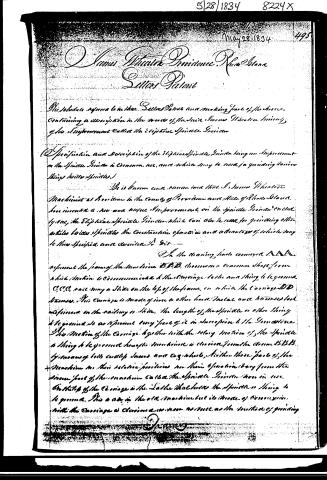
James Wheaton Providence, Rhode Island
Letters Patent
The solemnly referred to in these Letters Patent and making part of the same,
containing a description in the words of the said James Wheaton Inventor,
of his Improvement called the Elliptical Spindle Grinder.
(Specification and Description of the Elliptical Spindle Grinder being an Improvement
on the Spindle Grinder in Common use, and which may be used for grinding various
things with Spindles.)
Be it known unto all men that I, James Wheaton
Machinist at Providence in the county of Providence and State of Rhode Island,
have invented a new and useful Improvement on the Spindle Grinder called
by me, the Elliptical Spindle Grinder which can also be used for grinding other
articles with Spindles the Construction operation and advantages of which may
be thus specified and described. To wit—
In the drawing, lettered A A A A.
represent the frame of the machine B B B B. common a common shape from
which Motion is communicated to the Carriage, to the one thing to be ground
C C C C, said may a Slide on the top of the frame, on which the Carriage D D
turns. This Carriage is made of iron or other hard Metal once to have lock
and form on the railway or Slide, the length of the Spindle or other thing
to be ground so as to present every part of it in succession to the Grindstone.
The Motion of the Carriage together with the rotary Motion of the Spindle
a thing to be ground, though the mechanism is derived from the Arms B B B
by means of both equal levers and cog wheels, Neither these parts of the
Machine to their relative positions nor their operation vary from the
same part of the machine called the Spindle Grinder, nor in use.
On the top of the Carriage is the Table that holds the Spindle or thing to
be ground. This is also in the old Machine but its mode of connexion
with the Carriage is different as more as well as the method of grinding.
D. W.
Page 3.
it will move on the Carriage from the Course of the Carriage, or about the Centre, lengthwise and move the cage of it, next the gimcrack, explains plainly a short first wheel of part in the Carriage but moves easily in a slot in the Saddle. The Saddle might be driven entirely round, or this run it out for the parts of the machine, is object to be joined to be partly turned as it moves on the Carriage and at the same time to give it the same motion forward and back that the Carriage has. The New Old Machine the Saddle has the same motion forward and back as the Carriage and also a motion from side to side. The same effect may also be produced by connecting the Saddle to the Carriage by means of wheels or pulleys made fast to the one and moving, in reverse, those to the other, but this mode of connexion though more convenient, is plain to the one first obvious.
On the top of the side of the frame there is a notch from the Gimcrack one placed above stands extending upward which as the latter is lashed to there is the back of the latter L.P. against this back the latter helps to its fapping back and forth on the carriage. The stick or first wheel serves its connexion with the carriage permitting it always to help against it although it is not in a right line with the side of the latter. The same result can be obtained by having the back motion on one or the other side of the latter but so connecting this is also clearer or even the picture of the latter against the back and also on the carriage is diminished by the use of friction pulleys. The latter is kept steady and proper against the stick by means of the friction straps and weights one of which is fastened to each end of the carriage and a stick. The strap fapping up on a pulley on the latter from which the weight is suspended one of these is seen in the drawing and is marked D.
On the top of the latter are attached six by a strong bolt fapping through a slot in the Spindle and 2 more of that or other slot instead. The thickness of the metal is great to the diameter of the thing to be ground and its length depends upon the length of the thing to be ground. Against the side of this are hinged the Spindles. The Spindle a thing to be ground proper and so by means of two screws
Page 4.
8224X
497
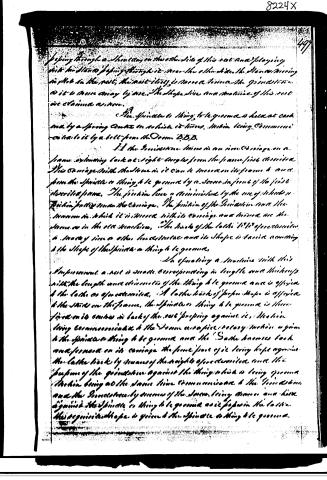
flying through a channel on the other side of this net and playing with the stone flying through it across the other side, the stone moving in the net, the net itself is more than the pinion to it is more easy by use. The shape size and motion of this net are claimed as new.
The spindle is thing to be ground a hole at each end by a spring cutter to reduce it to size, motion being communicated to it by a belt from the Drum B.B.B.
If the Spindle is thing to be ground is an iron carriage on a frame extending back at right angles from the frame first described. The carriage with the stone in it can be moved on its frame & one from the spindle is thing to be ground by a screw in front of the first described frame. The friction line is diminished by the use of which a friction pulley under the carriage. The friction of the Spindle and the manner in which it is moved with its carriage and motion are the same as in the old machine. The back of the latter 17th of the written is many times a other lines and its shape is similar according to the shape of the spindle or thing to be ground.
In operating a machine with this improvement a net is made corresponding in length and thickness with the length and diameter of the thing to be ground and is applied to the latter as a extension. A lathe back of proper shape is applied to the side on the frame, the spindle or thing to be ground is then fixed on its centre in back of the net pressing against it. Motion being communicated to the Drum as a piece of rotary motion again to the spindle or thing to be ground and the Stone becomes back and forward on its carriage the same force of it being kept against the lathe back by means of the straight of one described and the friction of the grinding against the thing which is being ground Motion being at the same time communicated to the Spindle and the Spindle by means of the Stone being moved and kept against the spindle or thing to be ground as it passes in the lathe the required shape is given to the spindle or thing to be ground.
Page 5.
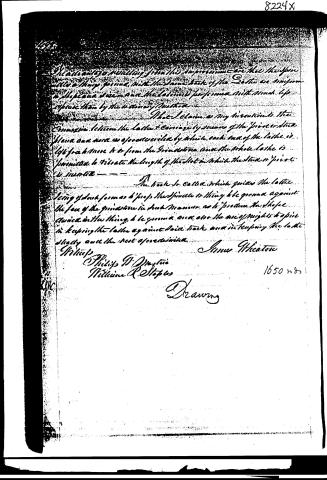
The advantages resulting from this improvement are that the spin-
tles are kept going, with the same back of the Satter are uniform
in shape and size, and the labor is performed with much less
expense than by the ordinary method.
That I claim as my invention is the
Connection between the latter & carriage by means of the pivot or stick
flank and more as a sort of lever by which each end of the latter is
kept from moving to or from the grindstone and the whole latter is
permitted to vibrate the length of the slot in which the stick or pivot
is inserted — — —
The back so called which guides the latter
being of such form as to keep the spindle or thing to be ground against
the face of the grindstone in such manner as to produce the shape
desired in the thing to be ground and also the use of weights to assist
in keeping the latter against said back and in keeping the latter
steady and the rest of the invention.
James Wheaton
Witness
Philip W. Doughty
William R. Staples
1650 n.d.
Drawing
Published accounts: journal notice
Notice in the monthly list of patents
Journal of the Franklin Institute, new ser., vol. 14 (1834), p. 408 · View the page
46. For an improved Spindle Grinder; James Wheaton, Machinist, Providence, Rhode Island, May 28.
DATAMP: illustration
Illustrations from DATAMP


DATAMP (Directory of American Tool and Machinery Patents), via the Internet Archive · Archived DATAMP page
About this record
- Patentee
- DATAMP
- Date
- the Name and Date index of patents, DATAMP, USPTO records
- Invention
- DATAMP
- Listed in
- the Name and Date index of patents, DATAMP, USPTO records, Jim Shaw's X-patent list, the Journal of the Franklin Institute, Burke's List of Patents (1847)
- Burke's 1847 Patent Office list gives the same patent.