

Drawings and documents
USPTO scan
The patent as scanned by the USPTO
-
 Page 1
-
 Page 2
-
 Page 3
-
 Page 4
-
 Page 5
-
 Page 6
-
 Page 7
-
 Page 8


U.S. Patent and Trademark Office · Google Patents
Show the transcription Hide (2,563 words)
Machine transcription (LightOnOCR) of the pages as scanned by the USPTO, most of them the handwritten copies made when the records were restored after the 1836 fire. Not checked; it can misread handwriting, so compare it with the scan.
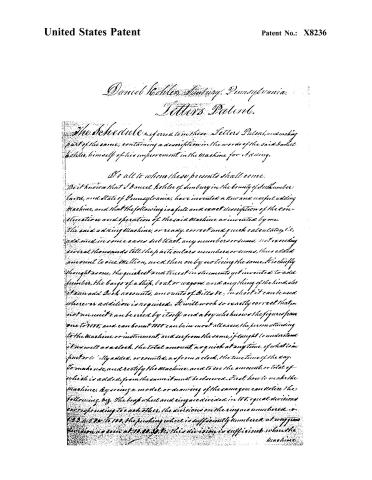
Page 2.
United States Patent
Patent No.: X8236
Daniel Kohler, Sunbury, Pennsylvania.
Letters Patent.
The Schedule referred to in these Letters Patent, and making part of the same, containing a description in the words of the said Daniel Kohler, himself of his improvement in the Machine for adding.
To all to whom these presents shall come.
Be it known that I Daniel Kohler of Sunbury in the county of Northumberland, and State of Pennsylvania, have invented a New and useful adding Machine, and that the following is a full and exact description of the construction and operation of the said Machine as invented by me.
The said adding Machine, or ready, correct and quick calculator, i.e., add and in some cases subtract, any numbers or sums, not exceeding several thousands till the particulars numbers, or sums, thus added amount to one Million, and then only noticing the same. It is chiefly thought as one, the quickest and truest instruments yet invented to add lumber, the cargo of a ship, boat, or wagon, and anything of the kind, also it can add Book accounts, amounts of Bills &c; in short it can be used wherever addition is required. It will work so exactly correct that no man unit can be erred by itself and a boy who knows the figures from one to 1000, and can count 1000 can be in most all cases, the person attending to the Machine or instrument, and see from the same, if taught to understand it as well as a clock, the total amount, as quick at any time, of what is put or to 'lly added, or counted, as from a clock, the time of the day.
To make use, and rectify the Machine, and to see the amount, or total of which is added, from the same it must be observed. First, how to make the Machine. By seeing a model or drawing of the same you can notice the following by. The top wheel and ring are divided in 100 equal divisions corresponding to each other, the divisions on the ring are numbered 1, 2, 3, 4, 5 to 100. The pushing wheel is sufficiently numbered at any given division as seen at 10, 20, 30, &c. this division is sufficient when the Machine.
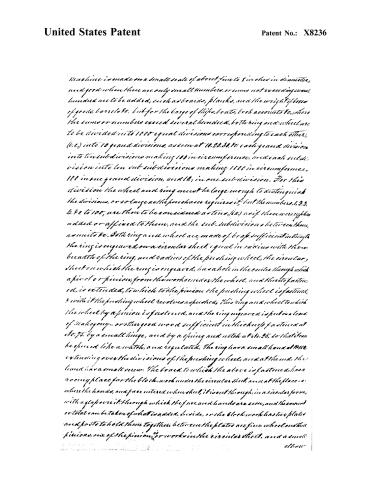
Page 3.
United States Patent
Patent No.: X8236
Machine is made on a small scale of about five to 8 inches in diameter, and good when there are only small numbers, or sums not exceeding some hundred and to be added, such as boards, planks, and the weight of boxes of goods, barrels &c. but for the barge of ships, boats, both accounts be, where the sums or numbers exceed several hundreds, both ring and wheel are to be divided into 1000 equal divisions corresponding to each other, (i.e.) into 10 grand divisions, as seen at 10, 20, 30, &c. each grand division into ten subdivisions making 100 in circumference, and each subdivision into ten sub-subdivisions making 1000 in circumference, 100 in one grand division, and 10, in one sub-division. For these divisions the wheel and ring must be large enough to distinguish the divisions, or so large as the purchaser requires it, but the numbers, 1, 2, 3, 4 &c to 100, are then to be considered as tens, (i.e.) as if there were cyphers added or affixed to them, and the sub-subdivisions between them, as units &c. Both ring and wheel are made of brass, sufficient in strength. The ring is engraved on a circular sheet, equal in radius with the breadth of the ring, and radius of the pushing wheel, the circular sheet on which the ring is engraved, has a hole in the centre through which a pivot or pinion, from the work under the wheel, and there to be fastened, is extended, to which to the pinion the pushing wheel is fastened, & with it the pushing wheel revolves as pushed. This ring and wheel to which the wheel by a pinion is fastened, and the ring engraved is put in a box of mahogany—or other good wood sufficient in thickness, fastened at its 75 by a small hinge, and by a spring and notch at its 25, so that it can be opened like a watch, and regulated. The ring has a small hand at 1000, extending over the divisions of the pushing wheel, and at the end, the hand has a small screw. The board to which the above is fastened, has a roomy place for the block-work under the circular sheet, and at the place where the hands, and face entered when shut, it is cut through, in a circular form, with a flap over it, through which the face and hands are seen, and the amount or total can be taken of what is added. Inside, or the block-work has two plates and posts to hold them together, between the plates are five wheel and five pinions, one of the pinions, or works in the circular sheet, and a small elbow
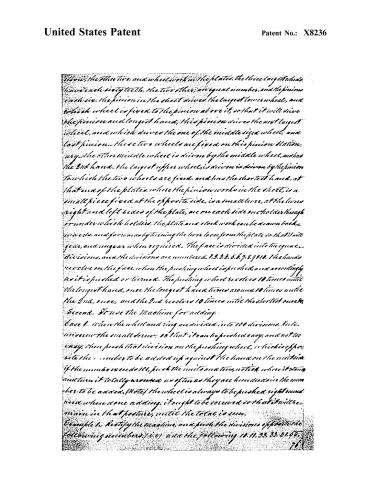
Page 4.
United States Patent
Patent No.: X8236
follow the other two, and wheel work in the plates. the three largest wheels have each sixty teeth, the two other, an equal number, and the pinions each six, the pinion in the sheet drives the largest lower wheel, and which wheel is fixed to the pinion above it, so that it will drive the pinion and longest hand, this pinion drives the next largest wheel, and which drives the one of the middle sized wheel, and last pinion. these two wheels are fixed on this pinion stationary. the other middle wheel is driven by the middle wheel, and has the 2nd hand. the largest upper wheel, is driven in driven by the pinion to which the two wheels are fixed, and has the shortest hand, at that end of the plates, where the pinion works in the sheet, is a small piece fixed at the opposite side, is a small lever, at the lower right and left sides of the plate, are on each side an holder through or under which holders, the plate and clock work can be drawn back inwards, and for purposes by turning the lever loose from the plate so that it will gear, and ungear when required. The face is divided into ten equal divisions, and the divisions are numbered 1. 2. 3. 4. 5. 6. 7. 8. 9. 10. The hands revolve on the face when the pushing wheel is pushed, and accordingly as it is pushed or turned. The pushing wheel revolves 10 times until the longest hand, once the longest hand turns around 10 times until the 2nd, once, and the 2nd revolves 10 times until the shortest once, Second. To use the Machine for adding.
Case 1. When the wheel and ring are divided into 100 divisions. Rule, move on the small lever, so that it can be pushed easy, and not too easy, then push that division on the pushing wheel, which is opposite the number to be added up against the hand on the units side if the number needs 116, push the units and tens, notice where it stands and turn it totally around as often as they are hundred in the number to be added. (Note) the wheel is always to be pushed right round and when done adding, it ought to be secured so that it will remain in that posture, until the total is seen.
Example to Rectify the Machine, and push the divisions opposite the following numbers, i.e. 10. 11. 23. 33. 41. 55.
78
Page 5.
United States Patent
Patent No.: X8236
76. 90. 81. 3. 98. 7. and see their total or amount. (there are 537) —
(Note) to see the total, see the last head, to see the amount.
Example. 2. Rectify the Machine, and push the following, or add
the following, 10. 9. 7. 60. 74. 90. 75. 20. 34. 31. 37. 40. 7. 8. 17. 19. 12. 13. 70. 65.
11. 5. 34. 73. 83. 95. 90. 50. 83. 41. 43. 36. 27. 23. 49. 67. 55. 45. 21. 30. 40. 13. 75. 90.
11. 9. 77. 88. 89. 99. 33. 34. 19. 2. 31. 29. 38. 49. 57. and see the total (this 2,531.
Case 3. when rings and wheel are divided in 1000 divisions or so
considered. Rule proceed as in case 1. by moving and adding, or
pushing, the numbers to be added, and if the number or sum be
added exceeds 1000, push the hundreds, tens, and units. Notice,
where it 2 Tens, and turn it once, totally around for why thou
sund in the sum or number given. Example. 315. 600. 770. 860. 166.
116. 230. 445. 990. 766. 320. 795. 880. 995. 115. 266. 360. 450. 655. 765. 337. 665.
840. 460. 550. 465. 2130, and see the amount. — [See 1610]
Push first 130, then the pushing wheel has 130. Notice these, and
take hold at the little slot or elsewhere and turn it twice around.
Thirdly. To rectify the Machine, — 1. when the machine is divided into
100 divisions. 1. when there are only a few hundreds added.
Rule, take hold at the little slot on the wheel or elsewhere, and turn it
backwards, or left around until all the hands are at 10, 100, at 100,
outside on the wheel, and it is ready for addition. 2nd. when there
are Units of thousands, and units, and tens of thousands added.
Rule, unscrew the outer screw on the hand, push 100 to 100, screw it
again, open it at the spring at 100, turn the lever on the sheet next to you
with your right hand towards you, draw the block work a little le-
wards the lever, take a slide hold at the largest wheel next to the lever,
with your fore finger move your finger in a shutting manner, by holding
it against the wheel, turn the wheel in that manner until all the hands
are at 10, or near, if near, turn the longest hand to 10, push the block work
from you into gear again, turn the lever as it was when made open, shut it,
unscrew the little screw at 100, so that it will permit the wheel to turn
and not too easy, and the machine is ready for a new addition.
B. when the machine is divided in a 1000 divisions. 1. When
Here
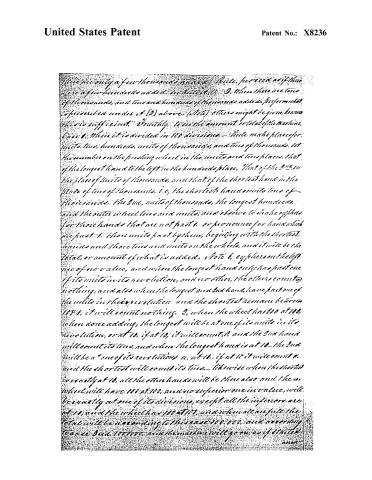
Page 6.
United States Patent
Patent No.: X8236
There are only a few thousands added. Rule, proceed as if there were a few hundreds added, as in Rule (1). 2. When there are tens of thousands, and tens and hundreds of thousands added, perform what is prescribed under it [2] above. (Note) others might be given, however this is sufficient. 3. Multiply, to see the amount or total of the Machine. Case 1. When it is divided in 100 divisions. Rule, make places for units, tens, hundreds, units of thousands, and tens of thousands. Let the number on the pushing wheel in the units and tens places, that of the longest hand to the left in the hundreds place, that of the 2nd on the place of units of thousands, and that of the shortest hand in the place of tens of thousands. i.e., the shortest hand counts tens of thousands. The 2nd, units of thousands, the longest hundreds, and the outer wheel tens and units, and observe to make off for those hands that are not past 1. or pronounce for hand which are past 1. those units past by them, beginning with the shortest hands and those tens and units on the wheels, and it will be the total, or amount of what is added. Note 1, ciphers on the left are of no value, and when the longest hand only has past one of its units in its revolution, and no other, the others count nothing, and also when the longest and 2nd hand, have past one of the units in their revolution and the shortest remain between 11 & 1, it will count nothing. 2, when the wheel has 100 at 100, when done adding, the longest will be at one of its units in its revolution, or at 10, if at 10, it will count 0, and the 2nd hand will count its tens, and when the longest hand is at 10, the 2nd will be at one of its revolutions a, at 10, if at 10 it will count 0, and the shortest will count its tens. likewise when the shortest is exactly at 10, all the other hands will be there also and the wheel will have 100 at 100, and no inferior one in value, will be exactly at one of its divisions, except all the inferiors are at 10, and the wheel has 100 at 100, and when all are full, the total will be according to this case 100,000, and according to case 3 and 100,000, and the machine will go on as if stated above.
Page 7.
United States Patent
Patent No.: X8236
unew or us a clock where 12. — 3. when the wheel has between 90 and 100, the longest hand will appear to be nearly at one of its divisions, but it is not to be put down, that only which it has past last, until the wheel has 100 at 100, or is past 100. Also the 2nd hand will not be at one of the divisions in its revolution until the longest hand is at 10, and only the longest hand is at 10, that number to which the 2nd is near coming to, is not to be put down, that only which it has past last, until the longest is at 10, or past, and also the shortest hand will not be at one of its divisions in its revolution until the 2nd hand is at 10, and before the 3rd hand is at 10, that number to which the shortest, is near coming to, is not to be put down, that only which it has past last until the 2nd is at 10 or past 10, i.e., 11. the whole will regulate each other, and each inferior in value will demonstrate the true epoch and exactness of all its superiors. Theorem 1. — Suppose 85 is on the wheel the longest hand has past 0, the 2nd past 6, and the shortest past 8, what is the total. Answer 86,335.
<table>
<tr>
<td>Units</td>
<td>or pronounce rights</td>
</tr>
<tr>
<td>100</td>
<td>6 right</td>
</tr>
<tr>
<td>hundreds</td>
<td>3 hundred</td>
</tr>
<tr>
<td>units 1000</td>
<td>3 thirty and</td>
</tr>
<tr>
<td>10 of 1000</td>
<td>5 five.</td>
</tr>
<tr>
<td></td>
<td>86,335</td>
</tr>
</table>
Theorem 2
Suppose 85 on the wheel (longest past 3, the 2nd past 4, but the shortest is past 7, what is the total?). Answer 70,360.
Theorem 3
Suppose the wheel has 100 at 100 (hand is past 4, the 2nd past 7, and the shortest is not past 4, what is the total?) Answer 9400.
Theorem 4
Suppose the shortest hand has past 8, and none of the others have past 8, but the wheel has 6, how much is it. Ans 87,106.
Case 2
When the ring and wheel are divided in 1000 divisions. Rule, make places for units, tens, hundreds, units of 1000, 10 of 1000, and 100 of 1000, let the number of the wheel in the three places on the right by. In the places
Page 8.
United States Patent
Patent No.: X8236
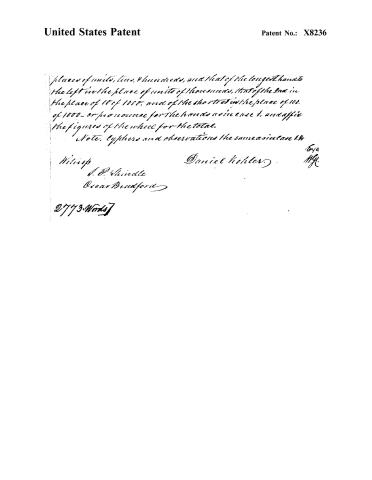
places of units, tens, & hundreds, and that of the longer hand to the left in the place of units of thousands, that of the 3na in the place of 10 of 1000, and of the shorter in the place of 100 of 1000— or pronounce for the hands as in case 1, and affix the figures of the wheel for the total.
Note. Cyphers and observations the same as in case 1.
Witness
J. P. Shindle
Oscar Bradford
Daniel Kohler
2773 Words
Published accounts: journal notice
Notice in the monthly list of patents, with remarks
Journal of the Franklin Institute, new ser., vol. 15 (1835), p. 29 · View the page
8. For a Machine for Adding; Daniel Kohler, Sunbury, Northumberland county, Pennsylvania, June 6.
Remarks. In the volume of the "Machines Approuveés par L'Academie Royale," there is a considerable number described for performing operations in arithmetic, and we could point to many others of more recent date. Judging, however, from the universal fate of such machines, we conclude that they have generally led to the road "round Robin Hood's barn," for we have never seen one, excepting in the collections of some learned societies, where they are deposited as articles of curiosity. We are apprehensive, therefore, that the present patentee has expended a portion of thought and money upon his contrivance, for which he will never be rewarded, either in pelf or in fame. The machine operates by means of wheels and pinions, and the sums added are pointed out by indices. We do not think that we should perform a service acceptable to our readers, by attempting a description of it, more especially as the patentee has neglected to tell in what particulars its novelty consists, having made no claim, and the whole affair being treated as though the Abacus and Babbage's machine, with all the contrivances intermediate in merit and in time, had never existed.
About this record
- Patentee
- DATAMP
- Date
- the Name and Date index of patents, DATAMP, USPTO records
- Invention
- DATAMP
- Listed in
- the Name and Date index of patents, DATAMP, USPTO records, Jim Shaw's X-patent list, the Journal of the Franklin Institute, Burke's List of Patents (1847)
- Burke's 1847 Patent Office list gives the same patent.