

Drawings and documents
National Archives restored drawings: drawing
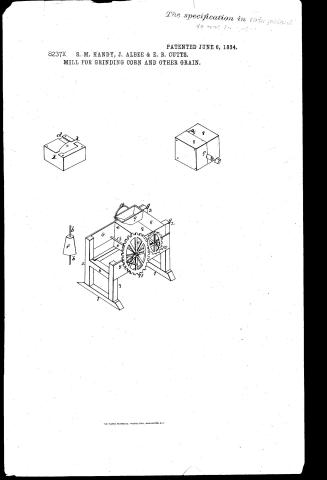
S. M. Handy, J. Albee, and E.B. Cutt's Patent Drawing for a Mill for Grinding Corn and Other Grain

National Archives, Restored Patent Drawings (Record Group 241) · Full-size scan at the National Archives · Catalog record
Show the text on the drawing Hide (47 words)
Words on the drawing as machine-read by the National Archives; not checked. Useful mainly for searching.
83. MILLS. / Grinding Mills. / S.M.HANDY, J.ALBEE & E.B.CUTTS' / Cone and Shell. / lone / shell / Mill for grinding corn $ other grain / CC ICATION / Patented June 6th 7834 / 82 8237.4 3% X / DIVISION. / 14 / 00 / 41 / 570 / Is / 6' / 11 / 010
USPTO scan
The patent as scanned by the USPTO
-
 Page 1
-
 Page 2
-
 Page 3


U.S. Patent and Trademark Office · Google Patents
Show the transcription Hide (723 words)
Machine transcription (LightOnOCR) of the pages as scanned by the USPTO, most of them the handwritten copies made when the records were restored after the 1836 fire. Not checked; it can misread handwriting, so compare it with the scan.
Page 1.
PATENTED JUNE 6, 1834.
8237X. S. M. HANDY, J. ALBEE & E. B. CUTTS.
MILL FOR GRINDING CORN AND OTHER GRAIN.

THE NORRIS PETERS CO., PHOTO-LITHO., WASHINGTON, D. C.
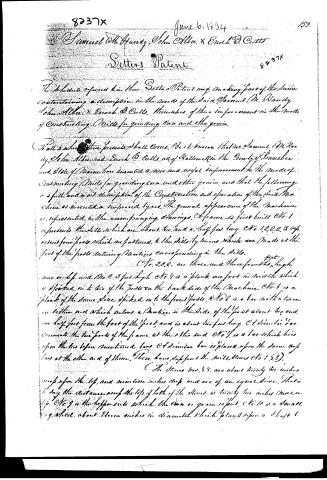
Page 2.
8237X
June 6, 1834
Samuel M. Handy, John Albee & Enoch B. Cutts
Letters Patent
The specification referred to in this Letters Patent and making part of the same containing a description in the words of the said Samuel M. Handy, John Albee & Enoch B. Cutts, themselves, of their improvement in the mode of constructing Mills for grinding corn and other grain.
To all to whom these presents shall come, Be it known that we Samuel M. Handy, John Albee and Enoch B. Cutts, all of Hallowell in the County of Cumberland and State of Maine, have invented a new and useful improvement in the mode of constructing Mills for grinding corn and other grain, and that the following is a full and exact description of the Construction and operation of the said Machine as invented and improved upon. The general appearance of the Machine is represented in the accompanying drawings. A frame is first built. No 1 represents the stile which are about two and a half feet long. No 1, 2, 2, 2, 3, 4, 5 represent four posts which are fastened to the stile by tenons which are made at the foot of the posts having notches corresponding in the stile.
No 2, 2, 2, are three and three-fourths feet long one or leg and No 3, 3 feet high. No 4 is a plank one foot in width which is spiked on to two of the posts on the back side of the Machine. No 5 is a plank of the same size spiked on to the front posts. No 6 is a bar with a tenon on either end which enters a Mortise in the Side of the post about two and one half feet from the foot of the post, and is about two feet long. A similar bar connects the two posts of the frame at the other end. No 7 is a bar which lies upon the two before mentioned bars. A similar bar is placed upon the same bars at the other end of them. These bars support the Mill Stones (No 1, 8, 8).
The Stones Nos. 8, 8, are about twenty two inches deep upon the top, and nineteen inches deep, and one of an equal size. That is to say, the distance over the tops of both of the Stones, is twenty two inches more or less. No 9 is the hopper into which the corn or grain is put. No 10 is a small 9, wheel, about Eleven inches in diameter which plays upon a shaft.
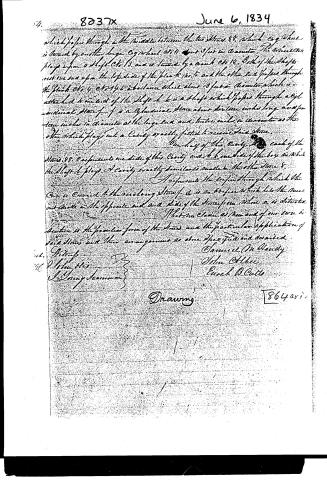
Page 3.
which passes through in the middle between the two stones 8 & 8, which cog wheel is turned by another large cog wheel 26 11 about 3 feet in diameter. The wheel 26 11 plays upon a shaft 26 13 and is turned by a crank 26 12. Both of the shafts rest one end upon the top side of the plank 26 10 and the other end passes through the plank 26 4, 26 14, 6 inches wide about 13 feet in diameter which is attached to one end of the shaft 26 12 is a shaft which passes through a cylindrically shaped stone about six feet in length and fourteen inches in diameter at the large end and twelve inches in diameter at the other which plays into a cavity exactly fitted to receive said stone.
One half of this cavity, 26 16, each of the stones 8 & 8 represents one side of this cavity and the lower side of the box 26 18 which the shaft 26 12 plays. A cavity exactly similar is made in the other stone 8.
A represents the orifice through which the corn is carried to the revolving stones 8 & 8 is an orifice which leads the corn out through the opposite end and side of the stones from where it is directed.
That we claim as new and our own invention is the peculiar form of the stones and the particular application of said stones and their arrangement as above specified and detailed.
Witness:
Samuel M. Handy
John Athier
Enoch B. Cutler
Drawing
Published accounts: journal notice
Notice in the monthly list of patents, with remarks
Journal of the Franklin Institute, new ser., vol. 15 (1835), p. 29 · View the page
7. For Mills for Grinding Corn, or other Grain; Samuel M. Handy, John Albee, and Enoch B. Cutts, Hallowell, Kennebec county, Maine, June 6.
Remarks. "A cylindrical stone," which cylinder, by the by, is the frustrum of a cone, about sixteen inches long, and fourteen inches in diameter at one end, by twelve at the other, is to be enclosed between two other stones, each of which is excavated to receive one-half of it, and to admit the spindle by which it is to be turned. There is also an opening for feeding the grain, and another for the exit of the meal. Of the frame, we need not say any thing; there is nothing particular in its form or substance, all the presumed novelty in the machine consisting in "the peculiar form of the stones," which, with the "particular application of said stones, and their arrangement," constitute the claim. This invention, it appears, is tripartite, each of the inventors having contributed his share of knowledge to bring it to perfection; and as the claim consists of three simple items, we suppose that one of the parties contributed the "form of the stones," another their "application," and the third their "arrangement." Should this contrivance not very far surpass our anticipations of its utility, we apprehend that neither of the gentlemen concerned will grow rich upon one-third of the profit to be derived from it.
About this record
- Patentee
- DATAMP
- Date
- the Name and Date index of patents, DATAMP, USPTO records
- Invention
- DATAMP
- Listed in
- the Name and Date index of patents, DATAMP, USPTO records, Jim Shaw's X-patent list, the Journal of the Franklin Institute, Burke's List of Patents (1847)
- Burke's 1847 Patent Office list gives the same patent.