

Drawings and documents
USPTO scan
The patent as scanned by the USPTO
-
 Page 1
-
 Page 2
-
 Page 3


U.S. Patent and Trademark Office · Google Patents
Show the transcription Hide (917 words)
Machine transcription (LightOnOCR) of the pages as scanned by the USPTO, most of them the handwritten copies made when the records were restored after the 1836 fire. Not checked; it can misread handwriting, so compare it with the scan.
Page 2.
United States Patent
Patent No.: X8248
Bernard Jackson, of Brown County Ohio
Letters Patent.
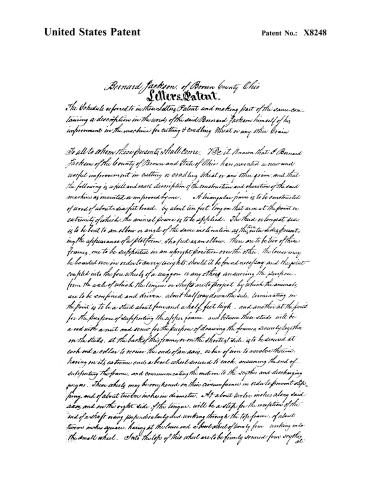
The Schedule referred to in these Letters Patent and making part of the same containing a description in the words of the said Bernard Jackson himself of his improvement in the machine for cutting & cradling Wheat or any other Grain.
To all to whom these presents shall come. Be it known that I Bernard Jackson of the County of Brown and State of Ohio have invented a new and useful improvement in cutting or cradling Wheat or any other grain, and that the following is a full and exact description of the construction and operation of the said machine as invented or improved by me. A triangular frame is to be constructed of wood of about six feet broad, by about ten feet long on that arm at the point or extremity of which the animal power is to be applied. The third or longest side is to be bent to an elbow or angle of the same inclination as the other sides presenting the appearance of a platform, shaped as an elbow. There are to be two of these frames, one to be supported in an upright position over the other. The lower may be boarded over in order to carry weights, should it be found necessary, and the joint coupled into the fore wheels of a wagon or any others answering the purpose, from the axle of which the tongue or shafts are to project, by which the animals are to be confined and driven, about half way down the side, terminating in the point is to be a stud about four and a half feet high, and another at the joint for the purpose of supporting the upper frame, and between these studs will be a rod with a nut and screw for the purpose of drawing the frames securely together on the studs. At the back of this frame, or on the shortest side, is to be secured at each end a collar to receive the ends of an axis, or bar of iron to revolve therein, having on its extreme ends a bevel wheel secured to each, answering the end of supporting the frame, and communicating the motion to the scythes and discharging pegs. These wheels may be roughened on their circumference in order to prevent slipping, and of about twelve inches in diameter. At about twelve inches along said axis, and on the right side of the tongue, will be a step for the reception of the end of a shaft, rising perpendicularly and working through the top frame, of about twelve inches square, having at the lower end a bevel wheel of twenty four working into the small wheel. Into the top of this wheel are to be firmly secured four scythes, etc.
Page 3.
United States Patent
Patent No.: X8248
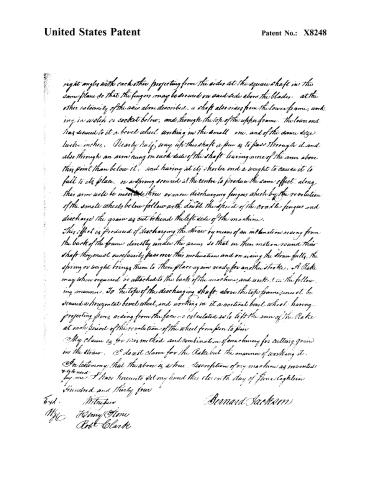
right angles with each other, projecting from the sides at the square shaft in the same plane so that the fingers may be secured on said side above the blades. At the other extremity of the axis above described, a shaft also rises from the lower frame, working in a slip or socket below, and through the top of the upper frame. The lower end has secured to it a bevel wheel working in the small one, and of the same size twelve inches. Nearly half way up this shaft a pin is to pass through it, and also through an arm hung on each side of the shaft leaving more of the arm above this point than below it, and having at its shorter end a weight to cause it to fall to its place, or a spring secured at the centre to produce the same effect. Along this arm will be inserted three or more discharging fingers which by the revolution of the small wheels below follow with double the speed of the cradle fingers and discharge the grain as cut behind the left side of the machine.
This effect is produced of discharging the straw by means of an inclination rising from the back of the frame directly under the arms so that in their motion round their shaft they must necessarily pass over this inclination and on rising the straw falls. The spring or weight brings them to their place again ready for another stroke. A Rake may when required be attached to the back of the machine, and works in the following manner. To the tops of the discharging shafts, above the top frame, must be secured a horizontal bevel wheel, and working in it a vertical bevel wheel, having projecting pins rising from the face so calculated as to lift the arm of the Rake at each period of the revolution of the wheel from pin to pin.
My claim is for this method and combination of machinery for cutting grain in the straw. I do not claim for the Rake but the manner of working it.
In testimony that the above is a true description of my machine as invented and used by me, I have hereunto set my hand this eleventh day of June eighteen hundred and thirty four.
Bernard Jackson
Exd. Witness
Myc Henry Stone
Rob Clarke
Published accounts: journal notice
Notice in the monthly list of patents, with remarks
Journal of the Franklin Institute, new ser., vol. 15 (1835), p. 38 · View the page
30. For a Machine for Cutting and Cradling Wheat; Bernard Jackson, Brown county, Ohio, June 14.
Remarks. The description of this machine is not very clearly written, but the drawing being well executed, its construction may be collected from the two together, although, without the latter, we can give but a general idea of it. The machine is to run upon four wheels, two of which are coupled on that end of it to which the horse is attached, and the other two at the hind, or operating, end. These latter wheels are made rough, to take hold of the ground, and have beviled teeth on them to gear into a bevil wheel upon vertical shafts; one of these vertical shafts carries four scythes, standing out at right angles from each other; above these scythes, there are fingers upon the same shaft to collect the grain. On the opposite vertical shaft, there are what are called discharging arms, which are to deposit the grain, as it is cut, behind the left side of the machine. The claim is to this combination of machinery for cutting grain. However good this apparatus may prove in certain situations, like other mowing machines, it can be used only upon such land, the surface of which is uniform, and clear from stones and stumps.
About this record
- Patentee
- DATAMP
- Date
- the Name and Date index of patents, DATAMP, USPTO records
- Invention
- DATAMP
- Listed in
- the Name and Date index of patents, DATAMP, USPTO records, Jim Shaw's X-patent list, the Journal of the Franklin Institute, Burke's List of Patents (1847)
- Burke's 1847 Patent Office list gives the same patent.