

Drawings and documents
National Archives restored drawings: drawing
J.C.Kempton's Patent Drawing for a Power Loom

National Archives, Restored Patent Drawings (Record Group 241) · Full-size scan at the National Archives · Catalog record
Show the text on the drawing Hide (56 words)
Words on the drawing as machine-read by the National Archives; not checked. Useful mainly for searching.
130. WEAVING, / Shattle-Boxes. / J.C.KE.MPTO.N. / IDATION / POWER LOOM. / Patented 14th June 1834. / 8250.X / LIV IDION. / Figh / Frig. Five 2. / DD / аД / D\ / DD / IF / Frg3. / Note. / Similar letters on the different Figures / refer to similar parts of machine. / h nn h
USPTO scan
The patent as scanned by the USPTO
-
 Page 1
-
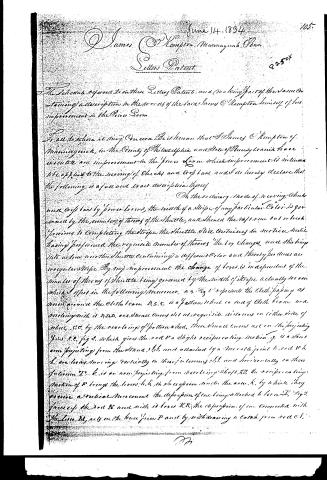 Page 2
-
 Page 3


U.S. Patent and Trademark Office · Google Patents
Show the transcription Hide (591 words)
Machine transcription (LightOnOCR) of the pages as scanned by the USPTO, most of them the handwritten copies made when the records were restored after the 1836 fire. Not checked; it can misread handwriting, so compare it with the scan.
Page 1.
8250X
J. C. Kempton.
Loom.
Patented Jun. 14, 1834.
Fig. 1
Fig. 2
Fig. 3
Page 2.
June 14, 1834
James C. Kempton, Manayunk, Penn.
Sellers Patent
The Schedule referred to in these Letters Patent, and a making part of the same containing a description in the words of the said James C. Kempton himself of his improvement in the Pica Loom.
To all to whom it may concern: Be it known that I, James C. Kempton of Manayunk, in the County of Philadelphia and State of Pennsylvania, have invented an improvement in the Pica Loom, which improvement is intended to be applied to the weaving of checks and cross bars, and I do hereby declare that the following is a full and exact description thereof.
In the ordinary mode of weaving checks and cross bars by pica looms, the width of a stripe of any particular color is governed by the number of threads of the shuttle, and should the warp come out or break previous to completing the stripe, the shuttle will continue its motion while having performed the requisite number of threads. The loom changes, and the loom will act on another shuttle containing a different color and thereby produces an irregular stripe. By my improvement, the change of looms is independent of the number of threads of the shuttle being governed by the width of stripe actually woven, which I effect in the following manner:
A & Fig 1 represent the cloth passing as woven around the cloth beam B, etc., is a pattern wheel on one of the cloth beams and working with it D, D, D, are small cams set at requisite distances on either side of wheel C, C, by the revolving of pattern wheel, these small cams act on the projecting pins C, C, Fig 2, which gives the rod R a slight reciprocating motion. Y is a short arm projecting from the stand S, etc., and attached by a universal joint to rod R, etc., are levers moving vertically in their fulcrums F, F, and horizontally on their fulcrum T. K is an arm projecting from revolving shaft S, S, the reciprocating motion of R brings the levers L, L, in the space under the arm K, by which they receive a vertical movement, the depression of one being attached to lever L, Fig 3, forces up the rod N and with it lever R, R, the depression of one connected with the lever M, acts on the brace piece P and by withdrawing a catch from rod C, etc.
Page 3.
allows the bow to fall. The rotation of Cloth-beam is effected in the usual manner by means of a ratchet and tongue which causes it to revolve only as the lofts or workers in the frame should thrust back or run out, the beam and with it the batten wheel remains quiet and thus the boxes remain unchanged during frequent the shuttle may be thrown.
That I claim as my invention is the method herein described of changing the boxes independent of the number of threads of shuttle by means of the stripe actually thrown and this I claim whether the same is effected precisely in the manner set forth or in any other operating on the same principle and producing the same effect.
Witnesses
Mary Keupton
Samuel Gordon
James C. Keupton
Drawing
162408
Published accounts: journal notice
Notice in the monthly list of patents, with remarks
Journal of the Franklin Institute, new ser., vol. 15 (1835), p. 34 · View the page
18. For an improvement in the Power Loom; James C. Kempton, Manayunk, Philadelphia county, Pennsylvania, June 14.
Remarks. In the weaving of stripes in the ordinary power loom, the width of each stripe is governed by the number of the throws of the shuttle, and in case of the breaking or running out of the weft, the shuttle still goes on, and is replaced by another when it has counted its number, rendering the stripe, in such case, narrower than it ought to be. The object of the present invention is to remedy this defect, by causing the change of shuttle to be independent of the number of throws, and governing it by the actual width of the stripe. The arrangement by which this effect is produced, is not given so much in detail as it ought to have been, for want of a more complete drawing; but the general principle is distinctly set forth. On the end of the cloth beam there is what is called a pattern wheel, which revolves with the beam, and has on it cams, which are made to act upon the levers which raise the shuttles; and as these cams operate only by the turning of the pattern wheel, the shuttles cannot be changed until a certain width of cloth is wound thereon; the same shuttle, therefore, may be thrown any number of times, if empty, as the beam will not move. The claim is, to "the method described of changing the boxes, independent of the number of throws of the shuttle, by means of the stripe actually woven."
About this record
- Patentee
- DATAMP
- Date
- the Name and Date index of patents, DATAMP, USPTO records
- Invention
- DATAMP
- Listed in
- the Name and Date index of patents, DATAMP, USPTO records, Jim Shaw's X-patent list, the Journal of the Franklin Institute, Burke's List of Patents (1847)
- Burke's 1847 Patent Office list gives the same patent.