

Drawings and documents
USPTO scan
The patent as scanned by the USPTO
-
 Page 1
-
 Page 2
-
 Page 3
-
 Page 4


U.S. Patent and Trademark Office · Google Patents
Show the transcription Hide (1,126 words)
Machine transcription (LightOnOCR) of the pages as scanned by the USPTO, most of them the handwritten copies made when the records were restored after the 1836 fire. Not checked; it can misread handwriting, so compare it with the scan.
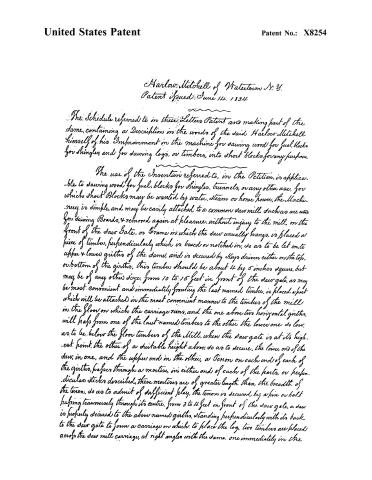
Page 2.
United States Patent
Patent No.: X8254
Harlow Mitchell of Watertown N.Y.
Patent issued June 11, 1834
The Schedule referred to in these Letters Patent and making part of the same, containing a Description in the words of the said Harlow Mitchell himself of his Improvement in the machine for sawing wood for fuel, blocks for shingles, and for sawing logs, or timbers, into short blocks for any purpose.
The use of the Invention referred to, in the Petition, is applicable to sawing wood for fuel, blocks for shingles, trunnels, or any other use, for which short blocks may be wanted by water, steam or horse power, the Machinery is simple, and may be easily attached to a common saw mill such as are used for sawing Boards, & removed again at pleasure, without injury to the mill, on the front of the saw Gate, or Frame in which the saw usually hangs, is placed a piece of timber, perpendicularly which is boxed or notched in, so as to be let on to upper & lower girths of the same, and is secured by keys driven either on the top, or bottom of the girths, this timber should be about 4 by 5 inches square, but may be of any other size, from 10 to 15 feet in front of the saw gate, as may be most convenient and immediately fronting the last named timber, is placed a post which will be attached in the most convenient manner to the timbers of the mill in the floor on which the carriage runs, and the one above two horizontal girths, will fast from one of the last named timbers to the other, the lower one so low, as to be below the floor timbers of the Mill, when the saw gate is at its highest point, the other, of a suitable height above, so as to secure, the lower end of the saw, in one, and the upper end in the other, a Tenon on each end of each of the girths, passes through a mortise, in either end of each of the parts, or perpendicular sticks described, these mortises are of greater length than the breadth of the tenon, so as to admit of sufficient play, the tenon is secured by a pin or bolt passing transversely through its centre, from 3 to 4 feet in front of the saw gate, a saw is firmly secured to the above named girths, standing perpendicularly with its back to the saw gate to form a carriage on which to place the log, two timbers are placed across the saw mill carriage, at right angles with the same, one immediately in the
Page 3.
United States Patent
Patent No.: X8254
rear of the wooden posts; and the other about 14 feet, in front of the saw, these are let down on to the carriage and secured to it by keys, two girths running parallel with the saw mill carriage are framed into the last named timbers half way near the saw on each side. Two or more Rollers with round tenons or pivots resting on the side timbers of the cross carriage are placed, through these rollers several large holes are bored near the ends, into which a cross bar or hand spike can be placed, and by turning them the log which had been placed on the cross carriage is drawn forward before the saw, the log is confined in the following manner, in one of the afore named timbers, which helps near the saw, a foot is inserted, nearly opposite the saw, a lateral perpendicular mortise, commences in the same bed piece, about a foot or less from said foot and extends forward to two or more feet the bed piece is perforated with holes helping horizontally through said mortise, about two inches apart, another foot is set in the long mortise, and secured by a bolt helping through some of the holes named, so that this foot may be moved near to the other, or distant from it, as the size of the log to be cut may require, near the top of the stationary part a mortise helps through it with a transverse hole through its centre, a small piece of timber is fitted, with a long tenon, perforated with many holes so that it, by helping through the last named mortise may be secured by a bolt & taken up, or let out to any required length, the other end of this piece of timber comes near to the head of the loose or movable foot & is secured to it by a lever, turning a short crank or tenon, near the connecting end which is made thin, in form of a tenon and helps through a slot in the end of the top piece and in to a slot in the head of the saw foot, and is secured to each by a bolt in such a manner that by bearing down the lever, the head of the two feet is brought nearer together, and binds the log between the two feet in the inside of which short iron teeth are placed. The last named lever & the manner in which it is connected with the head of the feet is called a jack, and may be secured by iron joints, instead of bolts, when the log to be sawn is placed in the proper place, and secured by the Jack, the saw mill gate is hoisted, and the lateral or common saw mill carriage moves forward, & the log is sawn off in the same time which would be required to saw the same surface of Board. The Subscriber has sawn with his first experiment as much as twenty four cords of large logs in twelve hours. The Subscriber claims as his own Invention, the application of water, steam, or Horse power to sawing wood transversely, the particular manner of placing a lateral and
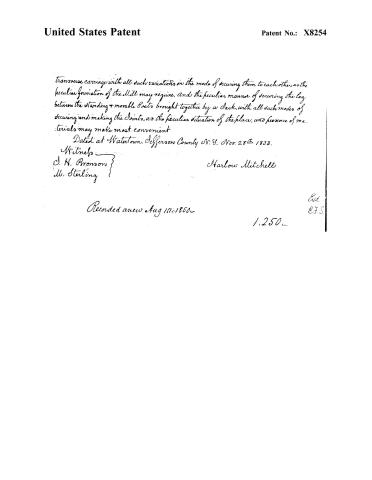
Page 4.
United States Patent
Patent No.: X8254
transverse carriage with all such variations in the mode of securing them to each other as the peculiar formation of the Mill may require, and the peculiar manner of securing the log between the standing & movable posts brought together by a Jack, with all such modes of securing and making the joints, as the peculiar situation of the place, and presence of materials may make most convenient
Dated at Watertown, Jefferson County N.Y. Nov. 28th 1833.
Witness
J. N. Bronson
W. Sterling
Harlow Mitchell
Recorded anew Aug 10, 1850
1.250
Evd
C.F.S.
Published accounts: journal notice
Notice in the monthly list of patents, with remarks
Journal of the Franklin Institute, new ser., vol. 15 (1835), p. 39 · View the page
31. For a Machine for Sawing Wood for Fuel; Harlow Mitchell, Rutland, Jefferson county, New York, June 14.
Remarks. This machine, as described, is to be attached to a common saw mill, so as to work a cross cutting saw by the ordinary power of the mill, and to use the ordinary carriage for moving the log, so as to bring it crosswise against the saw. The saw, and indeed the whole apparatus, is so made that it may be attached and removed at pleasure. The patentee proposes to use it in all cases where logs are to be cut transversely, into bolts or short blocks, for any purpose, and avers that, in his first experiment with it, he sawed to the amount of twenty-four cords of wood, from large logs, in twelve hours. The saw which he uses is to be fixed in a rectangular frame, working upon pins, forming joints at each of the corners. One of the vertical timbers of this frame is attached to the frame of the saw gate, there being another parallel to it, from ten to fifteen feet in front of it. The saw is to be hung to two of the horizontal pieces of timber that connect these vertical pieces, one of which will vibrate above, and the other below, the log to be sawed. The saw, like the ends of the frame, must work upon joint pins, and may be three or four feet in advance of the ordinary mill saw. There is a jack, or clamp, the construction of which is shown in the drawing, to hold the log to be cross-cut; this jack is attached to the ordinary carriage, so that, when the water is let on, the log will be carried against the saw. There are several particulars in the action of this machine, which should have been more fully set forth in the specification; and this certainly might have been done, as the inventor professes to have carried the plan into practical operation. The patentee "claims as his own invention, the application of water, steam, or horse power, to sawing wood transversely; the particular manner of placing a lateral and transverse carriage, with all such variations in the mode of securing them to each other, as the peculiar formation of the mill may require; the peculiar manner of securing the log between the standing and movable posts, but brought together by a jack; with all such modes of securing and making the joints, as the peculiar situation of the place, and presence of materials, may make most convenient." We think this claim is too broad, especially in the first member of it, as wood has been frequently sawed transversely by water, steam, or horse power; and if this had not been done, the mere doing so will not justify a claim to all the methods of accomplishing it which may hereafter be invented.
About this record
- Patentee
- DATAMP
- Date
- the Name and Date index of patents, DATAMP, USPTO records
- Invention
- DATAMP
- Listed in
- the Name and Date index of patents, DATAMP, USPTO records, Jim Shaw's X-patent list, the Journal of the Franklin Institute, Burke's List of Patents (1847)
- Burke's 1847 Patent Office list gives the same patent.