

Drawings and documents
National Archives restored drawings: drawing
Leonard Norcross' Patent Drawing for an Elastic Air Refreshing Water Dress

National Archives, Restored Patent Drawings (Record Group 241) · Full-size scan at the National Archives · Catalog record
Show the text on the drawing Hide (68 words)
Words on the drawing as machine-read by the National Archives; not checked. Useful mainly for searching.
HYDRAULIC NGINEERING. / Diving Armor. / LEONHARD NORCROSS. / Intented 14 the / Elastie air refreshing water Drep / wound / sound / 8255-X / whose ares with end phose / represented drawing hilling any / LIBERTY / Patent- office March 29 1839 / Made under the direction of the Commepioner / of Patents in conformity with acts / Many / Commisioner af atents / Prefences / airhor / Eube-with / helmet / Double / air
USPTO scan
The patent as scanned by the USPTO
-
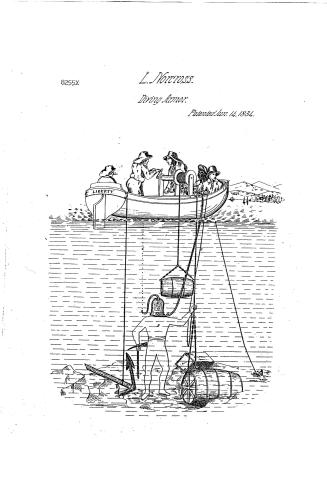 Page 1
-
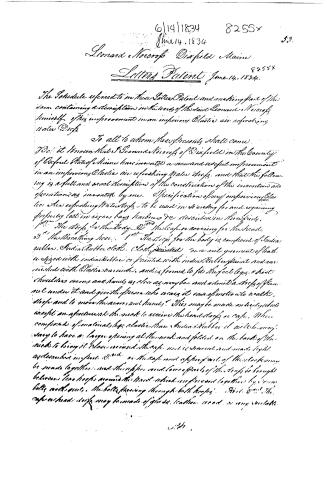 Page 2
-
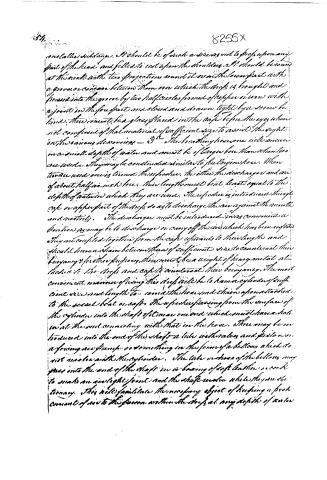 Page 3
-
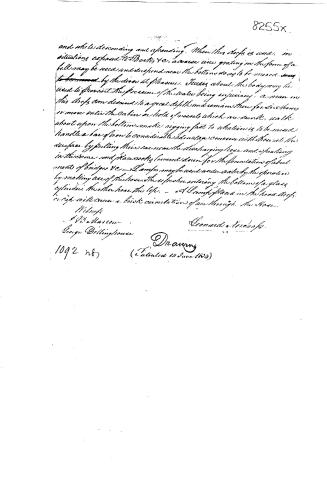 Page 4


U.S. Patent and Trademark Office · Google Patents
Show the transcription Hide (1,062 words)
Machine transcription (LightOnOCR) of the pages as scanned by the USPTO, most of them the handwritten copies made when the records were restored after the 1836 fire. Not checked; it can misread handwriting, so compare it with the scan.
Page 1.
8255X
L. Norross.
Diving Armor.
Patented Jun. 14, 1834.
Page 2.
6/14/1834 8255x
June 14, 1834
Leonard Norcroft Dixfield Maine
Letters Patent June 14, 1834.
The Schedule referred to in these Letters Patent and making part of the same containing a description in the words of the said Leonard Norcroft himself of his improvement in an inferiority Elastic air refreshing water Drips.
To all to whom these presents shall come.
Know that Leonard Norcroft of Dixfield in the County of Oxford State of Maine has invented a new and useful improvement in an inferiority Elastic air refreshing Water Drips, and that the following is a full and exact description of the construction of the invention and operation as invented by me. Specification of my inferiority Elastic Air refreshing Water Drips, to be used in drawing for and regaining property lost in rivers bays harbors &c described in these parts.
1st The Drips for the body & 2nd The Cape or covering for the head.
3rd The Breathing Hose. 1st The Drips for the body is composed of India rubber, India Rubber cloth, Cloth painted over with gum of India, varnished with India Rubber or painted with India Rubber paint and can varnished with Elastic varnish, and is formed to fit the feet legs, chest, shoulders arms and hands as close as may be, and admits a drop of water under it and gives the person who wears it ease of motion to walk, step and to move the arms and hands. This may be made entirely whole except an aperture at the neck to receive the head drops or cape. When composed of materials less elastic than India Rubber it will be necessary to have a larger opening at the neck and folded on the back of the neck to bring it close around the cape and is secured and made tight as described in part 2nd. or the cape and upper part of the drops may be made together, and the upper end loose parts of the drops be brought between two hoops around the neck which are secured together by iron bolts with nuts, the bolts passing through both hoops. 2nd. 2nd. The cape or head drops may be made of glass, leather, wood or any suitable
53.
Page 3.
an metallic substance. It should be of such a size as not to press upon any part of the head and fitted to rest upon the shoulder. It should be round at the neck with two projections around it near the lower part with a groove or concave between them over which the drop is brought and pressed into the groove by two half circles formed of copper or iron with a joint in the fore part and closed and drawn tight by a screw be hind. There must be a glass placed in the case before the eyes when not composed of that material of sufficient size to assist the sight in the various denouements. 3. The breathing hose one will answer in a small depth of water and must be of larger bore than when two are used. They may be constructed similar to the Engine hose. When two are used one is termed the aspirator, the other the discharger and are of about half an inch bore. Their length must be at least equal to the depth of water in which they are used. The aspirator is introduced through cap or upper part of the drop so as to discharge the air against the mouth and nostrils. The discharger must be introduced in as convenient a position as may be to discharge or carry off the air which has been aspirated. They are coupled together from the cap upwards to their lengths and should have a chain between them of sufficient size to counteract their buoyancy & for other purposes. There must be a weight of heavy metal attached to the drop and cap to counteract their buoyancy. The most convenient manner of fixing the drop will be to have a cylinder of sufficient size and length to wind the hose and chain upon attached to the vessel but or cap. The aspirator passing from the surface of the cylinder into the shaft of the inner one and which must have a hole in at the end connecting with that in the hose. There may be introduced into the end of the shaft a tube with valves and fixed to it a spring air pump or something in the form of a bellows which do not actuate with the cylinder. The tube or hose of the bellows may pass into the end of the shaft in a bearing of soft leather or cork to make an airtight joint and the shaft rotate while the pump operates. This will facilitate the necessary object of keeping a fresh current of air to the person within the drop at any depth of water.
Page 4.
and while descending and ascending. When this device is used, in situations exposed to shocks &c. a case iron grating in the form of a bell may be used and suspended near the bottom so as to be moved by the diver at pleasure. Fuses about the body may be used to prevent the pressure of the water being injurious. A man in this device can descend to a great depth and remain there for six hours or more either the cabin or hold of vessels which are sunk, walk about upon the bottom, make digging fast to whatever is to be raised, handle a bar of iron to considerable advantage, converse with those at the surface by putting their ear near the discharging hose and speaking in the same, and have roots lowered down for the foundation of buildings of bridges &c. A lamp may be used underwater by the operator by making use of this hose, the air being entering the bottom of a glass cylinder, the other hose the life. A lamp placed in the head device, or ring, will cause a brisk circulation of air through the hose.
Wilcox
J. B. Harrison
George Billingham
Leonard A. Nichols
Drawing
(Dated 11 June 1824)
1092 28
8255x
Published accounts: journal notice
Notice in the monthly list of patents, with remarks
Journal of the Franklin Institute, new ser., vol. 15 (1835), p. 38 · View the page
27. For an Elastic Water Dress; Leonard Norcross, Oxford, Dixfield county, Maine, June 14.
Remarks. A dress is to be made of India rubber cloth, or any similar material, with a suitable cap for the head, furnished with strong glass to see through. There are to be tubes for the supply and discharge of air, &c. &c. This patent is taken by one not acquainted with what has been heretofore done, or indeed with what can be effected by such means, as there is no novelty in the plan, and the anticipations of what can be accomplished by it are entirely illusive. We are told, for example, that "a man in this dress can descend to a great depth, and remain there for six hours, or more; enter the cabin or hold of vessels which are sunk; walk about upon the bottom; place rock for the abutments of bridges," &c. &c. Experience, we have heard, has since convinced the patentee that he had "reckoned without his host," and has taught him something of the powers of nature in this business; we are informed, also, that he has been thereby led to make a real improvement in the management of the apparatus.
About this record
- Patentee
- DATAMP
- Date
- the Name and Date index of patents, DATAMP, USPTO records
- Invention
- DATAMP
- Listed in
- the Name and Date index of patents, DATAMP, USPTO records, Jim Shaw's X-patent list, the Journal of the Franklin Institute, Burke's List of Patents (1847)
- Burke's 1847 Patent Office list gives the same patent.