

Drawings and documents
USPTO scan
The patent as scanned by the USPTO
-
 Page 1
-
 Page 2
-
 Page 3
-
 Page 4


U.S. Patent and Trademark Office · Google Patents
Show the transcription Hide (957 words)
Machine transcription (LightOnOCR) of the pages as scanned by the USPTO, most of them the handwritten copies made when the records were restored after the 1836 fire. Not checked; it can misread handwriting, so compare it with the scan.
Page 2.
United States Patent
Patent No.: X8275
Philo P. Stewart, of Elyria, Ohio
Letter Patent
The Schedule referred to in these Letter Patent and making part of the same, containing a description in the words of the said Philo P. Stewart himself of his improvement in the Cooking Stove.
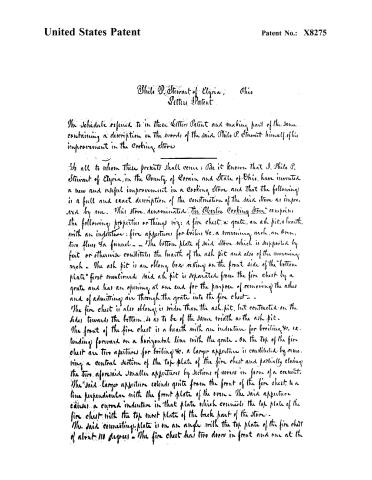
To all to whom these presents shall come: Be it known that I, Philo P. Stewart of Elyria, in the County of Lorrain and State of Ohio, have invented a new and useful improvement in a Cooking Stove and that the following is a full and exact description of the construction of the said Stove as improved by me. This Stove, denominated: The Oberlin Cooking Stove comprises the following properties or things viz: a fire chest, a grate, an ash pit, a hearth, with an indentation; five apertures for boiling &c, a warming arch, an oven, two flues & a funnel. — The bottom plate of said Stove which is supported by feet or otherwise constitutes the hearth of the ash pit and also of the warming arch. The ash pit is an oblong box resting on the front side of the “bottom plate” first mentioned. Said ash pit is separated from the fire chest by a grate and has an opening at one end for the purpose of removing the ashes and of admitting air through the grate into the fire chest.
The fire chest is also oblong, is wider than the ash pit, but contracted on the sides towards the bottom, so as to be of the same width as the ash pit. The front of the fire chest is a hearth with an indentation for boiling &c, extending forward on a horizontal line with the grate. On the top of the fire chest are two apertures for boiling &c, a larger aperture is constituted by removing a central section of the top plate of the fire chest and partially closing the two aforesaid smaller apertures by sections of covers in form of a crescent. The said larger aperture extends quite from the front of the fire chest to a line perpendicular with the front plate of the oven. The said aperture causes a curved indentation in that plate which connects the top plate of the fire chest with the top most plate of the back part of the Stove. The said connecting plate is on an angle with the top plate of the fire chest of about 110 degrees. The fire chest has two doors in front and one at the
Page 3.
United States Patent
Patent No.: X8275
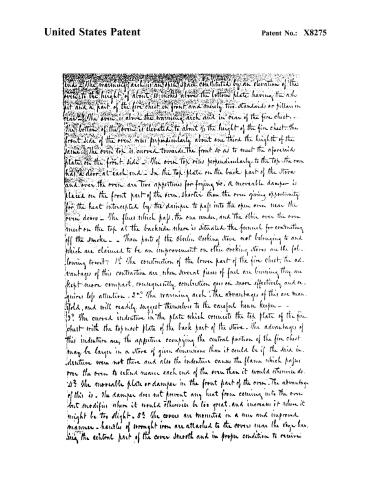
The warming arch is an open space constituted by an elevation of the oven to the height of about 10 inches above the bottom plate, having the ash pit and a part of the fire chest in front and merely two standards or pillars in rear. The oven is above the warming arch and in rear of the fire chest. The bottom of the oven is elevated to about ½ the height of the fire chest. The front side of the oven rises perpendicularly about one third the height of the same. The oven top is curved towards the front so as to meet the aforesaid plate on the front side. The oven top rises perpendicularly to the top, the oven has a door at each end. In the top plate on the back part of the stove and over the oven are two apertures for frying. A moveable damper is placed on the front part of the oven, shorter than the oven giving opportunity for the heat intercepted by the damper to pass into the open oven near the oven doors. The flues which pass, the one under, and the other over the oven meet on the top at the backside where is situated the funnel for conducting off the smoke. These parts of the Oberlin Cooking Stove not belonging to and which are claimed to be an improvement on other cooking stoves are the following:
1. The construction of the lower part of the fire chest; the advantages of this construction are, when several pieces of fuel are burning they are kept more compact, consequently combustion goes on more effectively and requires less attention.
2. The warming arch; the advantages of this are manifold, and will readily suggest themselves to the careful house keeper.
3. The curved indentation in the plate which connects the top plate of the fire chest with the topmost plate of the back part of the stove. The advantages of this indentation are, the aperture occupying the central portion of the fire chest may be larger in a stove of given dimensions than it could be if the said indentation were not there and also the indentation causes the flame which passes over the oven to extend nearer each end of the oven than it would otherwise do.
4. The moveable plate or damper in the front part of the oven. The advantage of this is, the damper does not prevent any heat from coming into the oven but modifies where it would otherwise be too great, and increases it where it might be too slight.
5. The covers are mounted in a new and improved manner—handles of wrought iron are attached to the covers near the edge, leaving the central part of the cover smooth and in proper condition to receive
Page 4.
United States Patent
Patent No.: X8275
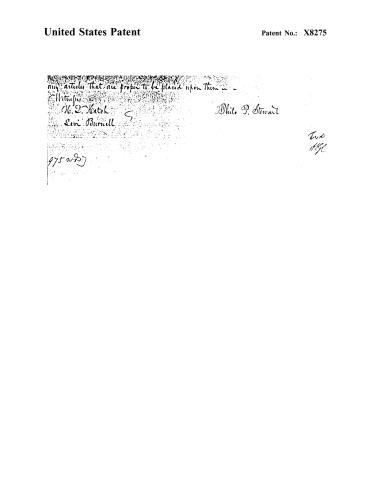
any articles that are proper to be placed upon them —
H. D. Hatch
Levi Burnell
Phil. P. Stewart
End.
1896
975.223
Published accounts: journal notice
Notice in the monthly list of patents, with remarks
Journal of the Franklin Institute, new ser., vol. 15 (1835), p. 43 · View the page
42. For a Cooking Stove; Philo P. Stewart, Elyria, Lorain county, Ohio, June 19.
Remarks. There is not any thing very peculiar in the construction of this stove, the claim being made to certain modes of arrangement, some of which may have their particular advantages. Those who can appreciate the luxury of a hot dinner, upon warmed plates, will approve of a "warming arch" constructed under the oven, whether the same be new or old.
About this record
- Patentee
- DATAMP
- Date
- the Name and Date index of patents, DATAMP, USPTO records
- Invention
- DATAMP
- Listed in
- the Name and Date index of patents, DATAMP, USPTO records, Jim Shaw's X-patent list, the Journal of the Franklin Institute, Burke's List of Patents (1847)
- Burke's 1847 Patent Office list gives the same patent.