

Drawings and documents
National Archives restored drawings: drawing
Nathan Booth's Patent Drawing for a Cider Mill

National Archives, Restored Patent Drawings (Record Group 241) · Full-size scan at the National Archives · Catalog record
Show the text on the drawing Hide (100 words)
Words on the drawing as machine-read by the National Archives; not checked. Useful mainly for searching.
NATHAN BOOTH. / Patented July 12. -1834 / Cider Mill / July 12 1.834 / CLASSIFICATION / Fig II / 8307-X / DIVISION. / Fig 2. / Fig. 3 / Patent office / es / tig1 The Mill when in operation leaving one board of the hoper, showing the grinder in operation. tion. / Hg2 2 / Cylinder or grinder with flutings & Irons a.a.a.a. and Shaft 6 / Made under the direction of the Commiprious / lig 3 / half of the shell with flutings C.C.C.C.C and Irons addd. / Patents in conformity with act 3d March 1837 / ML Whoth th / Commifere fitents
USPTO scan
The patent as scanned by the USPTO
-
 Page 1
-
 Page 2
-
 Page 3
-
 Page 4


U.S. Patent and Trademark Office · Google Patents
Show the transcription Hide (1,145 words)
Machine transcription (LightOnOCR) of the pages as scanned by the USPTO, most of them the handwritten copies made when the records were restored after the 1836 fire. Not checked; it can misread handwriting, so compare it with the scan.
Page 1.
8307X
J. Booth,
Cider Mill.
Patented July 12, 1834.
Fig. 1.
Fig. 2.
Fig. 3.
A.M. PHOTO-LITHO. CO. N.Y. (OSBORNE'S PROCESS)
Page 2.
July 12, 1854
Nathan Booth of Goshen, Connecticut
Letters Patent.
The Schedule referred to in these Letters Patent and making part of the same, containing a description in the words of the said Nathan Booth himself of his Improvement in cider mills, called "Booth's improved cider mill."
To all to whom these presents shall come.
Be it known that I Nathan Booth of Goshen, in the county of New Haven in the State of Connecticut, have invented a new and useful improvement in cider mills, called "Booth's improved cider mill," and that the following is a full and exact description of the construction and operation of said machine as invented or improved by me. My improvement or invention consists in the application of the principles of the old, well-known box coffee mill to the purpose of grinding apples into pomace. This is effected by enlarging the size, and I also make the box or shell, and the cylinder as I call it, of wood, and arm each with spiral bars of iron, so fixed on the shell and cylinder, as to brush, but not grind the apples to any desirable degree of fineness in this passage through the mill. The cylinder as I call it, I make of wood, and for the ordinary size of mills, about twenty-two inches long, exclusive of the shaft, twenty inches in diameter at the base, and thirteen at the top, being a truncated cone, on the sides of this cylinder, I place eight iron bars, one inch wide, and half an inch thick, and about twenty-four inches long, at equal distances, running round the cylinder at an angle of about twenty-five degrees. The upper ends of these bars, projecting their full thickness. The lower end sinks into the wood so as to project only one-eighth of an inch, thereby forming the fluting or grooves, and the wood between the bars may be taken off to a level, down half the length of the cylinder. From the cone to the base, I divide the cylinder into sixteen flutings or grooves, the intermediate bars
Page 3.
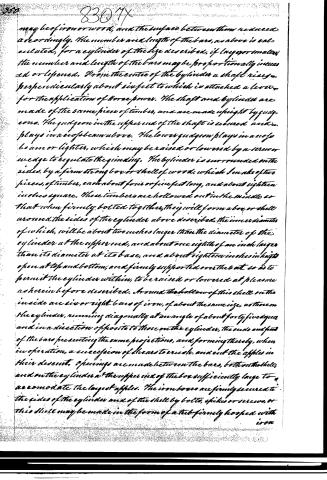
may be of iron or wood, and the surface between them reduced accordingly. The number and length of the bars, as above is calculated, for a cylinder of the size described, if larger or smaller the number and length of the bars may be proportionally increased or lessened. From the center of the cylinder a shaft rises perpendicularly about six feet to which is attached a lever for the application of horse power. The shaft and cylinder are made of the same piece of timber, and are made upright by guide-irons. The guide-iron in the upper end of the shaft is secured and plays in a cross beam above. The lower guide-iron plays in a cross beam or lighter, which may be raised or lowered by a screw or wedge to regulate the grinding. The cylinder is surrounded on the sides, by a firm strong box or shell of wood, which I make of two pieces, of timber, each about four or five feet long, and about eighteen inches square. These timbers are hollowed out in the middle so that when firmly bolted together, they will form a box or shell around the sides of the cylinder above described, the inner diameter of which, will be about two inches larger than the diameter of the cylinder at the upper end, and about one eighth of an inch larger than its diameter at its base, and about eighteen inches in height open at top and bottom, and firmly supported over the vat so as to permit the cylinder within, to be raised or lowered at pleasure as herein before described. Around the hollow of this shell on the inside are six or eight bars of iron, of about the same size, as those on the cylinder, running diagonally at an angle of about forty-five degrees, and in a direction opposite to those on the cylinder, the ends and feet of the bars presenting the same projections, and forming thereby, when in operation, a succession of shears to crush and cut the apples in their descent. Openings are made between the bars, both on the shell, and on the cylinder at the upper end of the box sufficiently large to accommodate the largest apples. The iron boxes are firmly secured to the sides of the cylinder and of the shell by bolts, spikes or screws, or this shell may be made in the form of a tub firmly hooped with iron
Page 4.
iron, or the whole shell, including its bars, or fluting, may be of cast iron, but will be more liable to corrosion, and therefore not to be preferred. The Mill or Machine herein described is calculated to stand with the cylinder, and shaft perpendicular, having a hopper around the shaft and over the opening on the top to receive the apples, and a suitable seat to receive the person at the bottom, it is to be moved by horse, or ox power, all in the usual manner, but, the mill may be placed horizontally with the hopper and a suitable opening on the upper side, and moved by water or other power. A model with drawings for illustration will accompany this specification. The advantages of this invention, or improvement are, that apples are more expeditiously, and more uniformly crushed and ground and the powder more more perfectly and uniformly formed than is or can be done by any known mill, as the whole may be made to pass a space between the cylinder, and shell, not exceeding, if so required one sixteenth of an inch, and this space may be lessened or enlarged at pleasure. This Mill thus armed with iron, is not subject to ordinary wear and tear, and is not liable to be injured by stones and stones when found in the Mill can be ejected by reversing the motion. As the basis of my improvement and invention, is the old and well known box, coffee mill, I claim only as my invention the use of iron bars to arm wooden cylinders, and shells of proper size, with suitable teeth and fluting to form a strong and durable surface peculiarly adapted to grinding apples for cider, in the manner as above specified, and therefore I solicit Letters Patent.
In witness whereof I subscribe this specification at New Haven, Conn. fourteenth of 8 1834.
Witnesses
Simon Baldwin
Abenezes Baldwin
Nathan Booth
1080 AWD (Patented July 2, 1834)
Published accounts: journal notice
Notice in the monthly list of patents, with remarks
Journal of the Franklin Institute, new ser., vol. 15 (1835), p. 101 · View the page
25. For an improved Cider Mill; Nathan Booth, Cheshire, New Haven county, Connecticut, July 12.
Remarks. This cider mill is to be made in the form of the old-fashioned coffee, or bark mill, with a conical nut, and a shell adapted to it, both of which are to be made of wood, the grooves or spirals upon them being formed by bars of iron fixed upon each, at an angle of about forty-five degrees. These bars are to be an inch wide, and half an inch thick; they are to project their whole thickness at the upper, or feeding, end, but are to be let into the nut and shell, so that, at their lower ends, they shall not rise more than a sixteenth of an inch. The wood between them, at the upper ends, is to be grooved out, so as readily to admit the apples. The patentee says, "As the basis of my improvement and invention is the old and well known box coffee mill, I claim only as my invention, the use of iron bars to arm wooden cylinders and shells of proper size, with suitable teeth and fluting, to form a strong and durable surface, peculiarly adapted to grinding apples for cider, in the manner above specified." It would seem to us that a cast-iron nut and shell would be more strong and durable than that described; and we also think that it could be made at less cost than one of wood, with wrought iron ribs, or flutes. Against the evidence of experience, we have not a word to urge; but, without the aid of this, we should be apprehensive that the pommage would not readily find its way through the mill, if set so close as is proposed; this, however, does not affect the patent, as the openings may, of course, be made of any required size.
About this record
- Patentee
- DATAMP
- Date
- the Name and Date index of patents, DATAMP, USPTO records
- Invention
- DATAMP
- Listed in
- the Name and Date index of patents, DATAMP, USPTO records, Jim Shaw's X-patent list, the Journal of the Franklin Institute, Burke's List of Patents (1847)
- Burke's 1847 Patent Office list gives the same patent.