

Drawings and documents
National Archives restored drawings: drawing
William Woolley's Patent Drawing for Bedsteads


National Archives, Restored Patent Drawings (Record Group 241) · Full-size scan at the National Archives · Catalog record
Show the text on the drawing Hide (329 words)
Words on the drawing as machine-read by the National Archives; not checked. Useful mainly for searching.
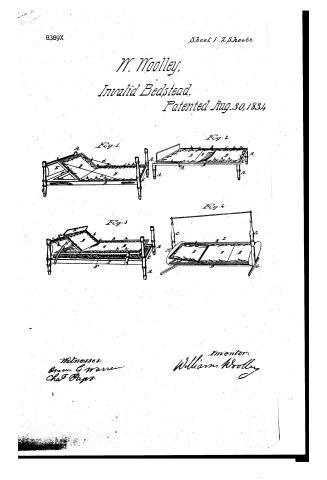
Sheet 1. CLASSIFICATION / 8389.7 / 'NOISIAIT / Williams needly / Bedsteads. / Patented Augu / The indicces are let into the hot by & tenon 12 may / be taken out when the tobotation / No.2. / No.1. / N.4 / No.3 / References / No.1 Shows the Bedstead that may also be used for ordinary purposes AAAA Posts; BBBB Side rails / CCC End do. a, one of the corner braces, b.b, the smaller or inner frame, turning on bolts at C.C. : dd the cords / by which it is held up, f,f. the rabbit in the outer frame, hh pins therein; DD the sacking bottom, E., the head / board, ee the braces or Levers at the sides of the outer frame, i, the roller at the head board. / No.2 / Shows an improved Cot Bed stead. - AAAA Feet which are only sereived on; B.B Side rails; C,C, End rails. / DD Sacking bottom g the lap that covers the aperture. E head board, 66 inner frame. / N3 Shows the combined use of No 1.82 the same letters refer to the same parts CCS above; F The matrass / K, the cord attached to the levers ee, for raising the cot horizon tally; m,the pin to fasten the roller. / NA Shows another use of the Cot bedstead, GG Thetrame like that ot a stuinging cradle to roleich the cot / is madelast; HH the swinging end boards, I the cot deprived of the feet and of the head board.
Sheet 2. 5. BEDS. / 62 Invalid B isteads. / 11 / "II / CLASSIFICATION / 8389 X / IIV SION. / 1st 30th 1834 / WE / ONE / the / И°2 / N°4 / WE / now / APP / -E / as / N°5 / N°6 / of / No7 / (o / Improved Bedstead for the Sick / H°1 Represents for ordernary bedstend / Noq as broken kind change." position / No3 roading the bed pan / N°4 Theme the legs differenth / the from hirning / Nob an en largement; the B Noy / Aro y an the by secy at Citos 5 / Chu. Pages / Green G.Warra / Williams Woothy
USPTO scan
The patent as scanned by the USPTO
-
 Page 1
-
 Page 2
-
 Page 3
-
 Page 4
-
 Page 5
-
 Page 6
-
 Page 7


U.S. Patent and Trademark Office · Google Patents
Show the transcription Hide (2,097 words)
Machine transcription (LightOnOCR) of the pages as scanned by the USPTO, most of them the handwritten copies made when the records were restored after the 1836 fire. Not checked; it can misread handwriting, so compare it with the scan.
Page 1.
8389X
Sheet 1-2 Sheets.
W. Woolley,
Invalid Bedstead,
Patented Aug. 30, 1834
Fig. 1
Fig. 2
Fig. 3
Fig. 4
Witnesses:
Owen G. Warren
Chas. Pappo
Inventor:
William Woolley
Page 2.
8389X
Sheet 2 - 2 Sheets.
W. Woolley,
Invalid Bedstead,
Patented Aug. 30, 1834.
Fig. 3
Fig. 1
Fig. 2
Fig. 4
Fig. 5
Fig. 6
Fig. 7
Witnesses:
Ewen G. Warren
Chas. Hayes
Inventor:
William Woolley
Page 3.
8389x Aug 30, 1834 565
Williams Woolley of New York City,
Letters Patent
The Schedule referred to in these Letters Patent and making part of the same containing a description in the words of the said Williams Woolley himself of his improvements in Bedsteads designed for the use of the sick and disabled and also for ordinary use.
To all to whom these presents shall come
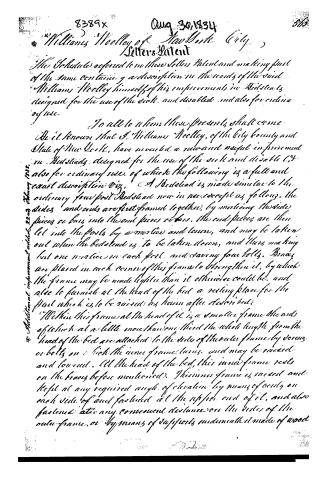
Be it known that J. Williams Woolley, of the City, County and State of New York, have invented a new and useful improvement in Bedsteads designed for the use of the sick and disabled, & also for ordinary use, of which the following is a full and exact description viz. A Bedstead is made similar to the ordinary four post Bedstead now in use except as follows. The sides and ends are first framed together, by making the side pieces or bars into the end pieces or bars. The end pieces are then let into the posts by a mortice and tenon, and may be taken out when the bedstead is to be taken down, and thus making but one mortice in each post and saving four bolts. Braces are placed in each corner of this frame to strengthen it, by which the frame may be made lighter than it otherwise could be, and also to furnish at the head of the bed a resting place for the head which is to be raised as herein after described.
Within this frame at the head of it is a smaller frame the ends of which at a little more than one third the whole length from the head of the bed are attached to the side of the outer frame by screws or bolts on which the inner frame turns, and may be raised and lowered. At the head of the bed, this inner frame rests on the braces before mentioned. This inner frame is raised and kept at any required angle of elevation by means of screws on each side of and fastened at the upper end of it, and also fastened at any convenient distance on the sides of the outer frame, or by means of supports underneath it made of wood
*Additional improvement added, 22nd February 1835.
Page 4.
8389X
8-30-1834
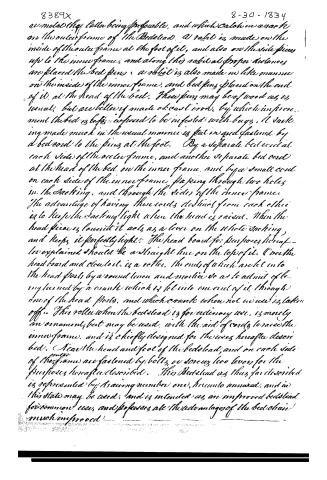
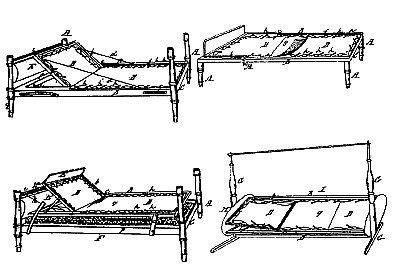
as metal they latter being preferable, and which catch in a rack on the outer frame of the Bedstead. A rebate is made on the inside of the outer frame at the foot of it, and also on the side pieces up to the inner frame, and along this rebate at proper distances are placed the bed pins. A rebate is also made in like manner on the inside of the inner frame, and bed pins placed on the end of it, at the head of the bed. These pins may be of wood as is usual, but are better if made of cast iron, by which improvement the bed is less exposed to be infested with bugs. A stretching made much in the usual manner is fast in and fastened by a bed cord to the pins at the foot. By a separate bed cord at each side of the outer frame, and another separate bed cord at the head of the bed on the inner frame, and by a small cord on each side of the inner frame, passing through two holes in the stretching, and through the sides of the inner frame. The advantage of having these cords distinct from each other is to keep the stretching tight when the head is raised. When the head piece is lowered it acts as a lever on the whole stretching, and keeps it perfectly tight. The head board for purposes hereafter explained should be a straight line on the top of it. Over the head board and close to it, is a roller, the ends of which are let into the head posts by a round tenon and mortice so as to admit of being turned by a crank which is let into one end of it, through one of the head posts, and which crank when not in use is taken off. This roller when the bedstead is for ordinary use, is merely an ornament, but may be used, with the aid of cords, to raise the inner frame, and is chiefly designed for the uses hereafter described. Near the head and foot of the bedstead, and on each side of the frame are fastened by bolts, or screws, two levers for the purposes hereafter described. This Bedstead as thus far described is represented by drawing number one, hereto annexed, and in this state may be used, and is intended as an improved bedstead for common use, and possesses all the advantages of the bed chair much improved.
Page 5.
8389x Aug 30, 1834
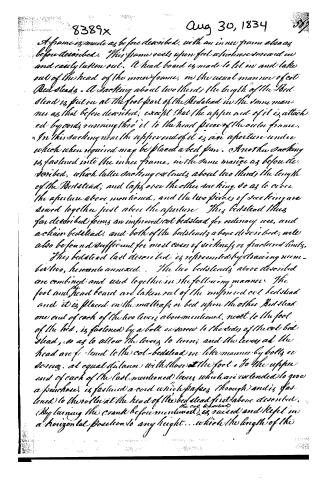
A frame is made as before described, with an inner frame also as before described. This frame rests upon feet which are screwed in and easily taken out. A head board is made to let in and take out of the head of the inner frame, in the usual manner of cot Bedsteads. A Sacking about two thirds the length of the Bedstead is put in at the foot part of the Bedstead in the same manner as that before described, except that the upper end of it is attached by cords running thro' it to the head piece of the outer frame. In this Sacking near the upper end of it is an aperture under which when required may be placed a bed pan. Another Sacking is fastened into the inner frame, in the same manner as before described, which latter Sacking extends about two thirds the length of the Bedstead, and laps over the other Sacking so as to cover the aperture above mentioned, and the two pieces of Sacking are sewed together just above the aperture. This Bedstead thus far described forms an improved cot bedstead for ordinary use, and a plain bedstead, and both of the bedsteads above described, will also be found sufficient for most cases of sickness or fractured limbs.
This bedstead last described is represented by drawing number two, hereto annexed. The two bedsteads above described are combined and used together in the following manner. The foot and head board are taken out of the improved cot bedstead and it is placed on the mattress or bed upon the other Bedstead. One end of each of the two levers above mentioned, next to the foot of the bed, is fastened by a bolt or screw to the side of the cot bedstead, so as to allow the levers to turn, and the levers at the head are fastened to the cot-bedstead in like manner by bolts or screws, at equal distances with those at the foot. To the upper end of each of the last mentioned levers, which are extended to give a purchase, is fastened a cord which passes through and is fastened to the wheel at the head of the bedstead first above described. By turning the crank before mentioned, the cot is raised and kept in a horizontal position to any height... which the length of the
Page 6.
8389x
8-30-1834
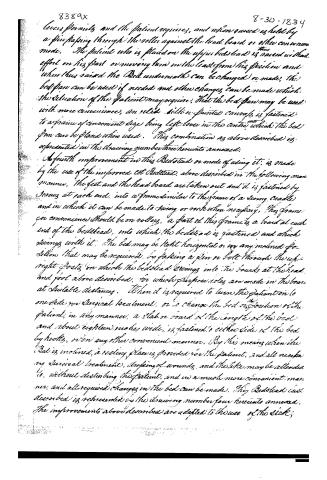
levies permits, and the patient requires, and when raised is held by a pin passing through the roller against the head board or other convenient mode. The patient who is placed on the upper bedstead is raised with effort on his part or moving him on the cast from his position and when thus raised the Bed underneath can be changed or made; the bed span can be used if needed and other changes can be made which the situation of the patient may require. That the bed span may be used with more convenience, an solid, white or painted canvas is fastened to a frame of convenient size being left loose in the centre into which the bed span can be placed when used. This combination as above described is represented in the drawing number three hereto annexed.
A fourth improvement in this Bedstead or mode of using it, is made by the use of the improved cot Bedstead, above described in the following manner. The feet and the head board are taken out and it is fastened by screws at each end, into a frame similar to the frame of a swing cradle and in which it can be made to swing or rock when necessary. This frame for convenience should be on rollers. A part of this frame is a board at each end of the bedstead, into which the bedstead is fastened and which swings with it. The bed may be kept horizontal or in any inclined position that may be required, by fastening a pin or bolt through the upright posts on which the bedstead swings into the boards at the head and foot above described, for which purpose holes are made in the boards at suitable distances. When it is required to turn the patient on to one side for surgical treatment, or to change the bed or position of the patient, in any manner, a slab or board of the length of the bed and about eighteen inches wide, is fastened to either side of the bed by hooks, or in any other convenient manner. By this means when the bed is inclined, a resting place is provided for the patient, and all necessary surgical treatment, dressing of wounds, and the like may be attended to, without disturbing the patient, and in a much more convenient manner, and all required changes in the bed can be made. This Bedstead last described is represented by the drawing number four hereto annexed. The improvements above described are adapted to the use of the sick;
Page 7.
8389x
Aug 30, 1834
infirm and disabled under all circumstances and especially to the use of Hospitals, and other similar establishments. They greatly promote the comfort and quiet of the patient, and enable the nurse, physician or surgeon to render the services necessary with much greater ease, to themselves and to the patient; at the same time they serve when separated, as improved Bedsteads for common use, and by being capable of use when separated, and also of being combined in the different modes above described, the advantages of four different kinds of Bedsteads for the sick to be used as occasion requires are attained by having only two which at the same time are also suited for common use, and thus much expense as well as room is saved.
I claim as my invention and improvement, the combination and union of the two Bedsteads first above described into one, forming that which is represented by drawing number three in the manner above set forth, which improvement was made by me in January last, and has been perfected by various experiments since that time, and also the above described mode of combining the said improved cot-bedstead, with the frame and other parts so as to form that represented in drawing number four, whereby it admits of being rocked, and also inclined to either side without removing the patient.
I also claim the foregoing improvements, in number one, by which the frame is fastened to the posts by one mortise in each, and may be taken out of the posts without being separated, thereby leaving room for the action of the said levers, and by which means said frame when taken from the posts may be used in lieu of the frame of the improved cot-Bedstead, and other useful objects are gained. And also the modes of adapting and fastening and tightening the locking above described, as applied to the foregoing improved Bedsteads.
In witness whereof I have hereunto set my hand at the City of New York this seventeenth day of August in the year one thousand Eight Hundred and thirty four.
Witnesses
Geo. C. Goddard
F. M. Van Cott
Drawing Williams Woolley, My.
(2080 words)
(See Additional Letters Patent No. 3, Recorded in Volume No. 1 of additional Improvements page 4, granted Feb. 22, 1835)
Published accounts: journal notice
Notice in the monthly list of patents
Journal of the Franklin Institute, new ser., vol. 15 (1835), p. 206 · View the page
56. For a Bedstead for the Sick; William Woolley, city of New York, August 30.
Published accounts: journal notice
Notice in the monthly list of patents (listed with a different spelling or date)
Journal of the Franklin Institute, new ser., vol. 15 (1835), p. 104 · View the page
For a Bedstead for Invalids; William Leo Wolf, city of New York, July 15.
DATAMP: illustration
Illustrations from DATAMP

DATAMP (Directory of American Tool and Machinery Patents), via the Internet Archive · Archived DATAMP page
About this record
- Patentee
- DATAMP
- Date
- the Name and Date index of patents, DATAMP, USPTO records
- Invention
- DATAMP
- Listed in
- the Name and Date index of patents, DATAMP, USPTO records, Jim Shaw's X-patent list, the Journal of the Franklin Institute, the Journal of the Franklin Institute, Journal, Burke's List of Patents (1847)
- Also listed in a contemporary journal or list under a different spelling or date; the record shown follows the standard lists.
- Burke's 1847 Patent Office list gives the same patent.