

Drawings and documents
USPTO scan
The patent as scanned by the USPTO
-
 Page 1
-
 Page 2
-
 Page 3
-
 Page 4


U.S. Patent and Trademark Office · Google Patents
Show the transcription Hide (891 words)
Machine transcription (LightOnOCR) of the pages as scanned by the USPTO, most of them the handwritten copies made when the records were restored after the 1836 fire. Not checked; it can misread handwriting, so compare it with the scan.
Page 2.
United States Patent
Patent No.: X8417
James D. Ogden, Lansing, New York
Letters Patent.
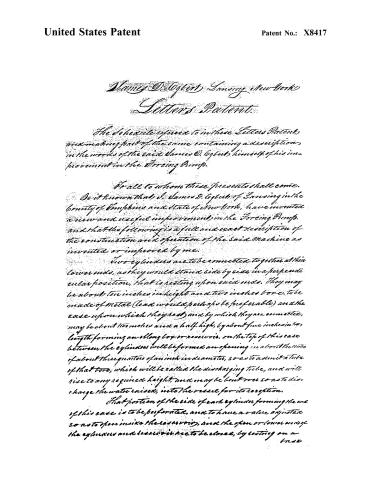
The schedule referred to in these Letters Patent, and making part of the same, containing a description, in the words of the said James D. Ogden, himself, of his improvement in the Forcing Pump.
To all to whom these presents shall come.
Be it known that I, James D. Ogden of Lansing in the County of Tompkins and State of New York, have invented a new and useful improvement in the Forcing Pump, and that the following is a full and exact description of the construction and operation of the said Machine as invented or improved by me.
Two cylinders are to be connected together at their lower ends, as they would stand side by side in a perpendicular position, that is resting upon said ends. They may be about ten inches in height and two inches bore, to be made of metal (lead would perhaps be preferable) and the case upon which they rest and by which they are connected, may be about 100 inches and a half high, by about five inches in length forming an oblong box or reservoir. On the top of this case between the cylinders will be formed an opening in about the circle of about three quarters of an inch in diameter, so as to admit a tube of that bore, which will be called the discharging tube, and will rise to any required height, and may be bent over so as to discharge the water raised, into the vessel for its reception.
That portion of the side of each cylinder forming the end of this case is to be perforated, and to have a valve adjusted so as to open into the reservoir, and the open or lower end of the cylinders and reservoir are to be closed, by resting on a base.
Page 3.
United States Patent
Patent No.: X8417
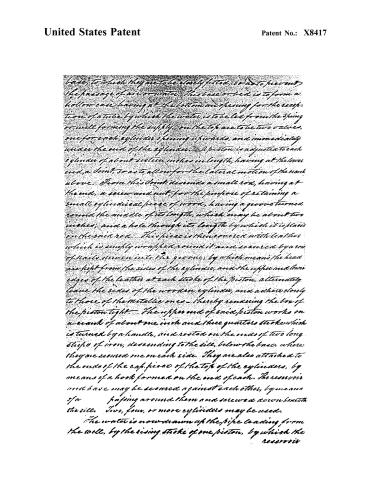
base, to which they are to be closely fitted, so as to prevent the passage of air or water. This base or box is to form a hollow case having at the bottom an opening for the reception of a tube by which the water is to be led from the spring or well forming the supply. On the top are to be two valves, one for each cylinder opening upwards, and immediately under the end of the cylinder. A piston is adjusted to each cylinder of about sixteen inches in length, having at the lower end, a joint, so as to allow for the lateral motion of the crank above. From this joint descends a small rod, having at the end, a screw and nut, for the purpose of retaining a small cylindrical piece of wood, having a groove turned round the middle of its length, which may be about two inches, and a hole through its length by which it is placed on the said rod. This piece is then covered with leather which is simply wrapped round it and secured by a row of nails driven into the groove, by which means the head are kept from the sides of the cylinder, and the upper and lower edges of the leather at each stroke of the piston, alternately leave the sides of the wooden cylinder, and adhere closely to those of the metallic ones—thereby rendering the box of the piston tight. The upper end of said piston works on a crank of about one inch and three quarters stroke which is turned by a handle, and rested on the ends of two long strips of iron, descending to the sill, below the base, where they are secured one on each side. They are also attached to the ends of the cap piece of the top of the cylinders, by means of a hook formed on the end of each. The reservoir and base may be secured against each other, by means of a faying around them and screwed down beneath the sill. Two, four, or more cylinders may be used.
The water is now drawn up the pipe leading from the well, by the rising stroke of one piston, by which the reservoir
Page 4.
United States Patent
Patent No.: X8417
reservoir is filled, and the descending stroke of the opposite piston discharges it by the tube above, for that purpose. It is particularly adapted to the use of domestic purposes, as it will supply a kitchen with any small force, at the rate of about three buckets full per minute; and from its force in discharging water, will be of great service when applied to engines, &c.
My claim is for the formation of the boxes as above described, and for the combination of the cylinders with the reservoir & base.
In testimony that the above is a full and correct description of the construction and use of my Machine, as invented or improved by me, I have hereunto set my hand this nineteenth day of September in the year eighteen hundred and thirty-four.
Witnesses
Honey Stone
Robt. Clarke
James D. Egbert
(Patented 22 Sept 1834)
948 and 2
Exa
11/4
Published accounts: journal notice
Notice in the monthly list of patents, with remarks
Journal of the Franklin Institute, new ser., vol. 15 (1835), p. 259 · View the page
28. For an improvement in the Forcing Pump; James D. Egbert, Lansing, Tompkins county, New York, September 22.
Remarks. Here there are to be two barrels, and other appendages, as in the ordinary fire engine, and the piston rods are to be worked by a double crank shaft above them. The whole affair is without the slightest claim to novelty, either in form or arrangement, in any one point. We, as well as the advocate employed, should really smile at the idea of commencing an action against any one for a violation of this patent.
About this record
- Patentee
- DATAMP
- Date
- the Name and Date index of patents, DATAMP, USPTO records
- Invention
- DATAMP
- Listed in
- the Name and Date index of patents, DATAMP, USPTO records, Jim Shaw's X-patent list, the Journal of the Franklin Institute, Burke's List of Patents (1847)
- Burke's 1847 Patent Office list gives the same patent.