

Drawings and documents
National Archives restored drawings: drawing
Eliphalet S. Scripture's Patent Drawing for a Centripetal Power Press

National Archives, Restored Patent Drawings (Record Group 241) · Full-size scan at the National Archives · Catalog record
Show the text on the drawing Hide (94 words)
Words on the drawing as machine-read by the National Archives; not checked. Useful mainly for searching.
RESSES. / Baling, Toggle-Joint. Invested / Cottan of Hay prepaes / no minuted / CLASS ICATION / 8422-x / DIVISION. / ELIPHALET.S.SCRIPTURE / Centripetal Power Prefs / Patented Sep26. 1834 / A... Four posts / B. B ed-perce / C. Power-beum / D. Tumbler or shaft / E. Arm or moving fulorum / F. Eliptic Lever / G Acting Lever / H. wind-tass / 7. Pulley. / FL / Patint Office 26th May May 1838, / Made under the direction of the Commipioner of / Patents in confo ormity with act3 March 1837. / M.L.Suberth / Geo. Strickland Den / Commisioned of Patents
USPTO scan
The patent as scanned by the USPTO
-
 Page 1
-
 Page 2
-
 Page 3
-
 Page 4


U.S. Patent and Trademark Office · Google Patents
Show the transcription Hide (805 words)
Machine transcription (LightOnOCR) of the pages as scanned by the USPTO, most of them the handwritten copies made when the records were restored after the 1836 fire. Not checked; it can misread handwriting, so compare it with the scan.
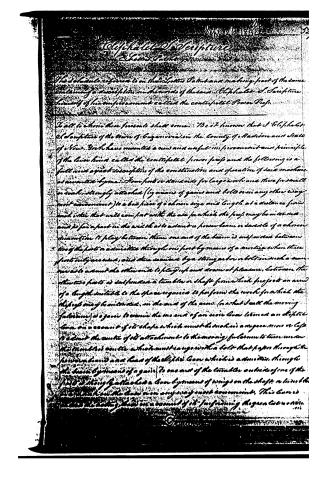
Page 1.
No Printed Specification Available
8422X
E. S. Scripture,
Cotton Press.
Patented Sep. 26, 183
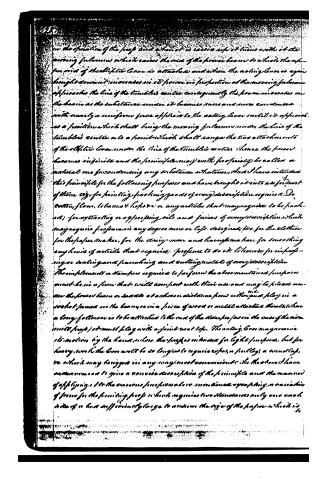
Page 3.
in the operation of the press and when it is raised up at times with the moving fulcrum which raises the end of the power beam to which the other end of the elastic lever is attached and when the acting lever is again brought down it increases in its power in proportion as the moving fulcrum approaches the line of the tumbler's centre consequently the power increases on the beam as the substance under it becomes more and more condensed with nearly a uniform force applied to the acting lever until it is applied as a position which shall bring the moving fulcrum under the line of the tumbler's centre or to a point which shall range the two attachments of the elastic lever under the line of the tumbler's centre. Hence the power becomes infinite and the principle may with propriety be called a natural one for condensing any substance whatever, and I have intended this principle for the following purposes and have brought it into use for most of them viz: for printing packing goods of every description acquired. Do cotton, flax, tobacco &c. &c. or any articles that may require to be packed; for extracting or expressing oils and juices of every description which may require pressure in any degree more or less. designed too, for the clothier, for the paper maker, for the crimp-maker and haughmaker, for smoothing any kind of article that requires pressure to do it. Likewise for impregnating or saturating &c. &c. and coating metals of every description. The implements or stamps required to perform the above mentioned purposes must be in a form that will comport with their use and may be placed under the power beam or saddle at chosen distance from either end. They may in a socket formed in the beam or in a piece of wood or metal attached thereto, where a long follower is to be attached to the end of the hammer (as in the case of the iron mallet press) it must play with a joint near the top. The acting lever may receive its motion by the hand or where the press is intended for light purposes, but for heavy work the lever will be so long as to require a foot, a stool, or a wheel, or which may be rigged in any way most convenient. In the above I have endeavoured to give a considerable description of the principle and the manner of applying it to the various purposes above mentioned excepting a variation of force for the printing press which requires two distinct ones only one each side of a bar sufficiently large to sustain the size of the paper which is
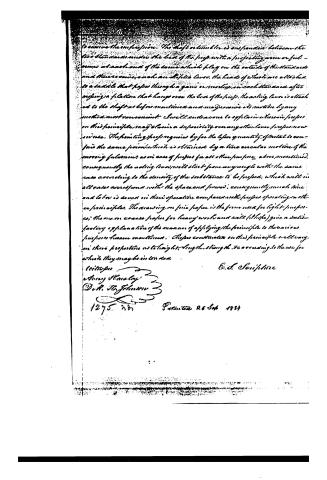
Page 4.
to receive the impression. The shaft or tumbler is suspended between the two standards under the base of the press with a projecting arm or fulcrum at each end of the beam which play on the outside of the standards and their respective anvil levers, the heads of which are attached to a saddle that passes through a gear or mortise in each standard after passing a plate that hangs over the base of the press. The acting lever is attached to the shaft as before mentioned and made to receive its motion by any method most convenient. I will endeavour to explain wherein presses on this principle may possess a superiority over any other lever presses now in use. The printing press requires by far the least quantity of metal to accomplish the same purpose which is obtained by a line circular motion of the moving fulcrum, as in case of presses for all other purposes above mentioned, consequently the acting lever will start from any angle with the same ease according to the density of the substance to be pressed, which will in all cases correspond with the space and force; consequently much time and labor is saved in their operation compared with presses operating on other principles. The drawing on fine paper is the form used for light purposes; the one on coarse paper for heavy work and will (I hope) give a satisfactory explanation of the manner of applying the principle to the various purposes before mentioned. The presses constructed on this principle will vary in their proportion as to height, length, strength, &c according to the use for which they may be intended.
E. S. Southerne
Witness
a. Henry Stansley
Dr. A. H. Johnson
1275 No. Patented 26 Sep 1834
Published accounts: journal notice
Notice in the monthly list of patents, with remarks
Journal of the Franklin Institute, new ser., vol. 15 (1835), p. 261 · View the page
We esteem this patent objectionable on several accounts. There is no novelty either in the thrashing or winnowing machines, nor is there any in the combination of the two. The machine for shelling corn is separate and distinct from that for thrashing, and is merely to be put into the same frame, after removing the former; the patent, therefore, covers two machines, instead of one. When rice is to be rubbed out, another apparatus is also to be substituted for the thrashing machine, and appears as a third member in the family, but related to each other by marriage only. 33. For a Centripetal Power Press; Eliphalet S. Scripture, Cazenovia, Madison county, New York, September 26.
Remarks. In the description of this press, the machine is spoken of as constructed upon a new principle, whilst to us it appears like an old acquaintance, very little altered by time or dress. It is, in fact, a compound lever press, in which the lever that is to make the pressure is to be placed horizontally, and to work upon a pin in a vertical standard, on one side of the frame, its other end working up and down between two vertical standards, where it is acted upon by a second lever, connected to it by links, which operate like the toggle joint. The follower, or pressing part, is on the lower side of the first named lever. This press is spoken of as capable, under different modifications, of being applied to a great variety of purposes, among which are mentioned, printing; packing goods, such as cotton, flour, tobacco, hops; extracting oil, and other juices; also, pressing for clothiers, paper makers, harness makers, dairy men, &c.; impressing and cutting metals, &c. From the smallness of its range, there are some of these objects to which it could not be advantageously applied; whilst for others to which it is more particularly adapted, it has long since been employed.
About this record
- Patentee
- DATAMP
- Date
- the Name and Date index of patents, DATAMP, USPTO records
- Invention
- DATAMP
- Listed in
- the Name and Date index of patents, DATAMP, USPTO records, Jim Shaw's X-patent list, the Journal of the Franklin Institute, Burke's List of Patents (1847)
- Burke's 1847 Patent Office list gives the same patent.