

Drawings and documents
USPTO scan
The patent as scanned by the USPTO
-
 Page 1
-
 Page 2
-
 Page 3
-
 Page 4


U.S. Patent and Trademark Office · Google Patents
Show the transcription Hide (810 words)
Machine transcription (LightOnOCR) of the pages as scanned by the USPTO, most of them the handwritten copies made when the records were restored after the 1836 fire. Not checked; it can misread handwriting, so compare it with the scan.
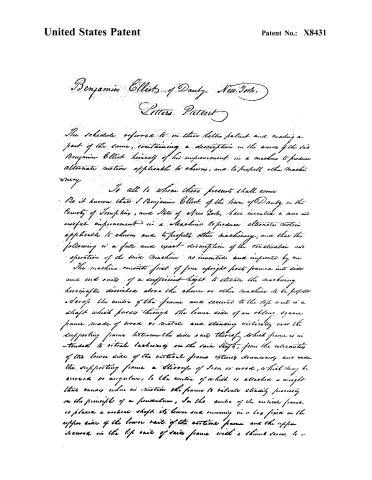
Page 2.
United States Patent
Patent No.: X8431
Benjamin Ellick of Danby, New York.
Letters Patent
The schedule referred to in this letter patent and making a part of the same, containing a description in the words of the said Benjamin Ellick himself of his improvement in a machine to produce alternate motion applicable to churns, and to propel other machinery.
To all to whom these presents shall come:
Be it known that I Benjamin Ellick of the town of Danby in the County of Suffolk, and State of New York, have invented a new and useful improvement in a machine to produce alternate motion applicable to churns and to propel other machinery; and that the following is a full and exact description of the construction and operation of the said machine as invented and improved by me.
The machine consists first of four upright posts framed into sides and end rails of a sufficient height to elevate the machinery hereinafter described above the churn or other machine to be propelled above the centre of the frame and secured to the top rail is a shaft which passes through the lower side of an oblong square frame made of wood or metal and standing vertically over the supporting frame between the side rails thereof, which frame is intended to vibrate back and forth on the said shaft, from the extremities of the lower side of the vertical frame extending downwardly and under the supporting frame a slingshot of iron or wood, which may be curved or angular, to the centre of which is attached a weight that causes when in motion the frame to vibrate steadily precisely on the principle of a pendulum, for the centre of the vertical frame is placed a vertical shaft, its lower end running in a box fixed in the upper side of the lower rail of the vertical frame and the upper secured in the top rail of said frame with a thumb screw, to —
Page 3.
United States Patent
Patent No.: X8431
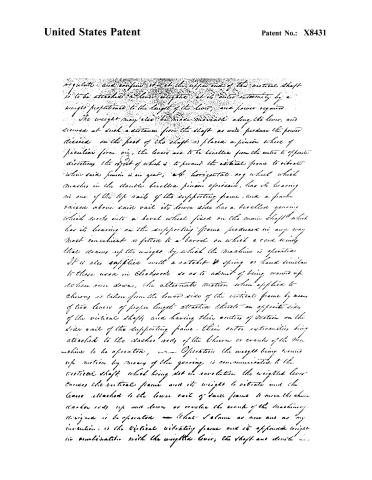
regulate and confine it at the upper end of the vertical shaft
is to be attached a lever weighted at its outer extremity by a
weight proportioned to the length of the lever, and power required
The weight may also be made movable along the lever, and
secured at such a distance from the shaft as will produce the power
desired in the foot of the shaft as placed a pinion wheel of
peculiar form viz, the levers are to be bevelled from the center to opposite
directions, the object of which is to permit the vertical frame to vibrate
when said pinion is in gear, a horizontal cog wheel which
meshes in the double bevelled pinion aforesaid, has its bearing
in one of the top rails of the supporting frame, and a frame
raised above said rail its lower side has a bevelled gearing
which works into a bevel wheel fixed on the main shaft which
has its bearing on the supporting frame produced in any way
most convenient is fitted to a barrel on which a cord winding
that draws up the weight by which the machine is operated
It is also supplied with a catchlet & spring or hand similar
to those used in Clockworks so as to admit of being wound up
when once down, the alternate motion when applied to
chiming is taken from the lower side of the vertical frame by means
of two levers of proper length attached thereto on opposite sides
of the vertical shaft, and having their centres of motion on the
side rail of the supporting frame, their outer extremities being
attached to the dacker rods of the chime or cranks of the ma-
chine to be operated, — Operation the weight being wound
up motion by means of the gearing is communicated to the
vertical shaft which being set in revolution the weighted lever
causes the vertical frame and its weight to vibrate and the
levers attached to the lower rail of said frame to move the chime
dacker rods up and down or revolve the cranks of the machinery
designed to be operated — What I claim as new and as my
invention, is the vertical vibrating frame and its opposite weight
in combination with the weighted lever, the shaft and double —
Page 4.
United States Patent
Patent No.: X8431
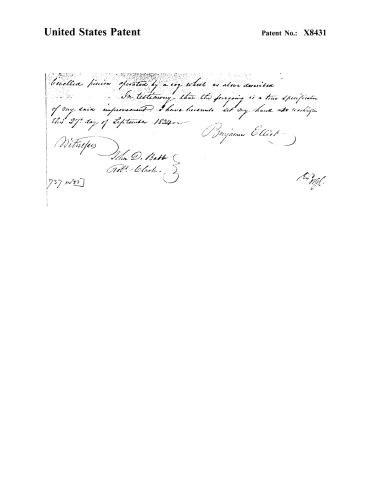
levelled pinion operated by a cog wheel as above described
In testimony that the foregoing is a true specification of my said improvement, I have hereunto set my hand and seal this 27th day of September 1834.
Benjamin Elliot
Witnesses
John D. Babb
Robt. Clark.
737 w82
[Signature]
Published accounts: journal notice
Notice in the monthly list of patents, with remarks
Journal of the Franklin Institute, new ser., vol. 15 (1835), p. 314 · View the page
7. For a Machine to produce Alternate Motion; Benjamin Elliot, Danby, Tompkins county, New York, October 4.
Remarks. The alternate motion to be produced by this machine, is said to be applicable to churns, and to the propelling of other machinery; the apparatus described is one of those unmechanical contrivances, in examining which a person who has no, or but little, acquaintance with the subject, may readily become bewildered, and imagine that, by the time the action of the first mover is transmitted through the long train of levers, wheels, and pinions, some wonderful effect must be produced. A weight is to be wound up, and the shaft upon which it is wound is to operate upon a sort of pendulum, which in its turn, through the intermedium of wheels, pinions, levers, &c., is to afford great assistance to the dairy-maid, who, however, will soon be willing to dispense with its services.
DATAMP: illustration
Illustrations from DATAMP

DATAMP (Directory of American Tool and Machinery Patents), via the Internet Archive · Archived DATAMP page
About this record
- Patentee
- DATAMP
- Date
- the Name and Date index of patents, DATAMP, USPTO records
- Invention
- DATAMP
- Listed in
- the Name and Date index of patents, DATAMP, USPTO records, Jim Shaw's X-patent list, the Journal of the Franklin Institute, Burke's List of Patents (1847)
- The Franklin Institute's journal spells the name differently.
- Burke's 1847 Patent Office list gives the same patent.