

Drawings and documents
USPTO scan
The patent as scanned by the USPTO
-
 Page 1
-
 Page 2
-
 Page 3
-
 Page 4


U.S. Patent and Trademark Office · Google Patents
Show the transcription Hide (847 words)
Machine transcription (LightOnOCR) of the pages as scanned by the USPTO, most of them the handwritten copies made when the records were restored after the 1836 fire. Not checked; it can misread handwriting, so compare it with the scan.
Page 2.
United States Patent
Patent No.: X8465
Benjamin Knight
Letters Patent.
The schedule referred to in these Letters Patent, and making part of the same, containing a description in the words of the said Benjamin Knight himself of his improvement in a machine for boring timber for morticing, in the framing of buildings of all descriptions.
To all whom it may concern, be it known, that I, Benjamin Knight of Cranston, in the county of Providence, and a state of Rhode Island have invented a machine for boring timber for morticing in the framing of buildings; and the following is a full and exact description thereof.
I construct a square frame, which, for ordinary purposes, I make of stuff of about an inch and a quarter square. The frame may be about twenty inches long, eight wide, and six high from out to out. This frame consists of twelve pieces of stuff, the four corner posts having longitudinal and end pieces formed into them, both at their upper and lower ends. This frame is to be fastened to the timber which is to be bored and is to support a second frame, which I call a slide and which carries the auger with its gearing and other apparatus employed in turning it. The slide is a frame which extends across, and rests upon the longitudinal pieces of the main frame, and is capable of slipping from one end thereof to the other; this slide may be eight inches in length more or less, and may be made of stuff of about the same size with the main frame. Two uprights rise from the top pieces of this frame to the height of ten or twelve inches, and are connected together at top by a top or cap piece. There are grooves within the inner edges of these uprights, within which a guide piece bears, which receives the upper end of the auger shank or shaft, and in which it revolves. This shaft works up and down between the uprights like a saw between the fence posts of a saw mill frame. The guide piece extends across from one groove to the other, and slides freely within them. Attached to the
Page 3.
United States Patent
Patent No.: X8465
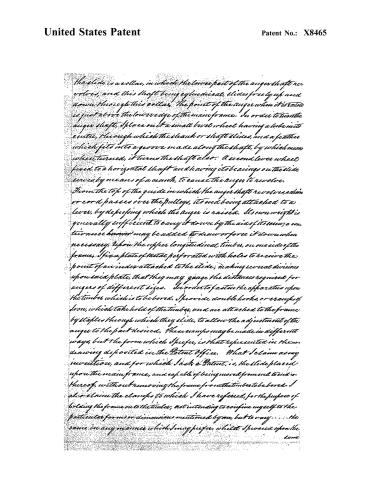
The slide is a collar, in which the lower part of the auger shaft revolves, and this shaft being cylindrical, slides freely up and down through this collar. The point of the auger when it is raised is just above the lower edge of the main frame. In order to turn the auger shaft, I place on it a small bronz wheel having a hub in its center, through which the shank or shaft slides, and a feather which fits into a groove made along the shaft, by which means when turned, it turns the shaft also. A second lever wheel fixed to a horizontal shaft and having its bearings on the slide serves by means of a crank, to cause the auger to revolve.
From the top of the guide in which the auger shaft revolves, a chain or cord passes over the pulleys, its end being attached to a lever, by depressing which the auger is raised. Its own weight is generally sufficient to carry it down by the aid of its lever; a counterweight however may be added to draw or force it down when necessary. Upon the upper longitudinal timbers, on one side of the frame, I fix a plate of metal perforated with holes to receive the point of an index attached to the slide; making several divisions upon said plate, that they may gauge the distances required for augers of different sizes. In order to fasten the apparatus upon the timber which is to be bored, I provide double hooks, or cramps of iron, which take hold of the timber, and are attached to the frame by staples through which they slide, to allow the adjustment of the auger to the part desired. These cramps may be made in different ways, but the form which I prefer, is that represented in the drawing deposited in the Patent Office. What I claim as my invention, and for which I ask a Patent, is, the slide placed upon the main frame, and capable of being moved from end to end thereof, without removing the frame from the timber to be bored. I also claim the clasps to which I have referred, for the purpose of holding the frame out to the timber; not intending to confine myself to the particular forms or dimensions mentioned by me, but to vary the same in any manner which I may prefer, whilst I proceed upon the same.
Page 4.
United States Patent
Patent No.: X8465
same principle and produce similar effects.
Witnesses
Leonard Whitney
Joseph Heuggins
(1844 Words)
Benjamin Knight
Ex.
1846.
(Granted October 23, 1834.)
Published accounts: journal notice
Notice in the monthly list of patents, with remarks
Journal of the Franklin Institute, new ser., vol. 15 (1835), p. 328 · View the page
40. For a Machine for Boring Timber; Benjamin Knight, Cranston, Providence county, Rhode Island, October 23.
Remarks. This is a patent for a "Machine for boring timber for mortising in the framing of buildings, of all descriptions." The machine is to be attached, by clamps of a peculiar construction, to the timber to be bored. The auger is to be turned by a crank acting upon a bevil gear, and the whole apparatus is so constructed as greatly to facilitate the operation of boring. The claim is to "a slide placed on the main frame, and capable of being moved from end to end thereof, without removing the frame from the timber to be bored. And also the clamps for the purpose of holding the frame to the timber."
About this record
- Patentee
- the Journal of the Franklin Institute, Journal
- Date
- the Name and Date index of patents, USPTO records, Jim Shaw's X-patent list
- Invention
- the Name and Date index of patents
- Listed in
- the Name and Date index of patents, USPTO records, Jim Shaw's X-patent list, the Journal of the Franklin Institute, Burke's List of Patents (1847)
- The patentee's full name comes from the Franklin Institute's journal.
- Burke's 1847 Patent Office list gives the same patent.